Identification 3206
Here a beautiful
shotgun SXS with locks of the house Louis Christophe of Brussels. Engraving
is signed M. Hannay.
The house Louis
Christophe was well-known in Brussels until the beginning of the years 1970.
Located Gallery of the Queen, it is related to Henri Mangeot, then in Joseph
Montigny.
M. Hannay is an
engraver of Liège which one finds the trace street of Kinkempois with
Angleur in 1929. He is mentioned in the 1933.1935 and 1938 old directory at
another address, street saint Paul, 39. In the directory of 1944, it is
always with the same address but as a grocer (one can suppose that it had
“to be recycled” during the 2nd GM…). It does not appear any more in the
directory of 1953.
GP with the very
appreciated assistance of PHL.
Identification 3207
Here a traditional juxtaposed rifle of the FN. The
weapon passed by two proofhouses.
Belgian markings
ELG on
star in crowned oval: acceptance between 1893 and 1968
12 C
in vertical rhombus: gauge between 1898 and 1924
Peron: inspection since 1853
Lion
on PV: test with the smoke-free powder between 1898 and 1968
R
under star: countermark of a controller since 1877
P 1
kg???.4: weight of the barrel between 1892 and 1924
D 65
mm over 20.6: length of the room and diameter in mm after the
optional test with the smoke-free powder between 1892 and 1924
English markings (provided)
R under crown: new test in England for a foreign weapon
BNP: punch of Birmingham since February 1st, 1955
12x65: gauges and length of the room? It is neither a
Belgian punch nor an English punch…
18.2: undoubtedly the diameter in mm.
850 BAR: undoubtedly pressure
I see also two swords crossed with letters: that
resembles by far the old English punches of before 1904…
Consequently, I can say that, according to the Belgian
punches, the weapon was manufactured with the FN between 1898 and 1924 and
even before 1922 being given the absence of yearly letter (practical started
in 1922).
It was undoubtedly exported in England and was
represented with the proofhouse of Birmingham after 1955. But I am not
explained the 12x65, I want to say the length of the casing expressed in mm
and not in inches… Unless there was a passage in a third proofhouse ?
GP
Identification 3208
Here a semi-automatic
pistol of pocket, probably gauges some 6.35, manufactured by the house
Auguste Francotte, on a patent deposited in 1913 by Emile Hermann (who,
curiously, does not appear in “Who's who arms manufacture of Liège) and
Charles Parent (registered with proofhouse of Liège 1912).
Markings
A Francotte à Liege:
very well known house activates of 1810 to 1991 in Liege
Patent 19141: mystery,
because it does not appear (and due, to see further) among the very many
patents deposited by the house Auguste Francotte.
626: undoubtedly the
number of the weapon?
In fact, and thanks to
the searchs for MAX, it Appert that this gun was designed per MM Emile
Hermann and Charles Parent, who deposited on June 19th, 1913 patent 257794
referring to the pistol in question. The house Auguste Francotte is thus the
manufacturer, but not the inventor. It also designed a gun of pocket around
1912, but it is not the gun under review.
Let us note that Emile
Hermann had already deposited a patent for a small gun in 1910 under number
224179, but it does not have any relationship with this one.
Also let us raise that
A.B. Zhuk announces also the existence of a pistol Hermann (n° 1451, page
182), but it has any relationship neither with the patent of 1910, nor with
that under review.
GP with the
effective assistance of MAX
Identification 3210
Here a
revolver of average quality to five shots of gauge not communicated, copy of
models Colt, rigged out of registered trademarks by Charles Clément in 1893.
Markings
ELG on
star in oval under crown: acceptance enters on July 11th, 1893 and on February
26th, 1968
F
under star: countermark of the controller between 1877 and 1968
The
White House: registered trademark by Charles Clément on June 21st, 1893
The
Washington 38: registered trademark by Charles Clément on June 21st, 1893
Provided being given the quality of the photograph: C Clemen (T) S Arms
Manufacturers
They
are by way of a copy Colt revolvers, either the Colt New Line manufactured
between 1873 and 1884, or the Colt New Police COP & Thug (also called House
Pistol and New Line Police) manufactured between 1882 and 1886.
Charles Clément was registered with the proofhouse of Liege of 1906 to 1914. He
deposited of 1883 until his death not less than 35 patents for revolvers, guns
and rifles, and 14 trademarks between 1893 and 1912.
The CT
on the plate of stick always asks question: CT for ClemenT?
GP with the assistance of PHL, MD and RD
Identification 3213
Here a
beautiful rifle with juxtaposed barrels, stick pistol and forearm with push rod,
manufactured in 1928 (yearly letter G).
Markings
R
crowned: rifled bores, between 1894 and 1968
G:
yearly letter for 1928
p
under asterisk: countermark of the controller since 1877
PV on
lion: test with the smoke-free powder, between 1898 and 1968
ELG on
asterisk in crowned oval: acceptance between 1893 and 1968
Peron:
inspection since 1853
Crowned JF: should be the gunner Jean Falla but according to the sources of
which I lay out, it was active starting from 1931.
Acier martelé (Hammered steel): type of steel used
.450/400 express 3 ¼ balle blindée
(if I read well because one struck another thing “armor-plated” which I cannot
decipher): gauge rifle, a long cartridge with pad whose average dimensions are
10.3 of diameter and 83 mm length, appeared in 1880 according to Bernard Meyer.
A very popular gauge until the appearance of the 375 magnum.
10.1:
should be the diameter of the barrel in mm
EL:
provisional test since 1852
T
under asterisk: countermark of the controller since 1877
Mark
EB: Braekers establishments deposited on July 7th, 1927
JAMIN:
“who's who arms manufacture of Liège” mentions Jamin Marcel, arms manufacturer
quay Saint-Léonard 41 in Liege, registered with the proofhouse between 1910 and
1933.
EB
interlaced in a double ellipse: registered trademark on July 7th, 1927 by the
Establishments Braekers SA, (BE of 1921 to 1935). Charles Braekers deposited
before and after the 1GM about fifteen patents, mainly for the shotguns.
One
can think that it is about a rifle manufactured by Braekers and sold by Jamin.
But without certainty.
GP with the appreciated assistance of PHL and HPH
Identification 3217
Here a
beautiful rifle juxtaposed with external hammers, forearm with push rod, squared
"pistol" handle, lever enters the hammers, barrels more than probably to Damas,
marked Lepage in Liege. Locks and trigger guard are nicely engraved in
particular with animals.
Markings
ELG on asterisk in crowned
rhombus:
acceptance between 1893 and 1968
12 on C in rhombus:
gauge of 1898 to 1924
Peron:
inspection since 1853
LC: quasi certainly the initial ones of Lucien Clement, gunner with
Nessonvaux
EL: provisional test since 1852
G under asterisk:
countermark of the controller between 1877 and 1968
I am a
little astonished not to see a photograph(s) weight of the barrel (marking
introduces in 1892), of possible the chokes, length of the room (marking
introduces in 1892) since the weapon is after 1898. In the same way, I am a
little astonished to see such a rifle of beautiful invoice being with black
powder after 1898… But which am I…
Finally and especially, I lose myself in the history of the Lepage arms
manufacturer: if I read well “Who's who arms manufacture of Liège, the
“Manufactory Lepage” was activates of 1919 to 1961. This rifle former to this
period since is thus marked “simply” Lepage in Liege. However, according to
publicity appearing on page 163 of “Who's who”, the company exists since 1790.
But how it signed its production being given all the associations and recoveries
largely evoked in “Who's who”...
In
short, still much of questions…
GP
Identification 3218
Here a beautiful juxtaposed lock rifle manufactured by
the firm Auguste Francotte for the Hungarian arms manufacturer Josz.
Kirner in Budapest, taken
again in 1905 by Johan Pirk. Pretty engravings.
Markings
Peron: inspection since 1853
EL: provisional test since 1852
12 on
C in rhombus: gauge of 1898 to 1924
ELG on
asterisk in crowned oval: acceptance between 1893 and 1968
A badly struck marking of a
tree surrounded by the letters A and F:
one of the many marks of the house Auguste Francotte.
AB
under asterisk: countermark of the controller of 1877 to 1968
Choke
17.6 (?) over 18.0: chokes barrels, of use between 1910 and 1924.
I do not see marking for the length of the room and the diameter in mm. In
theory of use of 1892 to 1924.
Budapesten Kirner Josz: see low
Utoda Pirk J: successor Pirk J.
There is also a marking for the type of steel used for
the guns, but I can decipher only Martin Steel.
Perhaps is this “Siemens
Martin Steel”. It surrounds
crowned
letters AF: one of the many marks of the
house Auguste Francotte.
The dynasty Hungarian arms manufacturer Kirner goes
back to Georg Kirner (1781-1847), originating in Bavaria, bench with Ofen then
with Pest (one of the two cities having constituted Budapest).
He succeeded his son Josef (1809-1869), credit between
1832 and 1861.
The son of this last was called also Josef (1838-1916).
He was arquebusier of the Court.
He sold his company in 1905 to Johann Pirk
(o).
There exist many publicities of this Kirner house, just
as of the shotguns of top quality.
GP with the effective and appreciated assistance PHL.
Identification 3222
Here a
boxlock flint pistol, pistol of bronze tromblon, safety of hammer, marked
(rather awkwardly) HJ Bury on the two sides of the box.
There is
no identifiable punch on the transmitted photographs.
There
was many Bury in Liege with 18th and 19th century, of which a Henry-Joseph
between 1791 and 1813 according to Neue Stockel.
According to Jarlier/Buigné, the aforementioned Henry-Joseph is located between
1780 and 1810 (he is written 1880-1810 but it is quasi certainly about a typing
error).
At all
events, the weapon dates well from the period 1790-1810 and can thus be allotted
to Henry-Joseph Bury.
The
Museum of Weapons of Liege has a blunderbuss or a espingole carrying the same
signature: this weapon was manufactured between 1780 and 1810.
GP and HPH
Identification 3226
Here a
curious revolver of calibre not specified, with interior hammer (also called
uneven) and folding trigger, whose handle can slide in order to reduce the
obstruction of the revolver. Blocking/releasing of the handle is probably done
via the button located on the right of framework. Door of side loading on the
right. Stem swivelling in line with cylinder.
Markings
Lion on
PV: test with the smoke-free powder between 1898 and 1968
There
should be other punches between the rooms of cylinder (in particular a ELG on
star in crowned oval).
C
crowned: it would be normally a punch of controller, but it is hardly possible
since this kind of punch with crown was used between 1853 and 1877. However, the
weapon is after 1898. Thus not identified until now.
Thanks
to the searchs of Max, one can allot this system of handle sliding to Michel
Thonon son, arms manufacturer with Corinhez-Housse, which deposited in 1909 four
patents, including 220480 (on November 16th, 1909) which corresponds in the
broad outlines to the weapon presented. The latter has however an improvement in
the shape of a button on the right side of the framework for - probably since we
were not pleased to have the machine in hand - blocking and freeing the handle.
In the original version of the patent of Michel Thonon, there is a system of
spring(s) which blocks the handle in position high or low, but not the
aforementioned button.
GP with MAX and Alan.
Identification 3227
Here a
shotgun juxtaposed to external hammers, stick pistol, engravings, quality and
completion very average.
Markings
Peron:
inspection since 1853
1 kg
440: weight of the barrel, of use since 1924
I:
yearly letter for 1930 (provided)
M under
star: countermark of the controller between 1877 and 1968
Lion on
PV: test with the powder lives of 1898 to 1968
EL:
provisional test since 1852
ELG on
star in crowned oval: acceptance between 1893 and 1968
F under
star: countermark of the controller between 1877 and 1968
12-65
in omega lying: gauge nominal and length of the casing since 1924
18.4
and 18.3: gauge in mm since 1889
"Nitro
Proved" and "Fire Armes" (sic) C° Liege: I do not find them in the file of the
registered trademarks in Belgium. There was well an English version of
Manufacture of Liège of firearms in 1901, but she is “Liege Fire Arms
Manufacturing C° Ltd”.
Does
the typing error "ARMES", therefore in French, instead of "ARMS", challenge to
me ..... would be a forgery?
Nitro
Proved exists well in England, but for rifles and rifles military (1916).
Consequently, I have the feeling which these English mentions are booby-traps…
but I do not affirm it either.
GP with the assistance of HPH and Max.
Identification 3229
Voici une arme longue relevant du système Remington Rolling Block « mis à la
sauce liégeoise ». Son propriétaire aurait pu préciser s’il s’agit d’un canon
lisse ou rayé. Il se pourrait aussi qu’il y ait des marquages sous le canon (=
dévisser la vis du fût) concernant notamment le calibre. Je présume que le
levier à droite sert à démonter l’arme en deux pièces.
Perron : inspection depuis 1853
S sous étoile : contremarque de contrôleur entre 1877 et 1968
FDC traversé d’une flèche vers la droite : peut-être François Dumoulin (actif
depuis 1870 selon une source française) ou François Dumoulin et Cie, mais j’ai
des doutes sérieux car
1° selon la même source française, la marque de François Dumoulin déposée en
1881 est une flèche vers la droite traversant les lettres DDF (et donc pas FDC
comme ici);
2° la société François Dumoulin et Cie a été inscrite au Banc d’épreuves de 1908
à 1968, ce qui ne correspond pas avec le marquage suivant :
GD en lettres anglaises : en principe Gilles Decortis de Cheratte, qui a déposé
huit brevets entre 1851 et 1875, aucun ne se rapportant à l’engin en question.
Jarlier/Buigné situe sa période d’activité entre 1856 et 1887.
Donc rien de certain, que du contraire..
GP avec HPH et MD
Identification 3231
Here a
traditional shotgun juxtaposed to external hammers, stick pistol and key of
opening Top Lever.
Markings
EL:
provisional test since 1852
Choke
16.6 over 16.6: chokes barrels, of use of 1910 to 1924
Peron:
inspection since 1853
U and P
under star: countermarks of controllers of 1877 to 1968
16 C in
vertical rhombus: indication of the gauge of 1898 to 1924
ELG on
star in crowned oval: meaning of 1893 to 1968
ACCT in
a circle: should be the mark of the manufacturer of barrels Lucien Clément of
Nessonvaux.
V in
square: not identified
Choke
Bore: indicate that the barrels are chokes.
In all
logic, this rifle was manufactured between 1910 and 1924.
GP
Identification 3232
Revolver
with percussion with box frame and black powder.
The
barrel is with 8 sides with small dovetail front sight inserted and bead cut in
the amount of hammer.
The
smooth cylinder is with six chimneys.
The
stick east seems it of only one part, out of wood of walnut finely squared. It
ends in a metal cap.
The
whole of the metal parts carries engravings of sheets of vine branch.
Punches
The
weapon carries the punches of the proofhouse of Liege, namely:
ELG on
star in an oval: final acceptance, of use of 1846 to 1893.
U
crowned: countermark of the controller, of use of 1853 to 1877.
Period
of manufacture: between 1853 and 1877.
Markings
The
weapon carries the mark of its inventor, namely D. RENOTTE Breveté (Patent)
Dieudonné RENOTTE, Joseph, was an arms manufacturer with COVER LEZ LIEGE since
1853. He was a then “platinor” (manufacturer of lock) to Liege. During the
period of 1856 to 1859, it deposits 5 Belgian patents for:
-
Improvements with pistols and rifles.
-
Modifications and improvements brought to firearms with DANDOY.C.
-
Modifications made to the system of firearms revolver with DANDOY C.
- A
double trigger with departure continuous or at will applicable to the revolvers,
with DANDOY. C manufacturer of weapons.
- An
addition with the closing of the weapons revolvers (with DANDOY.C.)
DANDOY
Célestin manufacturer of weapons was registered with the proofhouse of 1846 to
1865. From 1865 to 1867, it created company DANDOY Célestin & Co.
GG †
Note : You can see another weapon very similair here : Renotte Dieudonné Joseph
Identification 3235
Voici un classique revolver à percussion centrale se rapprochant du modèle
Constabulary mais dans ce cas-ci, la crosse est arrondie. Portière de chargement
à droite, baguette d’éjection pivotante dans l’axe du barillet. Six coups,
calibre non précisé, sans doute un .320. Sûreté de chien à gauche. Anneau de
calotte. Canon en partie octogonal et rond.
Les marquages
ELG sur étoile dans ovale couronné : acceptation entre 1893 et 1968
Double p sous étoile : sans doute la contremarque d’un contrôleur entre 1877 et
1968
C couronné sur le barillet : non identifié ; ce ne peut être la contremarque
d’un contrôleur d’avant 1877 puisque l’arme a été fabriquée au plus tôt en 1921…
EF ou EP (?) sur la carcasse côté gauche : pourraient être les initiales d’Emile
Fraipont, inscrit au Banc d’épreuves de Liège entre 1903 et 1927, fabricant
d’armes, rue Monulphe 45 à Liège.
LA : sans doute la marque du fondeur, non identifié
SF dans un cercle en dessous des plaquettes de crosse : sans doute la marque
déposée par la société Schroeder Frères le 26 février 1921. La fabrique d’armes
SPRL Schroeder Frères, Max et Charles Edouard, rue Simonon 8 à Liège, a été
inscrite au Banc d’épreuves de Liège entre 1919 et 1938. Ils succèdent à leur
père Edouard. Ils avaient une succursale à Bruxelles, rue des Comédiens, 26.
Le fait que les initiales EF soient apparentes peut nous mener à penser que
l’arme a quasi certainement été vendue par Emile Fraipont : les initiales SF
dans un cercle sont en effet dissimulées sous les plaquettes de la poignée. Mais
je ne suis pas certain à 100% qu’il s’agisse bien d’une part des initiales EF,
d’autre part que le SF dans un cercle soit bien la marque de Schroeder Frères.
GP avec l’aide d’Alan
Identification 3236
For understanding well it is necessary to look at the two united series of page:
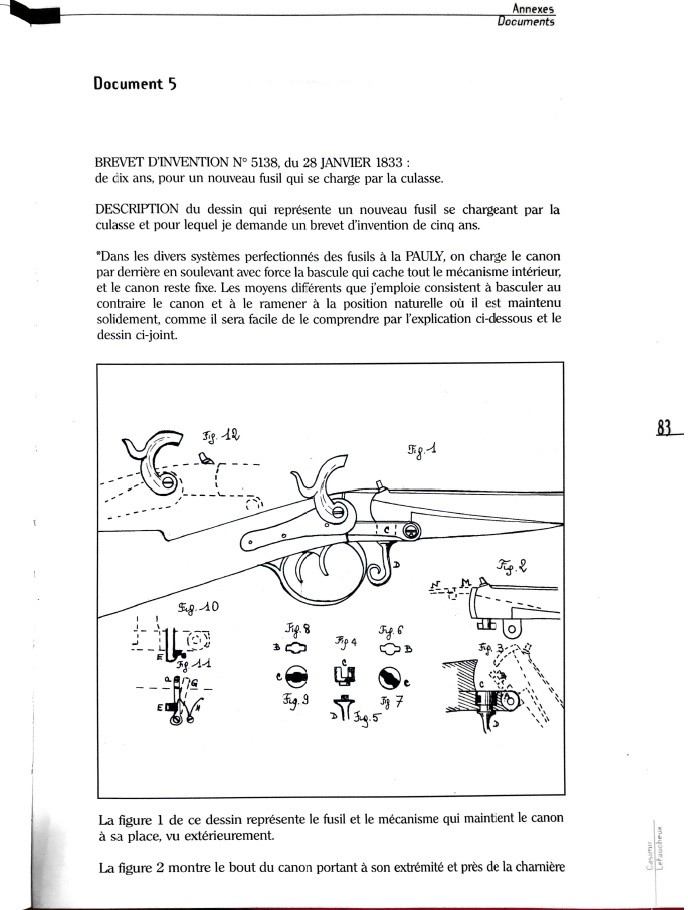
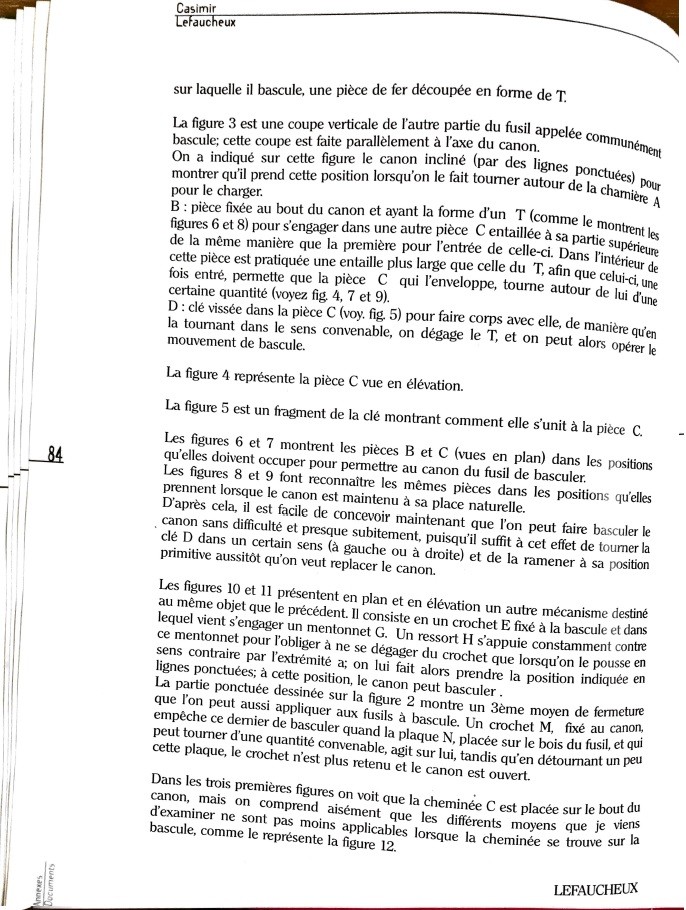
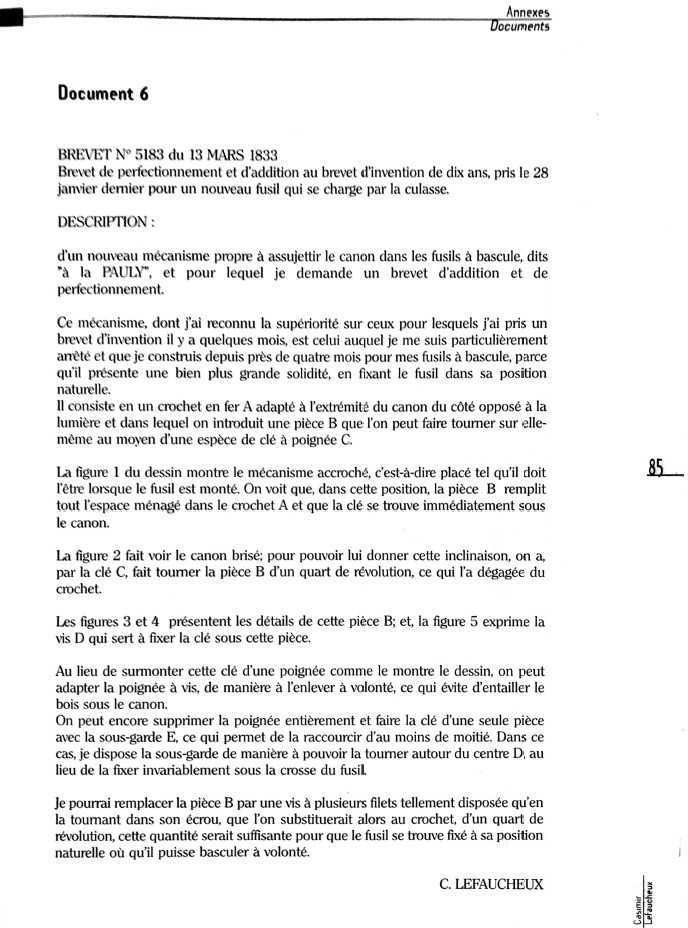
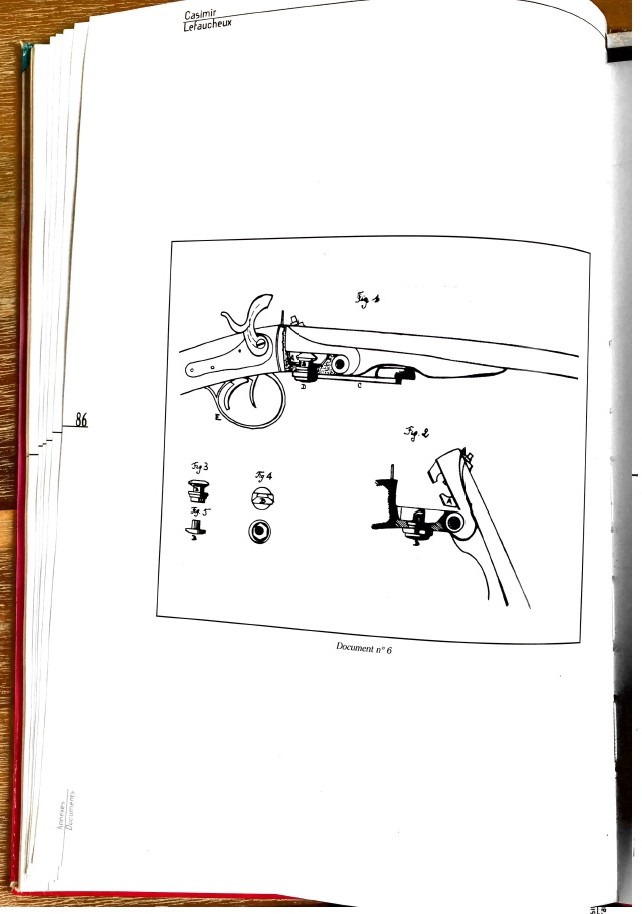
- Casimir Lefaucheux Arquebusier 1802-1852 pages 83 to 86 of Gerald Lautissier
- The saga of the shotguns Lefaucheux pages 23 to 28 of JC Mournetas
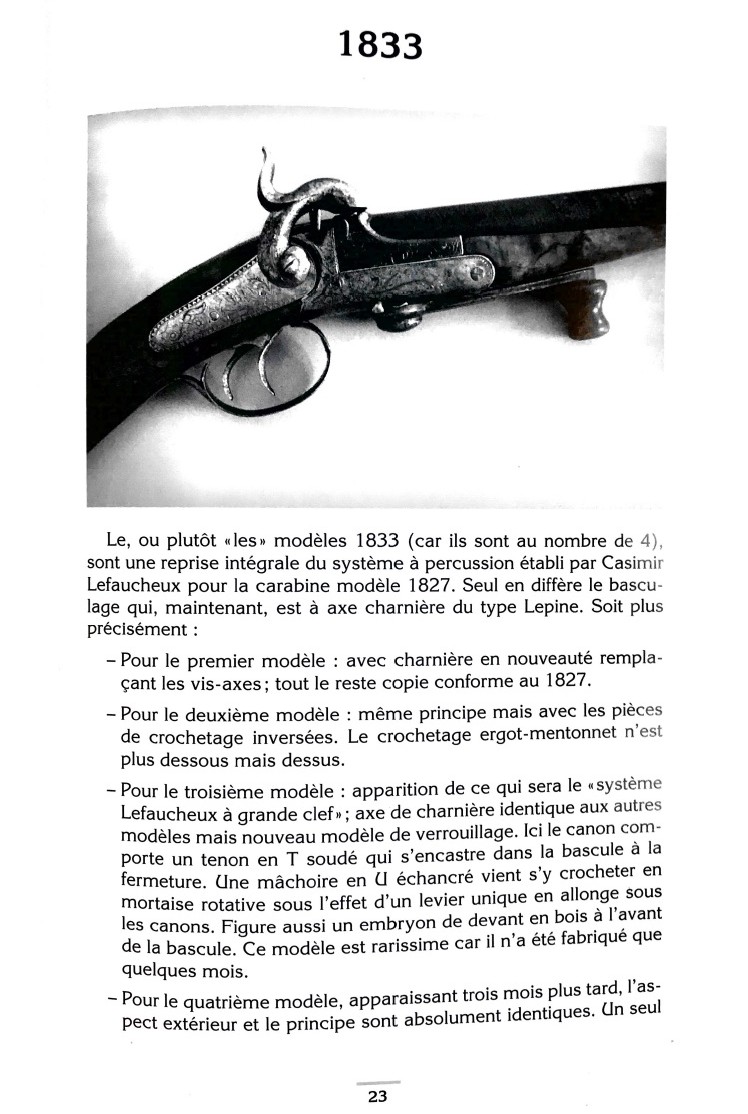
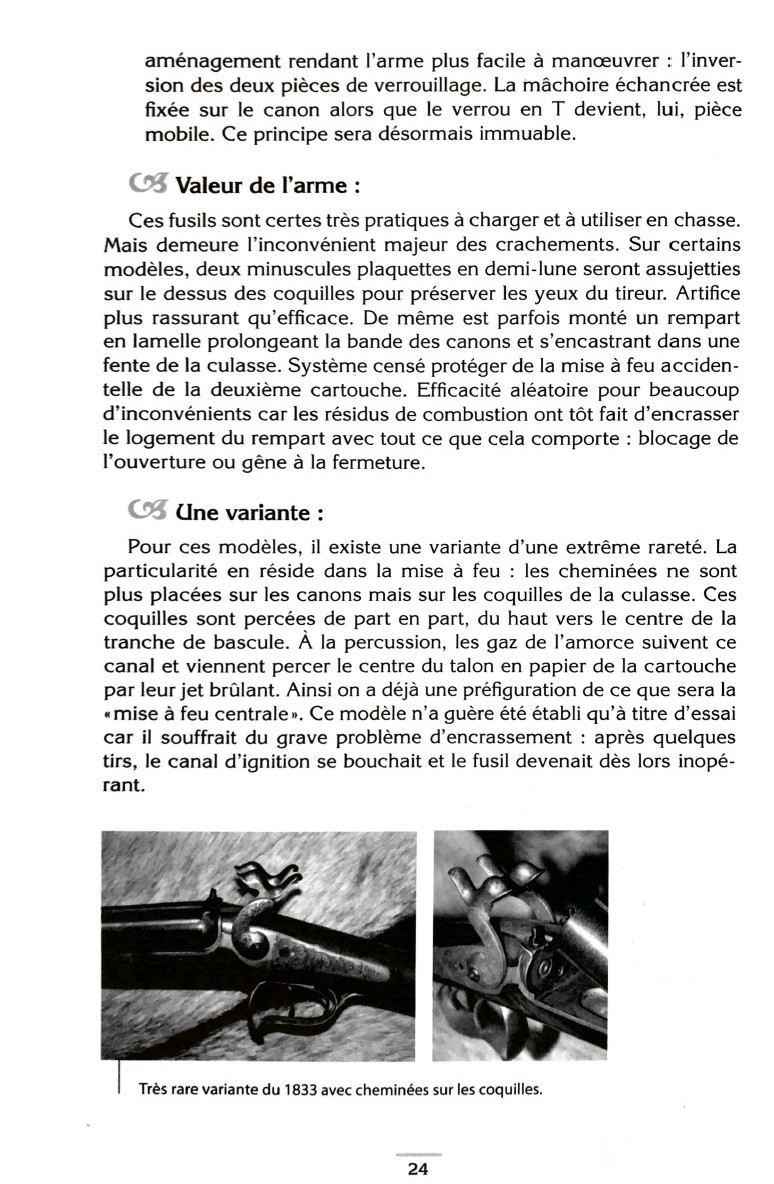
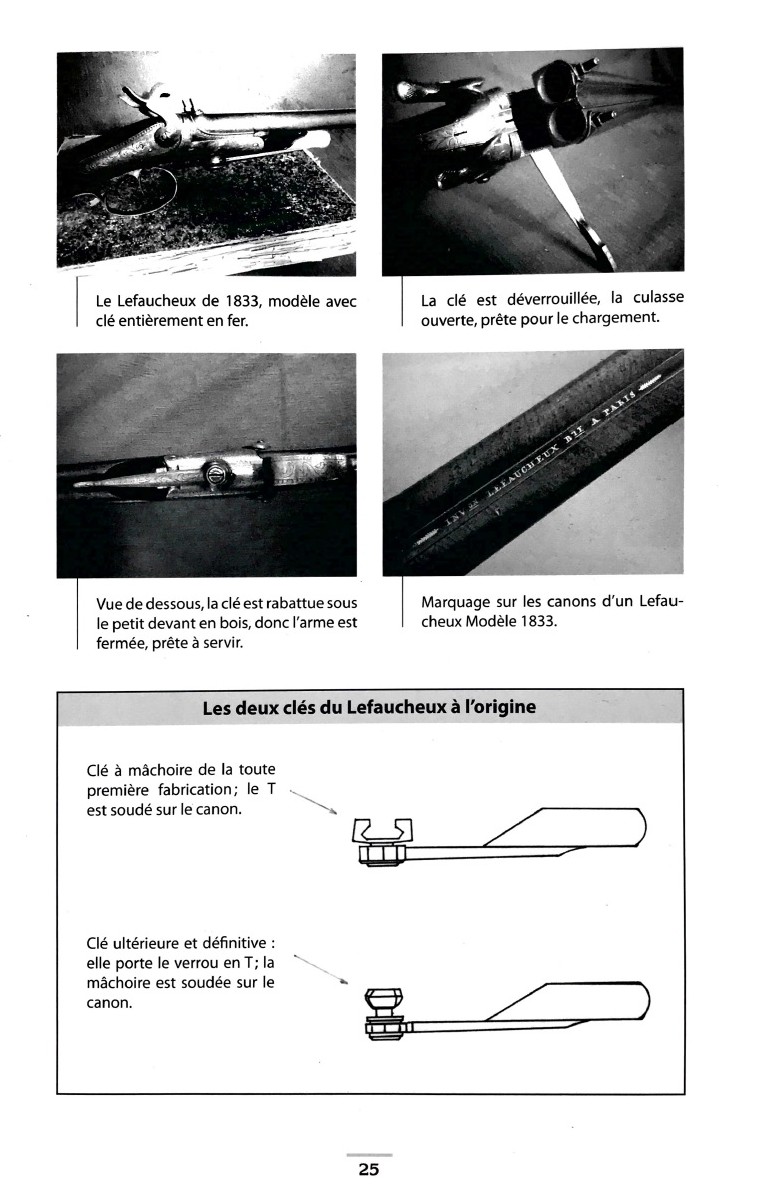
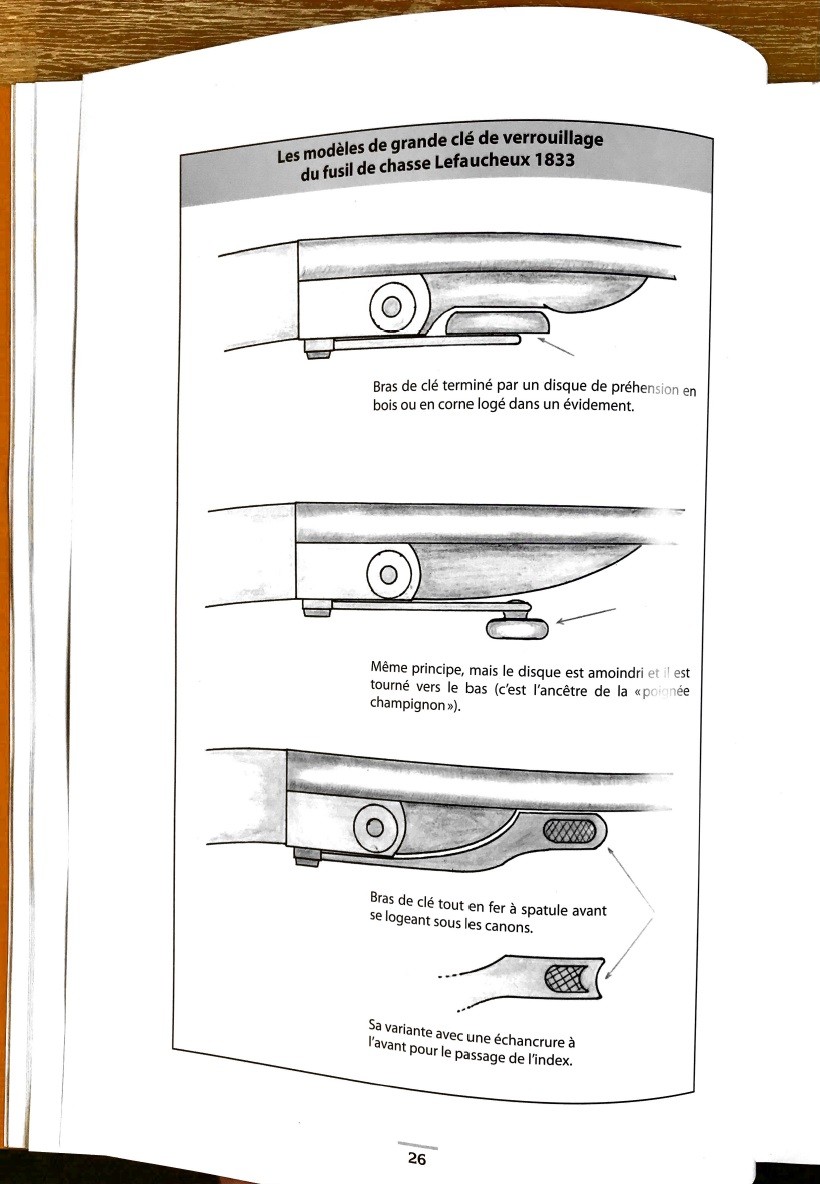
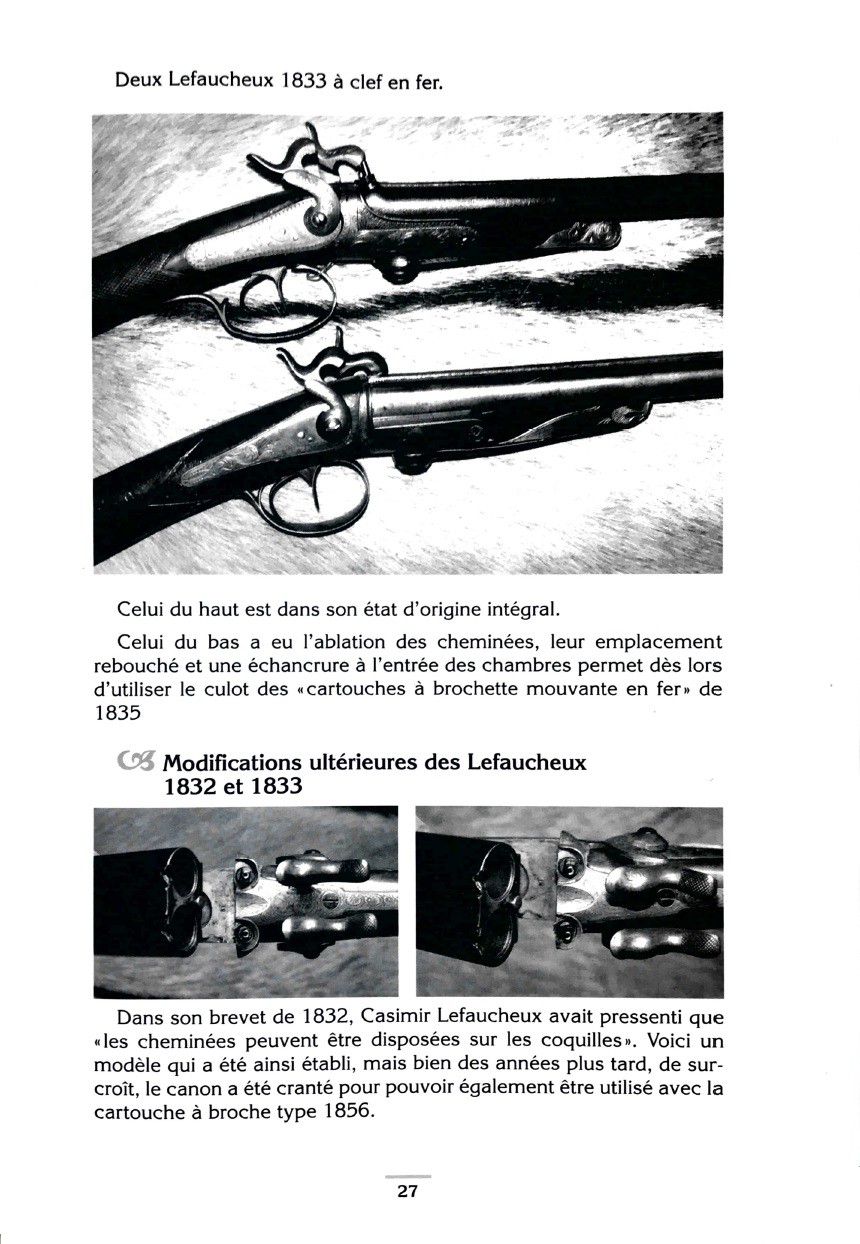
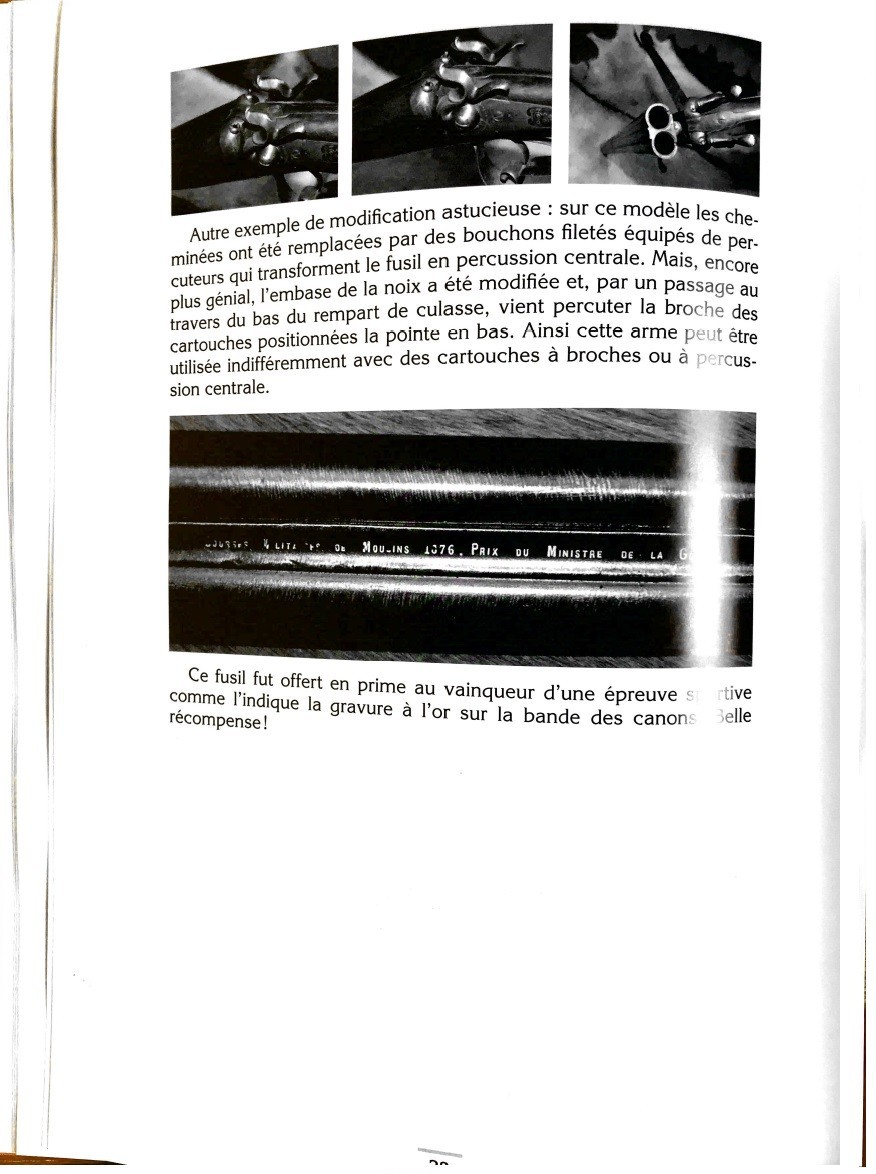
This single stroke rifle was produced by Casimir Lefaucheux in Paris, in the
workshops of the 5 street JJ Rousseau.
Rifle resulting from patent 5138 of January 28th, 1833 and addition of March
13th, 1833.
The patent and milked addition of the key of swing thus of the opening of the
barrels.
The chimneys are placed generally directly on the barrels, here they are on the
rocker what is rarer (more difficult has to realize)
GUILLAUME
Identification 3237
Here a revolver of quality, calibre .320 to five shots,
round barrel, foldable trigger, bearing on the plates letters CC interlaced of
Charles Clément.
Markings
R
crowned: rifled bore, of 1894 to 1968
ELG on
star in crowned oval: acceptance between 1893 and 1968
W
under star: countermark of controller of 1877 to 1968
C
under crown: not identified, perhaps the mark of the founder?
17345: undoubtedly the number of manufacturing
Charles Philibert Joseph Clement, gunmaker, street Chéri 37 in Liege was registered
with the proofhouse of Liege of 1906 to 1914. From 1883 to 1912, year of its
death, it deposited not less than 35 patents, but a priori, none seems to relate
to the weapon presented here.
He also deposited 14 trademarks between 1893 and
1912.
GP
Identification 3239
Here a
musketon with percussion with its long bayonet, marked GB for Belgian
government. Its owner was well inspired by us to communicate the main features
of them: overall length 114 cm, length of the gun 75 cm, weight 3.165 kg, gauges
17.5 mm, eight stripes.
Apparent
markings are
GB:
Belgian government
JP 50 in a hexagon: probably a marks of controller.
N overcome of a rhombus: probably a marks of controller.
There
are undoubtedly still other punches under the barrel.
There is
also a macaroon in the stick, undoubtedly that of the "Manufacture d’Armes de l’Etat"
in Liege.
One as
twice sees the date of 1850, more as probably that of the manufacturing of the
weapon.
One sees
also a number and the date of 1835 on the butt plate: it is perhaps about a
recovery of an older weapon.
As there
is no regimental marking of the Belgian army, one can conclude that this weapon
was perhaps intended for the Belgian customs. The National museum of the Customs
in Antwerp exposed there is a few years a musketon in one of its windows. It
would be necessary to be able to compare it to be sure of my assumption.
GP
Identification 3240
Here a superimposed rifle with two triggers of Belgian
manufacturing.
Markings
Peron: inspection since 1853
ELG on star in crowned oval: acceptance between 1893
and 1968
1kg259: weight of the barrel, since 1924
P turned over under star: countermark of a controller
since 1877
Lion on PV: test with the smoke-free powder since 1924
CHOKE 16.9: barrel choke between 1924 and1968
16-70 in omega lying: gauge nominal and length of the
room, since 1924
EL: provisional test since 1852
Y under star: countermark of a controller since 1877
"p": if what I read is well a "p", it is the yearly
letter of 1937
JS: undoubtedly the punch of the manufacturer of
barrel. Already met but not identified yet.
"Canon demi block best fluid steel" on a paper: I
suppose that it is the type of steel used. I do not know where figure this
registration nor which is its exact contents.
31951 must be the number of manufacturing of the
weapon.
GP
Identification 3241
Here a pistol with percussion with two superimposed
barrels, marked H. Petitjean Liege. It could have been used for hunting to
complete big game. The rather rudimentary manufacturing made me somewhat think
of a manufacturing of the 20th century, but which am I…
Markings
Peron: inspection since 1853
R crowned (if I see well, but I am not sure whole):
countermark of a controller between1853 and 1877
ELG on star in oval: acceptance between 1818and 1893
X under star: countermark of a controller between 1877
and 1968 and
v pennies star: countermark of a controller between
1877 and 1968: there is contradiction with the R crowned mentioned above (in so
far as it is indeed a R crowned of course…)
16.0: diameter of the barrel? To check by the owner
3382: the number of the weapon
I believe to distinguish letters EL, but I am not sure:
it could be a question of the provisional test, since 1852
JD or JF (in a letter) D: undoubtedly the manufacturer
of the barrel; not identified.
The name of Henri Petitjean is included in
Jarlier-Buigné and Stockel, but it is about an active arms manufacturer between
1770 and 1790 (even 1799 according to Stockel). What thus does not correspond
with the machine presented, since it is with percussion and thus posterior of
more than twenty years to the working life evoked above. The known parts of this
arms manufacturer are of a definitely higher quality, as one can see them on the
following link:
http://www.littlegun.be/arme%20belge/artisans%20identifies%20p/a%20petitjean%20fr.htm
A contrario, one of the weapons presented in the link
in question is also a pistol with percussion… but of definitely higher
manufacture.
The purists will have as noticed as Liege east written
on the barrel of this pistol with a grave accent (orthography in force since a
decree of the Regent in 1946), whereas one would have more expected an acute
accent… But it is not that a remark of (old EM…) purist… the more so as it is
well-known that the orthography of the proper names “fluctuated” with the wire
of the centuries, in Liège/Liége too!
In conclusion, doubts remain on the attribution of this
part with Henri Petitjean (fine 18th century). Unless it is about a later
homonym, unknown until now. Or of a skilful forger, using the name of a
well-known arms manufacturer in Liege end of the 18th century, since having
provided weapons to the revolutionists…
GP with the assistance of HPH.
Identification 3242
Voici une peu courante carabine mixte type Warnant à deux canons superposés et
deux détentes mais un seul chien, au-dessus en .22 Flobert long, en dessous en 9
mm Flobert court, donc à percussion annulaire dans les deux cas. Je présume que
le canon supérieur est rayé, l’inférieur lisse. L’heureux propriétaire aurait pu
le signaler.
Les marquages
Perron : inspection depuis 1853
ELG sur étoile dans ovale couronné : acceptation entre 1893 et 1968
FL 9 m C : calibre 9 mm Flobert court
8.6 : diamètre intérieur du canon inférieur
FL .22 L : calibre .22 Flobert long
5.4 : diamètre intérieur du canon supérieur
A sous étoile, AB sous étoile, J sous étoile : contremarques de contrôleurs
(entre 1877 et 1968)
Je crois aussi distinguer le L faisant partie du poinçon EL pour l’épreuve
provisoire, depuis 1852.
Il est bien dommage que le fabricant/armurier n’ait
pas mentionné son nom sur cette carabine sortant du commun.
Je ne m’explique pas la présence de deux détentes ; je ne crois pas qu’il
s’agisse d’une détente type stecher sur une telle carabine de jardin…mais ce
n’est pas impossible non plus. L’heureux propriétaire pourrait-il éclairer ma
lanterne ?
GP
Identification 3243
Voici un classique fusil de chasse juxtaposé de fabrication belge, à chiens
extérieurs, platines arrière, crosse anglaise, gravure sommaire. Marqué Boston
sur la bande entre les deux canons.
Les marquages
Perron : inspection depuis 1853
16 sur C dans losange vertical : calibre de 1898 à 1924
R et L sous étoile : contremarques de contrôleurs de 1877 à 1968
EL : épreuve provisoire depuis 1852
ELG sur étoile dans ovale couronné : acceptation entre 1893 et 1968
VJ : peut-être le poinçon du canonnier, non identifié.
La marque Boston ne figure pas dans le petit livre vert des marques déposées en
Belgique.
Il existe bien un (beau) type de damas appelé Boston, généralement destiné aux fusils de luxe, mais on ne peut pas dire que ce fusil-ci soit « de luxe ».
Ses canons ne sont apparemment pas en damas ; il faudrait les soumettre à un
traitement (ne serait-ce que du jus de citron, paraît-il) pour s’en assurer.
Donc mystère… ou tentative de tromperie ?
GP avec l’aide de HPH
Identification 3244
Here an
outline of juxtaposed rifle whose only barrels are completed and tested.
Markings
Peron:
inspection since 1853
S and V
under star: countermarks of controllers of 1877 to 1968
PV on
Lion: test with the powder lives between 1898 and 1968
3441:
undoubtedly the number of manufacturing of the barrels
EL:
provisional test since 1852
Choke
18.4: barrel choke to 22 cm of the breech, 1924 to 1968. I wonder why the number
18.4 is not on the same line as the word choke. Especially, this kind of wording
of choke was applied of 1924 to 1968. Mystery… because in contradiction with the
three following punches:
P 1 K
325.5: weight of the barrel of 1892 to 1924
12 C in
vertical rhombus: gauge of 1898 to 1924
D= 70 mm
over 20.6: length of the room and diameter of the barrel after the optional test
with the smoke-free powder, of 1892 to 1924.
There is
also an odd letter (on the left of V under star), which I believed being Greek
and which could thus have been a yearly letter. But there is problem since I do
not recognize any Greek letter (I know, a long time ago that I studied the
Greek…). And the Greek yearly letters were used between 1948 and 1961 if my
information is good. However, like say the last three punches, rifle goes back
at the latest to 1924.
According to the colleagues of the group of identifications and eminent other
specialists, it could be a question of a letter B badly struck; the letter B is
the yearly letter of 1923, therefore that could “stick”. But without guarantee
none.
GP with the assistance of HPH and PHL
Identification 3245
I would
like to thank well the owner of this pin revolver for having had kindness and
the intelligence to draw up the list of all the markings found on his revolver.
That facilitates much work and saves my tired eyes… If all the applicants of
information did as much of it, the life would be beautiful…
Here
thus a pin revolver with opened box, octagonal barrel and side rod of ejection
of the casings of very average quality, undoubtedly gauges 7 mm and out of run
cast iron of them, as one manufactured some much in Liège, still a long time
after the appearance of the smoke-free powder.
Markings
ELG on
star in crowned oval: acceptance between 1893 and 1968
R
crowned: rifled bore, in application between 1894 and 1968
J under
star (three times): countermark of the controller since 1877 until 1968
AS under
star, a plate of grips: one could think of the well-known arms manufacturers
Albert Simonis or Albert Spirlet, but it is not very probable, on the one hand
being given the “quality” of the weapon, on the other hand owing to the fact
that these initial is under a plate of stick, therefore non visible.
FG?: not
identified
W:
undoubtedly the founder.
GP
Identification 3246
Here a
pin revolver of gauge not specified (undoubtedly 7 or 9 mm) with a shield to
protect the pins. The octagonal barrel is surmounted by a band finishing in
language of snake on both sides of the hammer; the band is fixed at the breech
by two vertical screws. One thinks of the revolvers designed by the Merolla
brothers, but on their premises, the screws are horizontal. See the site
littlegun
http://www.littlegun.be/arme%20belge/artisans%20identifies%20m/a%20merolla%20fils%20fr.htm
There
are only few markings:
ELG on
star in oval: acceptance until 1893.
L under
star: countermark of a controller between 1877 and 1968
AS under
star, a plate of stick: one could think of the well-known arms manufacturers
Albert Simonis or Albert Spirlet, but it is not very probable, owing to the fact
that these initial is under a plate of stick, therefore not visible.
GP
Identification 3252
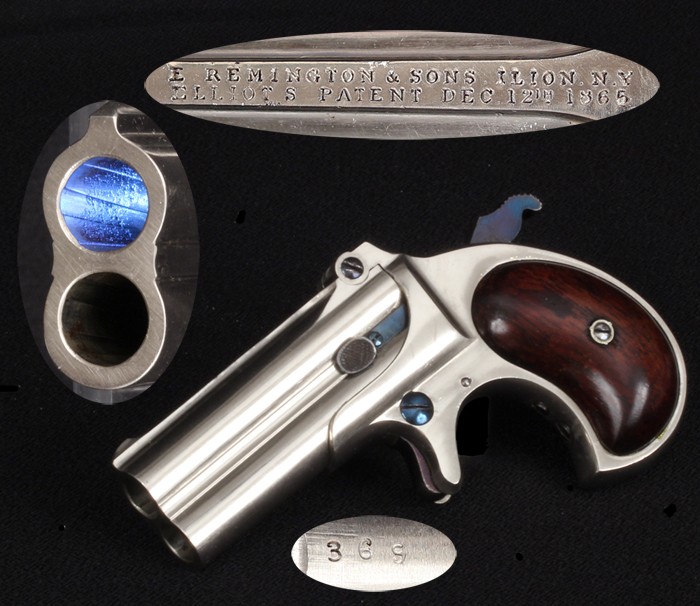
En annexe un exemple du marquage de canon original de Remington.
Il s'agit ici d'un pistolet à l'état mint, donc jamais utilisé.
Je n'en sais rien et j'en doute fort, à cause du marquage Remington sur le
canon.
Il s'agit à première vue d'un 2è modèle (6.000 ex produits entre 1868 et 1888)
avec le marquage sur 2 lignes sur le plat supérieur du canon. C'est le seul
modèle à porter ce marquage sur 2 lignes.
MAIS...
1. La forme du bouton d'extracteur n'est pas bonne: la partie quadrillée devrait
être ovale et le quadrillage plus fin
2. Les marquages sont pleins de fôtes d'ortaugraffe, et même dans un tunnel
obscur on voit à 20 mètres qu'ils ont été apposés avec des poinçons individuels
au lieu du roller die habituel. De plus, le modèle des lettres n'est pas le bon.
3. La forme de la tête du chien est un peu gnugnugnu, mais bon, ce n'est pas là
un critère certain.
Autres remarques:
- Tous ces pistolets ont le n° de série frappé sous le canon et sous la
plaquette gauche. Ceux du 2è modèle sont numérotés de 1 à environ 6000.
- Les Liégeois sont capables de tout copier, mais à mon avis bien peu se
risqueraient à copier des marquages d'aussi près, par peur des amendes parfois
énormes pour plagiat.
- Je ne connais pas de poinçon belge "G couronné", ce n'est en tout cas pas un
poinçon d'épreuve liégeois.
Je vais chercher dans le Directory pour essayer de l'identifier.
Marcel
Identification 3255
Here is a rifle of shooting of the family of the rifles Martini Francotte, with heavy barrel, rest-finger on the trigger guard, beautiful rest-head, hook probably serving also as counterweight. The calibre is unfortunately not specified. As there are graduations from 1 to 16 on the barrel, it could be that it is about a rifle for the shooting at long distance.
The markings
ELG on star in crowned oval: acceptance between 1893 and 1968
R crowned: indicates that the barrel is rifled; between 1894 and 1968
W under star: countermark of controller between 1877 and 1968
Peron (Little step): inspection since 1853
Lion on PV: test with the powder without smoke between 1898 and 1968
MP : unidentified
AF crowned patent : mark of the house Auguste Francotte.
GP with the efficient and appreciated help of MD.
Identification 3262
Here a sabre-revolver for cartridges with pin, of gauge not specified, marked HG and Son for Henry Goossens and Fils.
In fact, as it arises from the http://www.littlegun.be/arme%20belge/artisans%20identifies%20g/a%20goossens%20fr.htm note published “in illo tempore”, Henry Goossens represented Ambrogio Micheloni of Milan for the deposit of his patent 17084 in 1864. The following year, Henry Goossens deposited itself patent 18912 also referring to a sabre-revolver.
Markings
ELG on star in oval: acceptance between 1818 and 1893
H.G.et
Patented Sons:
Henry Goossens and Fils, street Trapped 3 in Liege, registered with the
proofhouse of 1848 to 1885.
345:
serial number?
V under
crown
(?): countermark of a controller from 1853 to 1877.
It will
be noticed that the tail of trigger was modified compared to the weapon already
presented before and compared to the patent.
GP with GG and MD
Identification 3272
Voici un pistolet à percussion à deux canons et deux détentes, marqué Lambert à Liège. Ciselures sur le pontet et la calotte, avec un décor quasi identique d’instruments de musique (lyre, deux trompettes et deux tambours ; je n’y vois aucune symbolique particulière). L’anneau de calotte assez frustre me semble postérieur à l’arme.
J’ai l’impression qu’il s’agit d’une arme à silex datant de la deuxième moitié
du XVIIIe siècle transformée à percussion vers 1830 : en effet, la forme de la
crosse et son ornementation sont en tout cas XVIIIe, pas XIXe.
Mais je ne vois pas de trace des trous de la batterie et du ressort de
batterie ; ils ont peut-être été très bien rebouchés... Ou l’on a placé des
nouvelles platines lors de la mise à percussion…
Je ne distingue aucun poinçon d’épreuve liégeoise. Je crois déchiffrer les lettres TW sur une étoile, surmontées d’une couronne. Il existe bien un Toussaint Wasseige renseigné comme canonnier, mais je ne connais pas sa période d’activité.
Quant à Lambert à Liège, il y en a plusieurs.
Le « Qui est qui de l’armurerie liégeoise » mentionne Lambert dit Biron, entre 1810 et 1836 d’après Pasleau.
Jarlier/Buigné mentionne Spinas Lambert, arquebusier à Liège entre 1770 et 1810.
« Vu sur paire de pistolets et également sur des pistolets à boule de
fulminate ».
Aussi « Jean Lambert dit Biron, fabricant et négociant en armes à Liège entre
1782 et 1802. Vu sur un fusil à air comprimé de 18-20 coups en 1782 ».
Ils citent aussi « Jacques Lambert, négociant en armes à Liège avec son frère Aymard Lambert ».
Heer les cite également dans son Neue Stöckel, suggérant qu’ils sont les fils du
précédent, Jean Lambert dit Biron.
Plus loin, Jarlier/Buigné citent « Jean-Joseph Lambert (né en 1782) et
Jean-Mathieu Lambert dit Biron, fabricants et négociants en armes à Liège en
1807-1810. Ce dernier, selon Heer, signait ses armes « JM Lambert dit Biron ».
Personnellement - mais cela n’engage bien sûr que moi et je suis ouvert à toute suggestion/correction - je penche pour
Spinas Lambert étant donné la forme de la crosse typique des années 1770. Ce qui
signifierait qu’il y a eu transformation à percussion par la suite.
GP
Identification 3279
Iden 3279 garden rifle Warnant style FL 22
Here is a garden or living room rifle, Warnant type
with tilting breech, octagonal short barrel, Flobert caliber. 22 C, with
semi-pistol stock. It is an extremely common model that was manufactured in
thousands of copies before and after the 1st GM.
The markings
There is a "Belgium"
on the barrel, which indicates if necessary that the weapon was manufactured in
Belgium.
There may also be another explanation: see the attached
link, where the second photo shows the inscription Henri Pieper Belgium. When we
clean the barrel, we'll see - miracle? - the name of Henri Pieper?
The link also and especially gives the patent of J.
Warnant.
The LLH
marking under the barrel refers to Laurent Lochet-Habran, manufacturer of
weapons and rifle barrels.
H: could be the brand of the weapons manufacturer Max Neumann.
Peron: is located on both the barrel and the breech, it is the inspection
punch since 1853
R
crowned: rifled barrel, between 1894 and 1968
ELG on
star in crowned oval: acceptance between 1893 and 1968
AE
under star: countermark of controller between 1877 and 1968
FL 22
C: short. 22 caliber. It will probably not be easy to find this type of
cartridge because it is no longer used much nowadays.
GP with the help of PHL.
Identification 3281
Voici un fusil de chasse juxtaposé à chiens extérieurs, crosse anglaise,
longuesse à poussoir, clé supérieure, de la maison H. Mahillon à Bruxelles.
Les marquages
ELG sur étoile dans ovale couronné : acceptation entre 1893 et
1968
Perron : inspection de 1853 à nos jours
Choke 18.2 et 18.3 : canons chokés, de 1924 à 1968
12-70 dans oméga allongé (si j’ai bien vu) : calibre nominal et
longueur de la chambre depuis 1924
1 kg 530 : poids du canon depuis 1924
3540 : numéro de fabrication de l’arme
JF : soit Janssen Frères,, soit Jean Falla, mais c'est presque certainement Jean Falla !
JS: non identifié
D dans losange vertical : non identifié
U sous étoile : contremarque d’un contrôleur entre 1877 et 1968
Lion sur PV : épreuve à la poudre sans fumée de 1898 à 1968
C dans cercle : non identifié
X : lettre annale de 1945… mais je trouve curieux qu’un fusil
de chasse à chiens extérieurs ait été encore fabriqué en 1945... à moins que
cette lettre x ne soit pas une lettre annale…
Le site littlegun.be mentionne à la fois B. et H.
Mahillon :
http://www.littlegun.be/arme%20belge/artisans%20identifies%20ma/a%20mahillon%20fr.htm
GP
Identification 3286
Here is a 9 mm box-frame six-shot pinfire revolver with a cap ring. On the
cylinder the inscription "Système Lefaucheux perfectionné - déposé" (Improved
Lefaucheux system - deposited). On the barrel: "Canon acier vissé" (screwed
steel barrel).
The punches are few in number or not visible or not photographed.
ELG on star in oval: acceptance from 1846 to 1893
U crowned, two types of crowns: controller countermark, between 1853 and 1877
Under the plates: the letters AF (?), MJ (?) and P: probably subcontractors, not
identified.
It is not a real revolver manufactured by Lefaucheux, neither in France nor in
Liege where Lefaucheux also had a factory.
A revolver also marked "Système Lefaucheux perfectionné (déposé)"; has already been examined on the littlegun. be website: http://www.littlegun.be/arme%20belge/artisans%20non%20identifies/a%20artisans%20inconnus%20revolver%20broche%20lefaucheux%20fermee%20gb.htm
without being able to determine what the improved system was about: either with
regard to the boxed frame or the model of the rod or barrel axis.
Nor does it seem to be a dual ignition model, i. e. both centerfire and pinfire,
as on the machine presented on the same site:
According to Guillaume Van Mastrigt, who is very familiar with the history of
the Lefaucheux family and its production, this is a late production, after the
1854 patent fell into the public domain (in 1869) and after the factory closed
in 1873. In his opinion, it is a Liège production, very late because it is a
pinfire cartridge production, whereas the central percussion was already
becoming widespread; but the manufacturer used a famous name as a selling point.
GP with the much appreciated help of GVM.
Identification 3294
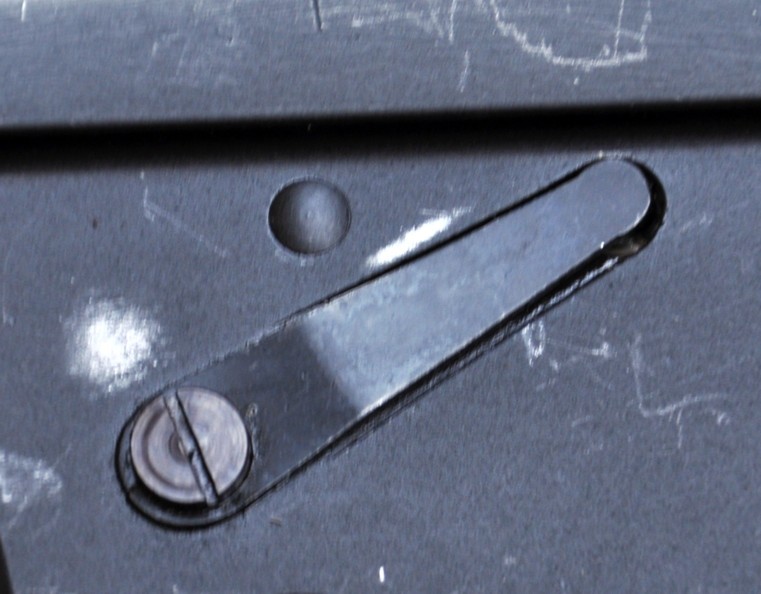
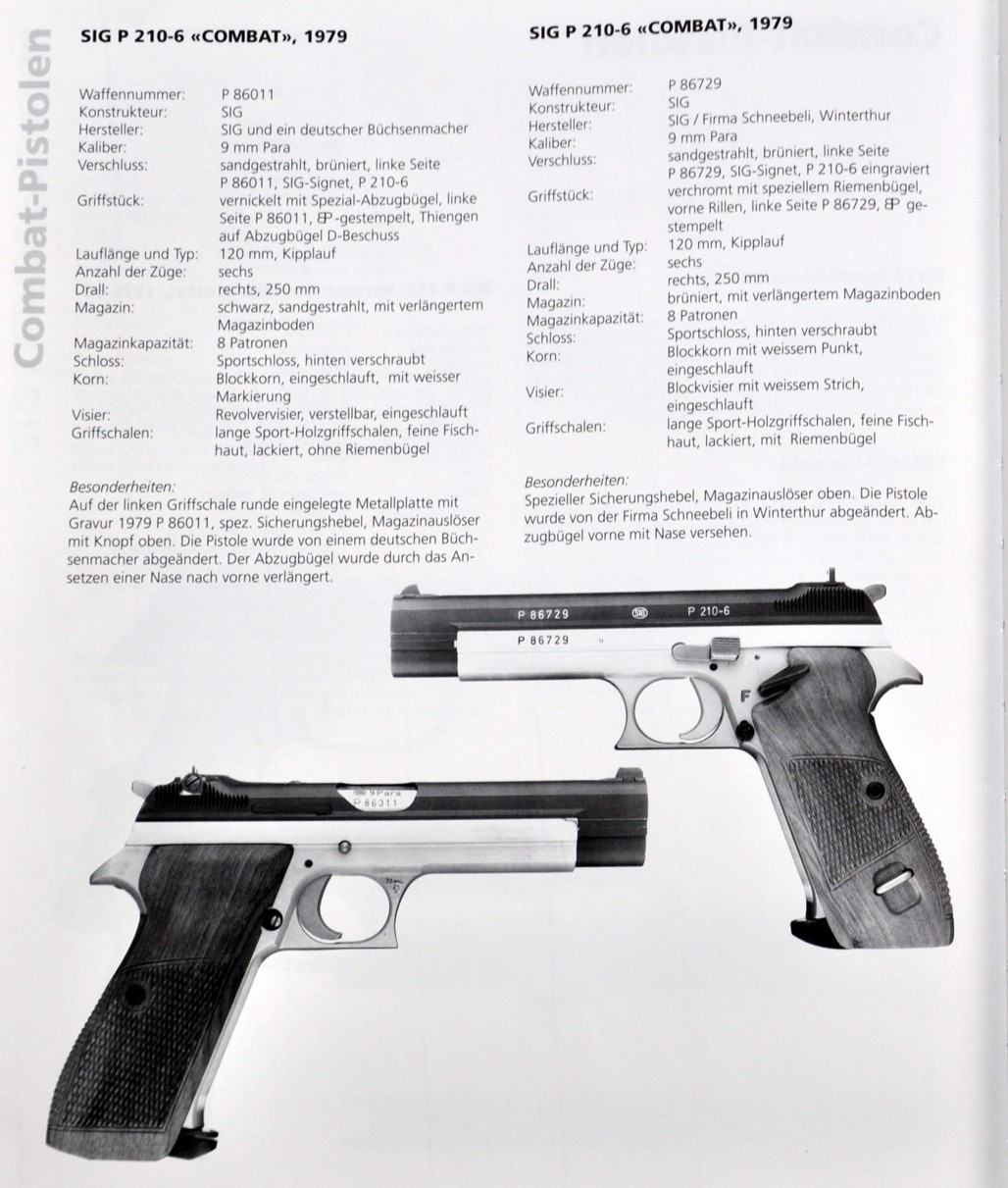
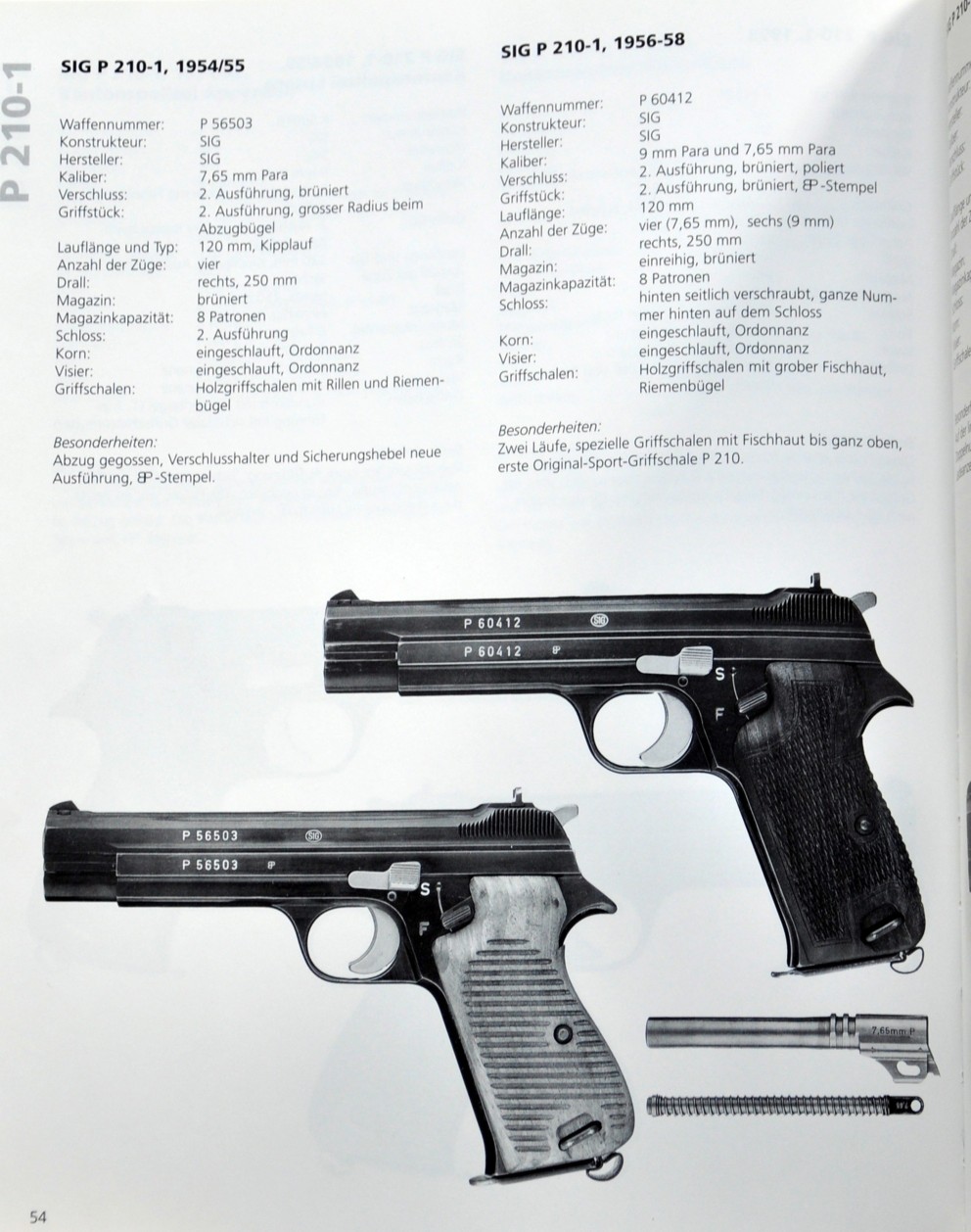
A mon humble avis et au vu du n° de série ce pistolet a été fabriqué en 1956/1958. Voir les photos en pièces jointes.
Cette arme à très certainement été modifiée en Allemagne, car elle possède un poinçon de contrôle allemand sur la glissière près des stries de préhension et d’autres masqués sur la même vue juste au-dessus du pontet sur la carcasse.
Je pense que cette arme à été customisée par l’armurier "Waffen Schwenke Helenestr,12 34454 Bad Arolsen", mais tout est relatif et je peux me tromper.
Le demandeur écrit : «il n'y a pas de vis pour la platine» c’est presque exact, il manque sur la carcasse le ressort et sa vis de fixation qui est une sécurité supplémentaire «chargeur en place», cela est tout simplement fait pour faciliter le tir de combat.
Cette opération se pratique aussi sur d’autres armes et notamment sur les GP 35, mais bien sûr d’une autre façon.
Pour ce qui est du bouton d’éjection du chargeur c’est exactement la même chose, cela ne sert qu’à faciliter le tir de combat. Cette pratique a été utilisée sur des armes d’essais P210-6 pour le combat et ceci dans les années 1976/83 par les armuriers suisses SIC/ L Crottet, et la firme Schneebeli à Winterthur, mais aussi par un armurier allemand dont je ne connais pas le nom.
C’est aussi pareil pour la queue de Castor.
Pour conclure, je me doit, à titre personnel, de constater que cette arme n’a plus rien d’une arme de collection.
Max.
Identification 3301
Iden partielle 3301 Vetterli.
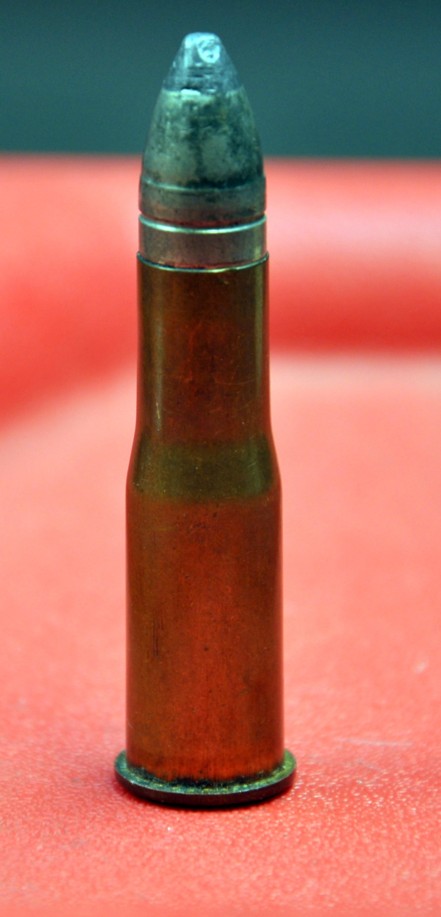
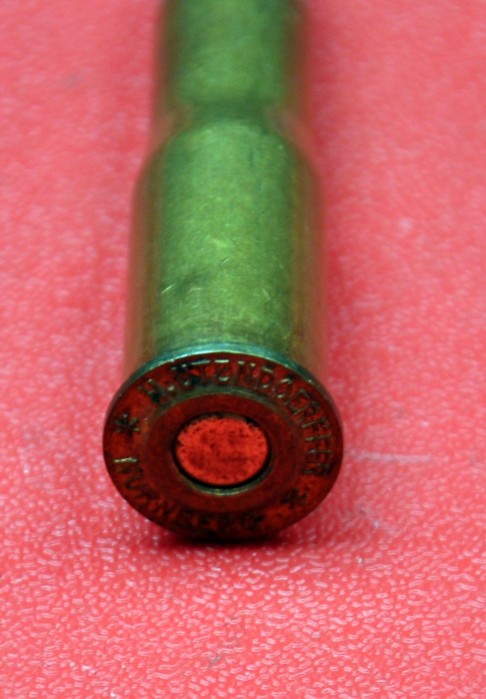
Voici un fusil Vetterli modèle 1869/1871, fabriqué en 1876 (d’après son
matricule), Ce fusil a été fabriqué à 134000
exemplaires, en ce compris 160
exemplaires de préséries mod 1869 et 1198 exemplaires mod 1869.
La plaque de couche, la hausse, et l’embouchoir sont apparemment bien du modèle
69/71.
Le poinçon figurant sur le fût est celui d’acceptation de ce dernier, ce poinçon
doit aussi figurer sur la crosse.
Je suis malheureusement obligé de m’arrêter là, car dans son ensemble cette arme
me paraît fortement modifiée, voir bidouillée pour la faire passer pour un autre
modèle.
Pour faire une identification sérieuse, j’ai besoin de plusieurs photos à
savoir ; de l’arme complète recto/verso, du dessus et du dessous sans escamoter
le bout de la baguette de nettoyage !!, mais aussi une photo du bout de la tête
de la culasse mobile et si possible le calibre actuelle
J’ai aussi besoin de connaitre la longueur totale de l’arme, du canon, et la
largeur de la grenadière.
Max.
3301 Complément.
Iden 3301 fusil Vetterli.
Voici ce qui était au départ un fusil Vetterli modèle 1869/1871, fabriqué en
1876 (d’après son matricule). Ce fusil a été fabriqué à 134.000 exemplaires, en
ce compris 160 exemplaires de présérie mod 1869 et 1.198 exemplaires mod 1869.
Nous sommes ici en présence de la variante d’environ de 1873.
Modifications d’ordonnance du 12 juillet 1871 :
À partir de la culasse, le canon de ce fusil est devenu octogonal sur 75 mm au
lieu de 65mm pour le modèle 1869 et ceci de façon à renforcer la clavette de
maintien du fût.
Modifications d’ordonnance du
21 août 1870
Sur ce fusil : le levier d’arrêt de répétition, le fermoir du magasin ainsi que
le couvre culasse sont supprimés, mais aussi tous leurs systèmes de fixation.
La capucine de ce fusil a vu sa largeur passer de 10 à 15mm afin de répartir la
pression sur une plus grande surface.
La plaque de couche, la hausse, et l’embouchoir sont apparemment bien restés du
modèle 69/71.
Le poinçon figurant sur le fût est celui d’acceptation de ce dernier ; ce
poinçon doit aussi figurer sur la crosse. J’avais demandé une photo complète
recto verso de la crosse, mais je ne l’ai pas reçue ! Cette dernière doit
normalement posséder un poinçon d’acceptation identique à celui du fût et une
broche de renfort en buis qui la traverse de part en part.
Ce fusil a été raccourci par l’avant d’environ de 300 mm ; de plus, il a été transformé en percussion centrale, ceci très certainement pour la chasse.
Il existe deux types de cartouche pour la chasse : la 10,4 x 38 R pour le modèle
69/71, et la 10,4 x 47 R pour le modèle 1870.
Je constate que le guidon n’est plus d’origine et qu’il a été fortement
rehaussé, chose normale du fait du raccourcissement de l’arme.
Je constate aussi que la capucine a été modifiée en grenadière porte bretelle ;
cela est aussi dû au raccourcissement du fût.
Je suis persuadé qu’on ne peut plus fixer la baïonnette à douille sur ce fusil.
J’avais aussi demandé une bonne photo de la tête de culasse côté percussion,
mais je ne l'ai pas reçue.
Je n’ai pas reçu non plus la dimension de la largeur de la grenadière qui doit
se situer entre 10 à 15mm.
MAX et PHL
Identification 3306
Here is a Levaux six-shot revolver of unspecified caliber (probably 380), sold by T Page Wood to Bristol.
I see only a crowned G (?) as a punch, which could be the mark of a controller of the Liege Proof House (in use until 26 January 1877). But I don't see the ELG punch in an oval (unless it's on the barrel, where the gold wire is interrupted????).
The mention DD Levaux Patented appears on the weapon, but it may have been manufactured by someone else. Read the long notice published on the Littlegun website on this subject.
http://www.littlegun.be/arme%20belge/artisans%20identifies%20l/a%20levaux%20gb.htm
The mention ACIER FONDU (FOUND STEEL) refers to the type of metal.
As for the mention on the barrel, it is in fact the house T. Page-Wood of Bristol, created in 1876. See the interesting notice below. Note that the Stockel does not mention it. . . .
I cannot explain the two numbers, 1863 and 4569. 1863 does not correspond to a date since Dieudonné Levaux's patent dates back to 1876. . .
GP
T Page-Wood established his business in 1876 at 29 Nicholas Street, Bristol. One
report states that the address was 35 Nicholas Street.
In about 1885 he opened branches at 13 Market Place, Frome,
Somerset, and at 1 Westgate, Cardiff, Glamorganshire.
In about 1890 the address of the main business in Bristol was
given as 26 High Street, but it may be that the 26 Nicholas Street shop was
retained. The Frome branch closed, the Cardiff branch moved to 21 Castle Street,
and new branches were opened at 39-40 Walcot Street, Bath, and 19 High Street,
Shepton Mallet, Somerset.
In 1900 the firm started buying guns from Thomas Wild and
Rowland Watson, others followed from time to time.
In about 1905 all the branches appear to have closed and the
only address of the business was 26 St Nicholas Street (street re-named?).
In 1907 the business was registered as a limited company, T
Page-Wood Ltd.
T Page-Wood had promoted themselves as "The Gun Makers of the
West", and they acted in a wholesale as well as a retail capacity. They had
agents in Malta, Cyprus and Canada. They made a folding aperture sight for
shotguns, an elliptical aim corrector (which was a metal half circle mounted
over the barrels in front of the fore-end), and a fore-end elevator (an enlarged
fore-end which was clipped over the existing fore-end to discourage low
shooting.
In about 1920 the company moved to 28 St Nicholas Street.
In 1924 the firm patented a shotgun cartridge with a small
over-shot wad in a cone shaped case, perhaps this was thought to ease loading
without impairing pattern quality.
In 1942 the company's premises were bombed and by 1955 they
were trading at Old Park Hill, Park Row. At about this date it is thought that
the company was sold to Sheldon Bush & Patent Shot Co Ltd, but reportedly in
1964 it traded as T Page-Wood Ltd at 8 Pipe Lane, off Colston Lane, Bristol,
they were not recorded after 1964.
The firm sold cartridges under the names "Anti-Recoil
Cartridge" (post 1920), "Anti-Recoil Economic Cartridge" (post 1920), "Bristol",
"Climax Cartridge", "Page-Wood D S", "Page-Wood's Shield Cartridge", "T
Page-Wood Second Quality" (Nobel Glasgow 16 bore post 1919) "Wildfowler", "Park
Row", "Double Crimp", "Imperial Crown" and "Special .410".
Identification 3308
Iden 3308 pinfire revolver DAL
Here is a relatively well-made pinfire revolver, of unspecified caliber (probably 7 or 9 mm), five or six shots, single and double action, open frame, octagonal barrel, lateral bush ejection rod.
The cylinder was tanned.
Looks like there's a gap on the barrel feed door.
We would have liked a picture of the small plate near the trigger: would that be a safety feature?
The initials DAL and Cie in Liège are very interesting
because they allow us to date the relatively limited production period.
The markings
V and Y under crown: countermarks of
controllers (in use between 1853 and 1877).
ELG in oval: acceptance between 1846
and 1893
3 B under plate: not identified
The initials DAL and Cie can almost certainly be
attributed to the company Dresse-Ancion-Laloux et Cie, arms manufacturers rue
Sur la Fontaine 47 in Liège, registered in the proofhouse between 1862 and 1866,
as the "Qui est qui de l'armurerie liégeoise" (page 77) of Michel Druart and Guy
Gadisseur (†) tells us.
GP with the help of the whole team.
Identification 3309
Here is a juxtaposed shotgun of Liège manufacture which has known better days.
It is obviously not very young since it dates back to 1928.
The markings
ELG on
star in crowned oval: acceptance since 1924.
0
kg973: barrels weight, since 1924.
g : annal letter of 1928 (Year of manufacture of your weapon).
lion
on PV: smokeless powder test between 1898 and 1968
32-65
in omega lying: nominal size and length of the sleeve, since 1924
AD
under star: countermark of the controller between 1877 and 1968
D
crowned: Delcour barrel maker in Nessonvaux (Manufacturer of the barrels of your
weapon)
I didn't see the inscription
"épreuves officielles ......"
(official events.......) on the pictures you sent me!
The manufacturer of this weapon has not been identified but it was not
manufactured by the FN.
GP with the help of PHL
Identification 3312
Voici un beau fusil de chasse juxtaposé à platines. Il est curieux qu’il n’y ait
pas de nom du fabricant, sur la
bande par exemple.
Les marquages
1 kg 025 : poids du canon, en usage
depuis 1924
AE sous étoile : contremarque du contrôleur
de 1877 à 1968
Lion sur PV : épreuve à la poudre sans
fumée, en usage de 1898 à 1968
ELG sur étoile dans ovale
couronné : acceptation, en usage
depuis 1924
20-70 dans oméga allongé : calibre nominal et longueur
de la douille, en usage depuis 1924
EL en lettres anglaises : épreuve provisoire de 1852
à nos jours.
k (si j’ai bien lu) : lettre annale pour 1932.
Andrews Toledo Steel : un fabricant d’acier établi
à Sheffield. Voir sur le lien
http://www.littlegun.be/arme%20belge/artisans%20identifies%20t%20w/a%20thonon%20fernand%20gb.htm
Sur la platine, on peut lire Grosjean Frères, sans doute le platineur.
Il se pourrait que le fusil ait été fabriqué par Fernand Thonon qui utilisait ce type d’acier. Voir sur le lien : http://www.littlegun.be/arme%20belge/artisans%20identifies%20t%20w/a%20thonon%20famille%20fr.htm
GP avec l’aide de HPH et Alain
Identification 3313
This is a classic "garden" Flobert rifle with rimfire, 6 mm calibre and octagonal barrel; it is curious that the calibre does not appear on the left side barrel.
There is only one punch, ELG on star in an oval, the acceptance punch in use between 1846 and 1893.
There is also what seems to be a mark, (the rectangle with a snake), but it could not be identified.
There is also LL, which could be the hallmark of the Manufacture d'armes Lepage, rue des Augustins 26 in Liège, active under different names since - at least - 1842 to 1961.
GP
Identification 3315
Dear Sir,
Alan relayed your message to me.
Your revolver is a Spanish made copy of the Smith & Wesson Hand Ejector 2nd
Model of 1902-1903.
It was manufactured by Trocaola Hermanos of Eibar (Spain), but other Eibar
gunmakers such as Arizmendi
along with copies of the Colt Military & Police Model
These revolvers are true copies of the originals, and are of about the same
quality.
During WW 1 - around 1915-1916 - the French and Commonwealth armies,
that
suffered a shortage of handguns
Since the French army used the St-Etienne 1892 Service Revolver, which chambered
the 8 mm "Lebel" cartridge,
The British govt, however, could use the standard .38 caliber
You should measure the caliber in the barrel (diameter between 2 grooves).
If the measure is 8 mm, it was made around
If it is 9 mm however, it was made for everyone who wanted to purchase
it, except the
We know that, because according to the British law, all non-British made
firearms had to be re-proofed in
Standard calibers for this model are S&W .32-20 and S&W .38.
The "French versions" in the 8 mm Lebel caliber were produced during WW 1 only.
Best regards,
Marcel
Identification 3316
Here is a beautiful percussion
pistol in the Empire style, rifled barrel in Turkish damask (one of the many
types of damask). 55 caliber, marked H. Gonzales New York under the barrel and
Ch. Pirlot and Simonis in Antwerp on the lock.
These Messrs. Pirlot and Simonis are
mentioned in an 1838 business directory as merchants on Hoboken Street. Ch.
Pirlot is still mentioned as owner Courte rue de l'Hôpital in a 1877-1878
directory.
I do not know if there is a link
between this Ch. Pirlot d'Anvers and the Pirlot Brothers active in Liège between
1836 and 1879.
H. Could Gonzales in New York be the
manufacturer?
Or the importer?
There is in any case no punch of the
proofhouse
of Liège.
The initials SJB could not be
identified.
GP
Identification 3317
Here is a revolver of Belgian manufacture copied on S&W, five shots in caliber 380. A very, very common practice.
It has been provided with a left hand security that does not exist on the "real" S&W.
The markings
1115 under the heel of the stock: probably a serial number
ELG on star in crowned oval: acceptance between 1893 and 1968
P under star: countermark of the controller between 1877 and 1968
R under crown: rifled barrel between 1894 and 1968
Under the plates are also the letters JD and a crowned D.
But it is reckless to attribute them: JD could be Jean Duchateau but I don't know the period of activity, so it's better to abstain.
GP
Identification 3318
This is a classic Mariette five-barrel pepperbox made more than likely by
Auguste Francotte.
Everything has been said in the following section:
http://www.littlegun.be/arme%20belge/artisans%20identifies%20ma/a%20mariette%20guillaume%20gb.htm
There are only two punches
ELG on star in oval: acceptance between 1846 and 1893
Crowned AF: the initials of the house Auguste Francotte
http://www.littlegun.be/arme%20belge/artisans%20identifies%20francotte/a%20francotte%20gb.htm
GP with the help of HPH
Identification 3324
Voici un revolver de type Kobold avec sûreté Mauser à gauche, poignée en bec de corbin. Le canon fait 12 cm de long.
Selon le vendeur, le barillet, long de 39 mm, accepte pas moins de trois munitions : le 11 mm Chamelot, le .44 Russian et le .450 Adams-Webley. Le .44 Russian doit « flotter » un peu…
Il existe déjà un Kobold sur le site littlegun.be, fabriqué par Neumann Frères qui a déposé la marque Kobold le 29 décembre 1893 :
http://www.littlegun.be/arme%20belge/artisans%20identifies%20no/a%20neumann%20freres%20fr.htm
Il existe aussi la marque Cobold de HDH :
http://www.littlegun.be/arme%20belge/artisans%20identifies%20h/a%20h%20d%20h%20fr.htm
La description du revolver Cobold correspond aussi parfaitement à l’exemplaire
présenté, sans doute réalisé par un troisième fabricant…
Les marquages
R couronné : canon rayé, en usage depuis 1894
ELG sur étoile dans ovale couronné : acceptation en usage entre
1893 et 1968
Curieux poinçon T sur A sous étoile pas encore rencontré:
contremarque de contrôleur en usage entre 1877 et 1968
Jeune cerf : peut-être une marque déposée ?
Lettres ou chiffres « asiatiques » : il s’agirait de la version chinoise du nom
de l’entreprise Carlowitz & C° , une société allemande d’import-export installée
à Shanghai à la fin du XIXe siècle.
GP
Identification 3337
Paire de fusils superposés à platines Jean Duchateau
Voici une belle paire de fusils superposés de fabrication liégeoises, gravés
chacun par un graveur, Dieudonné Pirard et A. Rouffin.
Lettre grecque phi : lettre annale de 1961
G et T sous étoile : contremarques de contrôleurs de 1877 à
1968
Perron : inspection depuis 1853
1kg190 : poids du canon pouvant tirer des cartouches à poudre
sans fumée depuis 1924
Lion sur PV : épreuve à la poudre vive de 1898 à 1968
ELG sur étoile dans ovale couronné : acceptation entre 1893 et
1968
12-70 dans oméga couché : calibre nominal et longueur de la
douille depuis 1924
Poldi Nickel Steel JF ? : le type d’acier produit par la
société tchèque Poldi située à Kladno utilisé par le canonnier Jean Falla, mais
il y a un petit problème puisque Jean Falla a été actif jusqu’en 1953. Or, le
fusil a été éprouvé en 1961…
JD couronné : quasi certainement les initiales de Jean
Duchateau.
Jean Duchateau a d’abord travaillé seul entre 1923 et 1925. Il s’est associé
avec Jules Thonon de 1925 à 1936. De 1936 à 1963, il a de nouveau travaillé seul
et en 1964, la société est devenue Duchateau Jean fils.
Cette paire est donc une production de la fin de l’activité de Jean
Duchateau qui s’était spécialisé dans les armes fines, par paire et
même trio si l’on en croit un catalogue.
Le graveur Dieudonné Pirard a vécu de 1887 à 1965.
Voici sa photo :
http://www.littlegun.be/arme%20belge/graveurs/a%20pirard%20dieudonne.htm
Nous n’avons rien trouvé sur A. Rouffin. On trouve aussi son nom sur une autre arme présentée dans le lien suivant
GP
Identification 3341
Voici un fusil de chasse « léger » (calibre 28) à chiens extérieurs, platines
arrière, clé d’ouverture entre les chiens, crosse semi-pistolet.
Les canons sont en Acier Cockerill.
Les marquages :
Lion sur PV : épreuve à la poudre sans fumée de 1898 à 1968
ELG sur étoile dans ovale couronné :
Perron : inspection depuis 1853
28-55 ( ?) dans oméga couché : calibre nominal et longueur de
la douille
1 kg 181 : poids du canon de 1924 à nos jours
Z et B sous étoile : contremarques de contrôleurs entre 1877 et
1968
EL : épreuve provisoire depuis 1852
CHOKE 13.9
JB (?) : sans doute le fabricant de canons, non identifié
v ( ?) : lettre annale pour 1943 ?
Cruzeiro H.S. & C : peut-être le revendeur de cette ville près
de Sao Paulo au Brésil ?
GP
Identification 3342
Monsieur,
Merci de votre intérêt pour notre site et de votre
question.
Votre revolver est un modèle 1889 converti au
mécanisme du modèle 1895 comme l'indiquent les alvéoles
de blocage sur le pourtour du barillet, lesquelle
n'apparaissaient pas sur le modèle initial.
Il y a peu à dire de ce revolver, qui n'a pas été
produit longtemps (selon James Serven seulement de
Production totale environ 31.000 exemplaires, dont
les 5.000 premiers ont été acquis par l'US Navy. une arme
assez rare donc. Longueurs de canons disponibles:
3", 4 1/2" et 6"Tous les exemplaires vendus à L'US Navy sont en calibre .38 Long
Colt
et bleus avec crosses en bois; les exemplaires
destinés au marché civil sont disponibles en calibres .38 ou .41 et ont des
crosses en bakélite avec le logo Colt dans
un ovale, finition bleue ou nickel. Le vôtre est
donc un exemplaire civil. Le barillet tourne dans le sens contraire aux
aiguilles d'une montre (vers la gauche donc), une
exigence militaire stupide et incompréhensible qui a provoqué tant chez Colt
que chez Smith & Wesson une vague de colère à cause
des frais provoqués par ce changement inutile.
Meilleures salutations
Marcel.
Identification 3347
Bonjour,
Votre pistolet Over/Under n'est évidemment PAS un Remington. Ce n'est pas
non plus une réplique licenciée genre Uberti ou Pietta, mais une
copie illégale. Origine évidemment inconnue.
Le véritable Over/Under Remington a été produit de 1866 à 1935 en 4
variations. Ces variations ne concernent que les marquages
(placés entre les canons, puis sur deux lignes sur le pan supérieur du
canon, puis sur une ligne…) et pour les 2.000 premiers exemplaires
fabriqués de 1866 à 1867, l'absence d'éjecteur. Celui-ci est apparu sur les
100 derniers ex de cette série.
Chaque variation est numérotée de 1 à...
Le calibre du pistolet original est TOUJOURS le .41 Xtra Short annulaire.
Seules les copies modernes d'autres fabricants existent en .22 ou en .32
court,
mais ne portent bien entendu pas le nom de Remington.
Plus personne ne fabrique la 41 Xtra Short annulaire, et je serais bien en
peine de vous dire où trouver une .45 Xtra Short...
Ce n'est pas le modèle qui en fait une copie illégale - le brevet original a
expiré il y a belle lurette - mais le fait que cette arme porte le nom de
Remington
alors qu'elle ne provient pas de ce fabricant. C'est ce qu'on appelle du
plagiat, et c'est interdit et sévèrement réprimé sur environ toutes les
planètes
de la galaxie. Il n'est donc pas étonnant qu'elle ne porte aucune marque de
fabrique ni de poinçon d'épreuve permettant de retracer son origine.
L'étoile dans un cercle sur le côté droit du bâti évoque une partie
de marque d'épreuve italienne, mais ce n'est qu'une fantaisie destinée
également à
tromper le pigeon, d'autant que Remington n'est pas italien. Les autres
petites marques autour sont des marques de petits coups, volontaires ou
non...
Poudre noire ou vive ? Aucune idée. Classement en France ? Idem.
Valeur de collection ? Nulle, sauf si on veut garder cette pièce dans une
collection de Remington comme exemple de copie sauvage. Mais alors il faut
également se procurer des copies sauvages de Rolling Blocks, et tant qu'on y
est celles faites sous licence officielle, telles les pistolets de
gendarmerie
Nagant mod 1877...
Désolé.
Meilleures salutations
Marcel
Identification 3348
Here is a shotgun juxtaposed with external dogs and two-key locking key also called Lefaucheux of very common manufacture.
The markings
Perron: inspection since 1853
ELG on star in oval: acceptance between 1846 and 1893
Y and J under crown: countermarks of controllers between 1853 and 1877
17. 0: could be the diameter (in millimetres) but this does not correspond to a known size since the 18 is 16. 5 mm and the 16 17. 4 mm. In addition, it would normally require a comma, not a period. It can hardly be a choke 17. 0 since this marking is after 1898: out of the blue, the rifle dates anyway from before 1893. So mystery. . . .
EL: provisional test from 1852 to the present day.
GP
Identification 3359
Here is a classic shotgun juxtaposed Anson & Deeley system of Liège
manufacture.
English stock, pushrod forearm.
The markings :
ELG on star in crowned oval: acceptance between 1893
and 1968
Perron: inspection since 1853
Lion on PV: Smokeless powder test in use between 1898 and 1968
V under star: countermark of a controller between 1877 and 1968
EL: provisional test in use since 1852.
12-70 in omega: nominal size and length of the
cartridge sleeve in use since 1924.
1kg402 : weight of the barrel capable of firing
smokeless powders in use since 1924.
Choke 18. 3: barrel choked between 1924 and 1968
Greek letter zeta: annual letter of 1952.
JF: either Janssen Frères or Ateliers Jean Falla.
As this mark is on the barrels, it would rather be the
mark of Jean Falla who was a barrel maker!
GP
Identification 3361
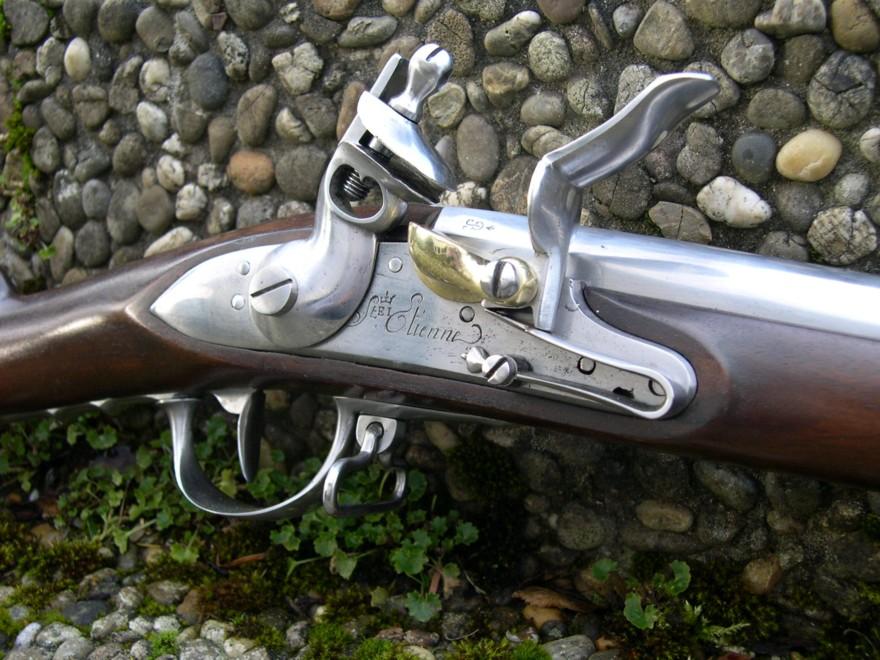
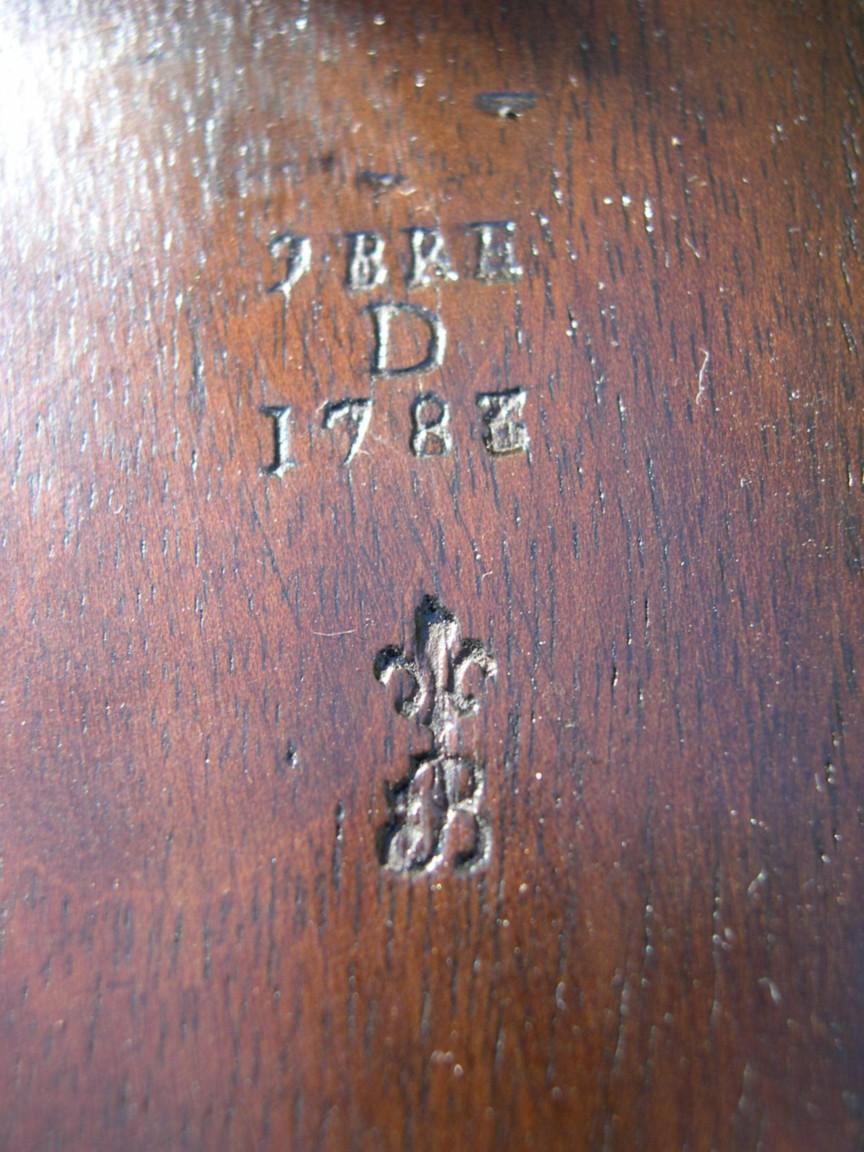
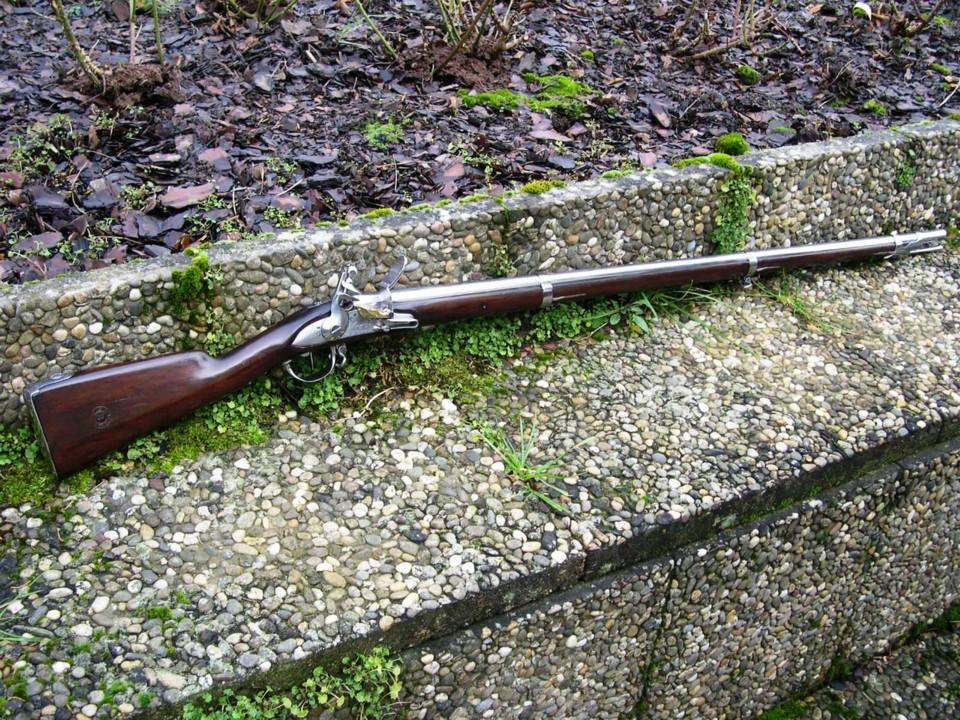
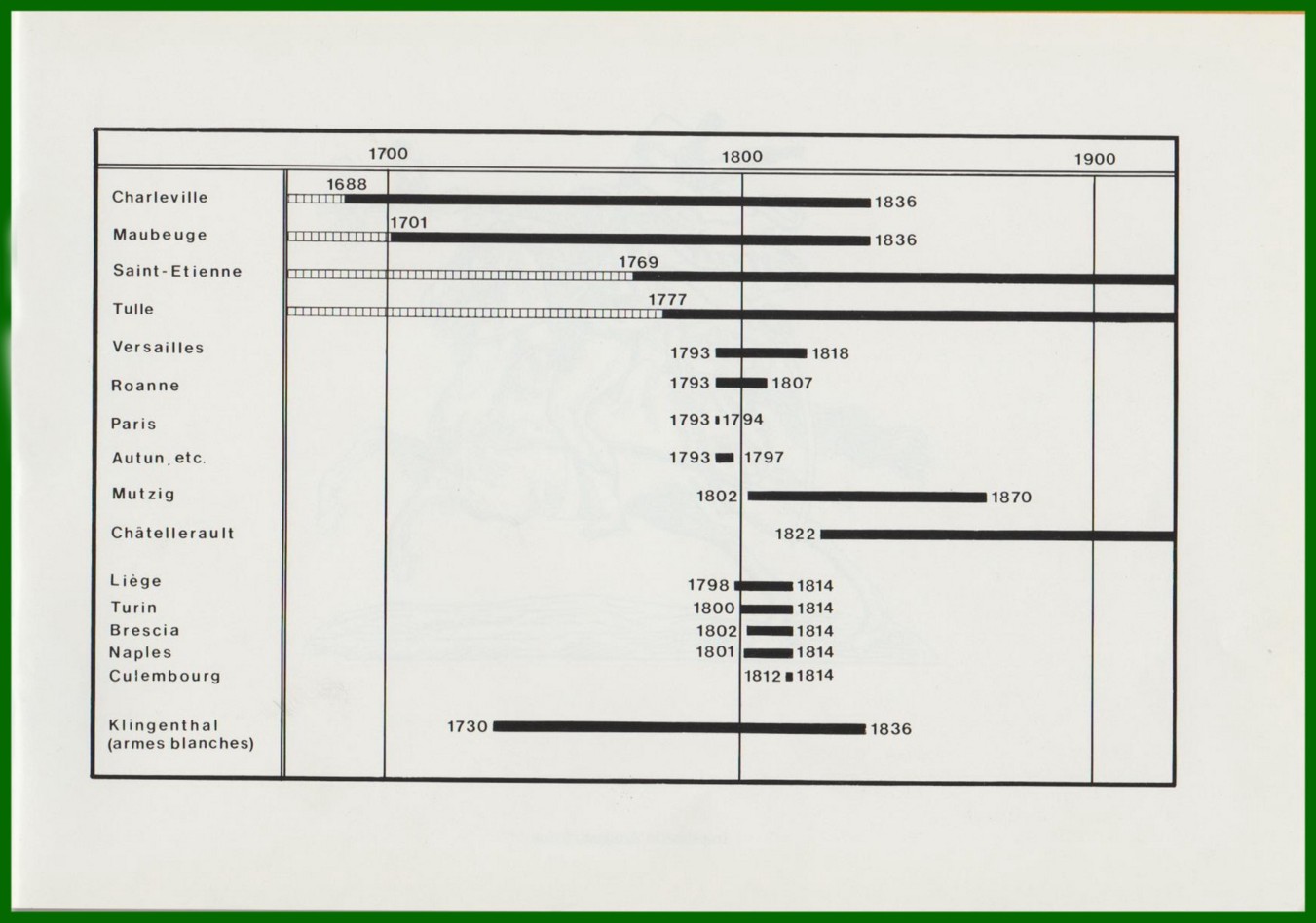
Indeed Mle 1777 basic rifle, probably due to the absence of Marking of the
lock (civil Mle Year IX) it could be a "Revolutionary" assembly (under
reserve) or a model reserved for export which would have undergone the
modification "Year IX" of the lock (civil), or a weapon of "Treaty".
Photo below of an unmodified 1777.
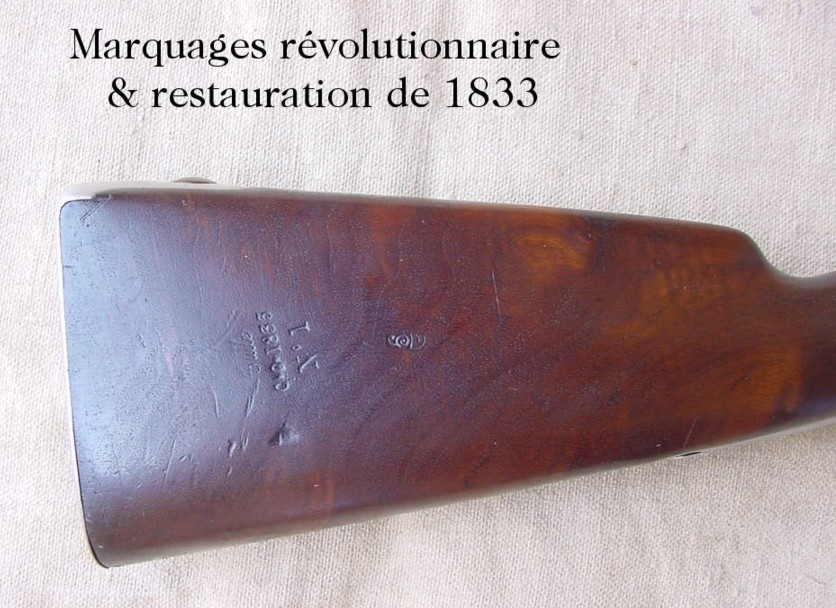
Those of the revolution have a "G" stamp surmounted by a Phrygian cap,
controller of the Manufacture de PARIS - Citizen "Gérrat".
Downgraded to No. 1 in 1833.
The 1777 models were mainly made in St Charleville (Nozon in the Meuze
Valley), Maubeuge & St Étienne.
Current village of "Nouzonville" in the Pointe Ardennaise for "NOZON".
Manufacturing prior to Year II of the Revolution. . . . it was modified
after Year IX (lock)
@lain
Identification 3370
Here a traditional shotgun juxtaposed of type Anson & Deeley, developed in
1875, almost centenary. It comes out from research in “Who's Who arms
manufacture of Liège” and in volume 3 of the “Arms manufacturers of Liege”
in catalogs of (deceased) Guy Gadisseur, which the mark “Sirène Hammerless
Arms comp.” was deposited in Liege, on May 20th, 1912 by Ziegler Adolf
Robert, street Sœurs of Hasque, (which manufactured shotguns and traded with
Poland. The mark “Syrena Hless Arms Co” could be the translation for the
sale in Poland of its weapons of hunting.
However, one does not find worthless trace of this Ziegler in the
directories. One wonders consequently if it had really a factory, or if it
were active in import/export.
Markings
16 on C in rhombus: indication of the gauge between 1898 and 1924.
PV surmounted of a stylized lion: test with the smoke-free powder between
1898 and 1968.
UA under star: countermark of a controller between 1877 and 1968.
Peron: inspection since 1853.
D=70 over 19.0: length of the room in mm and diameter in mm after the
optional test with the smoke-free powder between 1892 and 1924.
P under star: countermark of a controller between 1877 and 1968.
1kg336: weight of the barrel.
C: undoubtedly the yearly letter for 1924.
The marked initials of a red arrow are that of the gunner Joseph Cap.
GP with the essential assistance of PHL and GG †
Identification 3374
Voici un pistolet semi-automatique en calibre 6,35 de fabrication espagnole
et pourvu de poinçons liégeois.
Il provient des usines de Martin A. Bascaran à Eibar. Il est curieux de
relever que la marque Thunder a été déposée en Espagne par un autre
Espagnol, Alberdi, Telleria y Cia.
Comme dit plus haut, on repère sur la culasse quelques poinçons liégeois :
Lion sur PV : épreuve à la poudre sans fumée entre 1898 et 1968
R couronné : canon rayé en usage de 1894 à 1968
C sous étoile : contremarque d’un contrôleur entre 1877 et 1968
Perron : inspection depuis 1853
ELG sur étoile dans ovale couronné : acceptation entre 1893 et 1968.
Il est curieux de constater que la lettre L dans une grenade indiquant
l’origine étrangère d’une arme présentée au Banc d’Epreuves de Liège, en
usage depuis 1924, ne figure pas parmi les poinçons. Peut-être que l’arme a
été passée au BE avant cette date. Ou qu’elle a été expédiée « en blanc »
depuis l’Espagne, éprouvée et puis réexportée…
Dans le livre de Iann Hogg et John Weeks « Pistols of the World », on peut
lire que le « Thunder » est en fait une version améliorée du pistolet
« Martian » du même Martin A Bascaran de Eibar, lancé au début de la 1GM.
Le « Thunder » a été vendu jusqu’à la fin des années 1920.
GP avec l’aide de MD
Identification 3380
Here is a classic Anson & Deeley hunting rifle of Liège manufacture in 16 gauge, well marked Jean Riga-Stassart, arms manufacturer patented in Liege. English stick.
The markings
C: Year letter of 1924.
P under star: countermark of a controller since 1877.
Lion on PV: Smokeless powder test since 1898.
Peron: inspection since 1853.
16 C in vertical diamond: size (between 1898 and 1924).
ELG on star in crowned oval: acceptance between 1893 and 1968.
P 1 K170
: weight of the barrel capable of firing smokeless powders (since 1924).
D=65 on 18. 9: length of the chamber in mm and diameter in mm after the provisional test.
EL: provisional test since 1852.
CHOKE 16. 9 : choked barrels caliber at 22 cm from the breech.
JM in oval: it could be the initials of the gunner Joseph Ch. Monisse.
Martin Siemens Steel: type of steel produced according to the Martin-Siemens system (see Wikipedia: https://fr. wikipedia. org/wiki/Procédé_Martin-Siemens).
Jean Riga-Stassart, patented arms manufacturer, 288 rue Vivegnis in Liege, was registered with the Liege proofhouse from 1908 to 1936. He filed a Belgian patent for a bolt lock for tilting barrel rifles. The activities were taken over by Léon Stassart in 1938.
He also worked in export since we found his name on an advertisement by a Warsaw gunsmith in a 1928 Polish hunting magazine (on the second page) http://trofeamysliwskie. pl/admin/upload/File/LP/1928-42. pdf
GP
Identification 3381
Here is a revolver for six
pinfire cartridges (probably in 9 mm) marked Meyers Bté. Foldable trigger.
Ejector rod sliding along the barrel.
See also on the website
littlegun.
http://www.littlegun.be/arme%20belge/artisans%20identifies%20m/a%20meyers%20gb.htm
http://www.littlegun.be/ma_collection/belgique/be%20klmno/a%20be%20meyers%208mm%20gb.htm
http://www.littlegun.be/ma_collection/belgique/be%20klmno/a%20be%20meyers%20gb.htm
http://www.littlegun.be/ma_collection/belgique/be%20klmno/a%20be%20meyers%2012mm%20gb.htm
http://www.littlegun.be/ma_collection/belgique/be%20klmno/a%20be%20meyers%20poivriere%20gb.htm
The only photographed and
identifiable marking is the ELG on a star in an oval, that is, the one of
acceptance between 1846 and 1893.
Guillaume-Joseph Meyers, a
weapons manufacturer in Liege, filed seven patents between 1866 and 1879.
Unfortunately, we do not have the one that concerns this revolver.
It should also be noted that
Meyers sold 7 mm rimfire revolvers to the police of the canton of Zurich!
GP with the help of HPH
Identification 3386
This is a five-shot hammerless revolver in 7. 65 mm calibre from the manufacturer-importer Edgard Grimard.
Bronzed barrel and cylinder. Chrome-plated carcass.
The ejector
rod is located in the axis of the cylinder.
The markings
Lion on PV : live powder test between 1898 and 1968
S under star: countermark of a controller between 1877 and 1968
R crowned: rifled bore between 1894 and 1968
ELG on star in a crowned oval: acceptance between 1893 and 1968
Initials ELG in a diamond shape: the trademark (unregistered) of Edgard Grimard.
ING 1342: not identified.
The company
Edgard Grimard has been registered with the Liège Proofhouse since 1908.
At the
time, it was located rue Chéri 31 in Liège.
In 1930, she took over the workshops and equipment of the former Nagant company. She then moved her workshops to the Quai Roi Albert in Bressoux.
The company
still exists in Ans-Alleur.
GP
with the help of PHL
In 1906:
creation of the company. I don't have the address !
Around 1910: César Franck street, 26
Around 1914: rue Edouard Wacken, 32, Liège
Circa 1924:
rue Louvrex,90, Liège
In 1930:
takeover of the Nagant factory (cf. Guy in the Who's Who belgian
manufacturers) but I can't find a trace of it in my papers.
Circa 1937: rue Louvrex,90, Liège: central office
Quai du Roi Albert, 106, Bressoux: factory
Rue Chéri, 31: stores and depot
Around
1945: rue Louvrex,90, Liège: offices and warehouse
Quai du Roi Albert, 106, Bressoux: factory
Around 1960: Quai du Roi Albert, 102 to 108, Bressoux: factory
Around 1967: rue Chéri, 31, Liège
In 1976: Avenue de l'Energie, 9, Industrial Park, Alleur
In 1984: rue Chéri, 31, Liège
I'm finding traces of the
trademark from 1924. The dates are approximate because I
could not formally establish the dates of change, not having the directories
of each year!
Obviously,
the address rue Chéri, 31 remained current in parallel with that of Alleur
but until what date?
For the
"partial" history see :
https://www.edgardgrimard.com/
Identification 3393
Here is a small calibre
shotgun with central percussion, external hammers, key of opening between
the hammers, semi-pistol butt, frustrated engravings, of cheap Liège
manufacture intended for export, in this case to Brazil given the marking
Ordem & Progresso on the band between the barrels.
The
markings
Peron: inspection since 1853.
Lion
on PV: test with smokeless powder between 1898 and 1968.
Z
under star: countermark of a controller since 1877.
EL:
provisional test since 1852.
1kg192 : weight of the barrel that can fire smoke-free powders since 1924.
13,8
and 13,9: calibre in mm since 1889 (according to the sources so I have).
C or
G under star: countermark of a controller since 1877 (the presence of two
countermarks surprises us...).
28-65 in omega lying: nominal size and length of the sleeve since 1924.
Cockerill Steel: the type of steel used for barrels.
We
do not see any manufacturer's or gunner's marks, which is not surprising
given the low production cost of such a rifle.
"Ordem & Progresso"; appears on the Brazilian flag. See on this subject
Auguste Comte and positivism.
GP
with the help of HPH.
Identification 3394
This is a "classic" Anson and Deeley system shotgun with English stock,
probably the beginning of the FN range. He is almost a hundred years old and
we can see that he "have many lived".
A
very similar rifle has already been identified:
http://www.littlegun.be/arme%20belge/fn/a%20fn%20fusil%20chasse%20gb.htm
The markings
Crowned ELG: acceptance between 1893 and 1968
Lion on PV: test with smokeless powder between 1898 and 1968
d: annual letter for 1925
S
under star: countermark of a controller between 1877 and 1968
16-65 in elongated omega: caliber and length of the casing since 1924
Underneath the longline are probably the weight of the guns and any chokes.
GP with the help of PHL
Identification 3395
Here is a nice drilling marked JB DEFOSSÉ in Liege. External hammers, nice
stick "pistol". Barrels are relatively short, quasi indeed to try to
compensate for the weight of the third striped barrel and to make sure so as
the weapon remains "nice" to hit.
Marking
12 on C in vertical rhomb: calibre between 1898 and 1924
Peron: examination since 1853
ELG on star in oval crowned: acceptance between 1893 and 1968
EL: interim test since 1852
17. 4 and 18. 2: chokés cannons
AD under star: pass of the inspector from 1877 till 1968
The happy owner signalled us that the calibre of the striped cannon is 8x58
R Sauer there.
Concerning Defossé, here is what the members of the team found:
In the directory of 1889 appear among the armourers:
Defossé – St-Gilles, 222 in Liege
Defossé – Vennes, 317 in Liege
They also found:
1897: J. Defossé, armourer, living in Street Wazon, in 22 in Liege
1905: J. -B. Defossé, armourer, living in Street Wazon, in 22 in Liege
1908: J. Defossé, producer of weapon, street Wazon, 22 in Liege
1910: more trace of aforementioned Defossé at address above mention.
The according to «Whom is who of the armory liégeoise», JB DEFOSSEZ was
registered in the Bench of tests of Liege from 1904 till 1908: since then,
is there is an error the in «Whom is who», is there was an error in the
Bench of tests (it would not be the first time) when they Defossé and
Defossez were merged, that is the engraver made a mistake it would not be
either the first time. And they see badly not selling such a nice gun for
such a small "error";!
GP with HPH, PHL and MD
Identification 3396
Voici un revolver à 6 coups, cartouches à broche, sans doute du 7 mm. Il a
été fabriqué par Bonhomme, qui a apposé son nom sur la portière de
chargement. On voit aussi les initiales BD sur le pan droit du canon. La
baguette d’éjection a fait l’objet d’un brevet déposé par Bonhomme et David.
Les marquages
ELG sur étoile dans ovale : acceptation entre 1846 et 1893
K sous étoile : contremarque d’un contrôleur entre 1877 et 1968.
Guillaume Bonhomme et Mathieu David ont déposé le brevet 040843 le 13
novembre 1876 qui figure ci-dessous. Ils ont ensuite déposé un brevet de
perfectionnement 041286 le 15 janvier 1877 mais il ne nous concerne pas.
Guillaume Bonhomme (Voie de Liège 11 à Herstal) a aussi déposé d’autres
brevets entre 1870 et 1878.
Mathieu David (fils) était aussi armurier à Herstal, rue Hayeneux 76.
GP avec l’aide de HPH
Brevets :
028277
– 30/11/1870 Système de clef de fermeture à ressort avec
tire-cartouches mobile applicable aux revolvers basculants
029187
– 11/08/1871 Nouveau système de portière de sûreté applicable aux
revolvers
033009
– 29/07/1873 Système de pistolet revolver avec fermeture de sûreté
040843
– 13/11/1876 Modification applicable aux revolvers (avec DAVID
Mathieu)
041286
– 15/01/1877 Baguette à charnière
(brvt ppal n° 040843 du 13/11/1876) (avec DAVID Mathieu)
045211
– 20/05/1878 Système de revolver basculant.
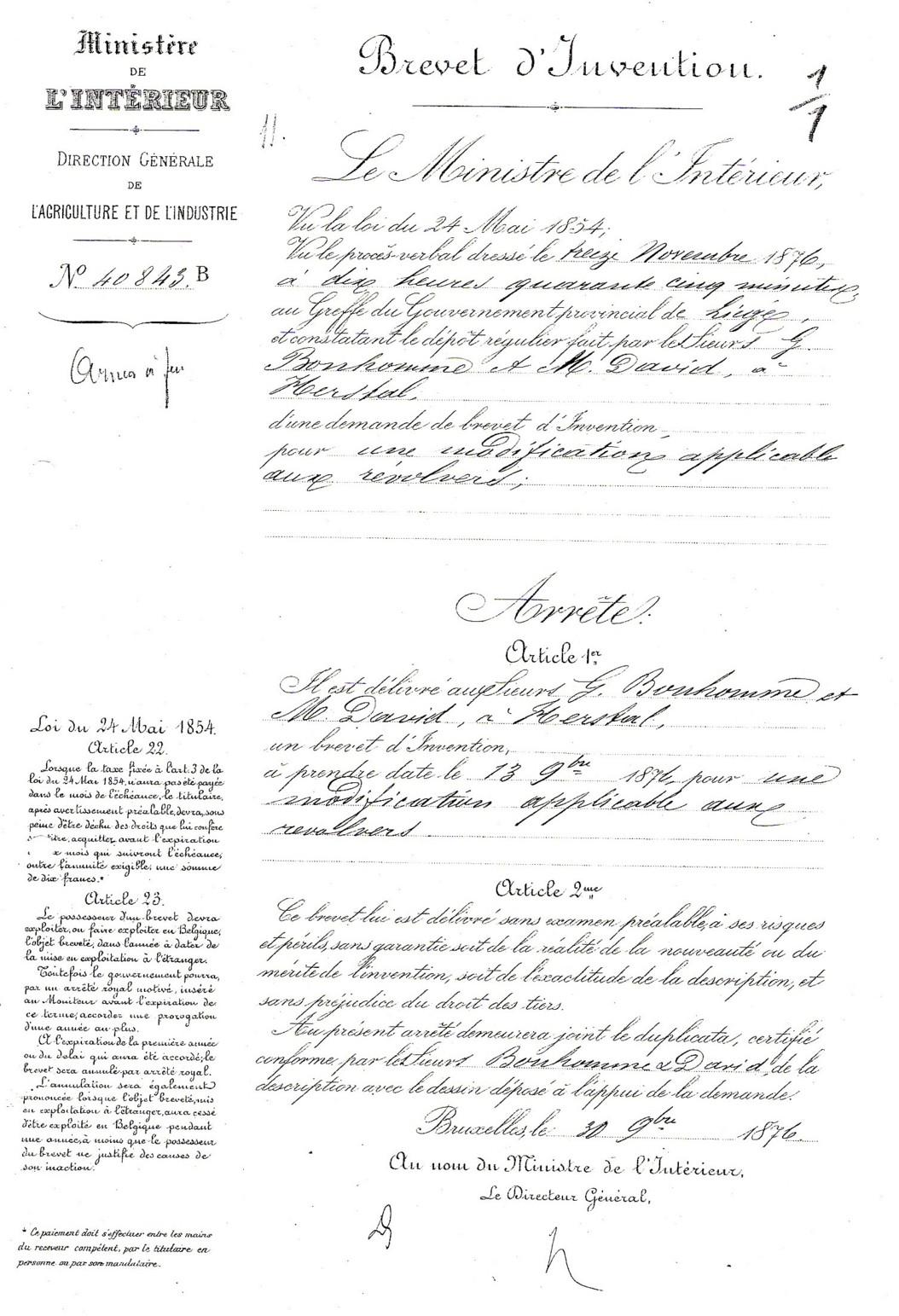
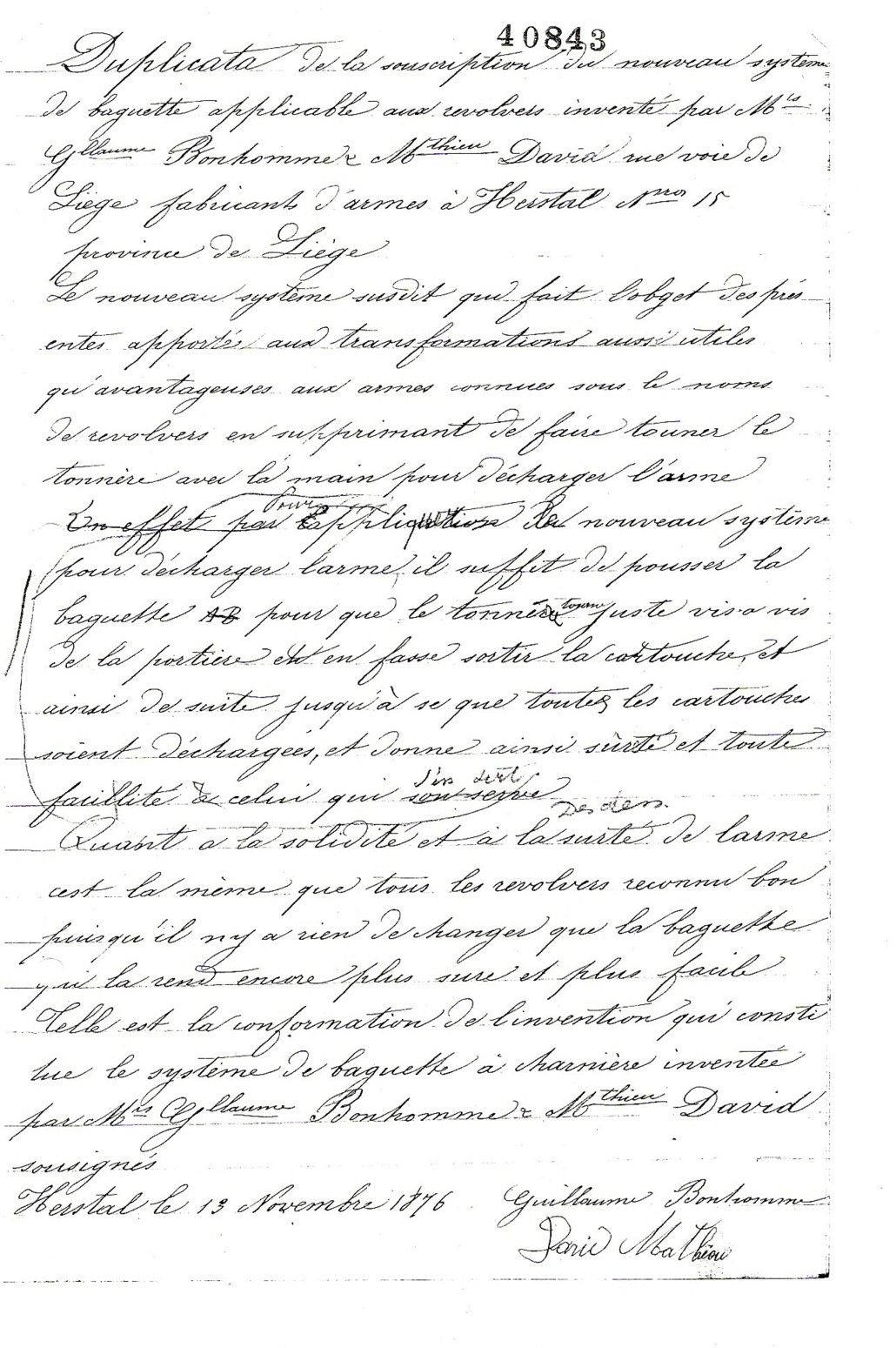
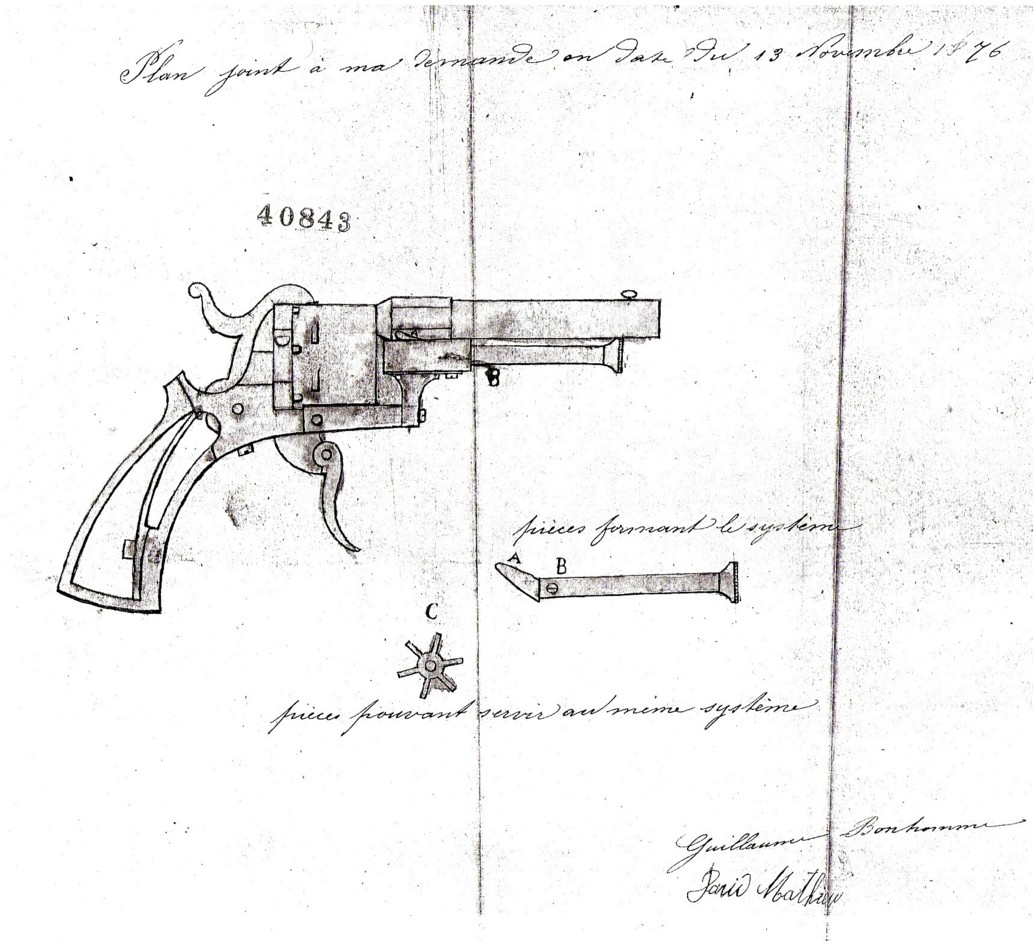
Identification 3403
Voici un bien « drôle de pistolet », qu’on
peut attribuer au génie d’A. Barbault, armurier à Paris, place de la
République, 16, vers 1909. Il eut été encore plus « drôle » si ce « pistolet
de précision » avait été équipé du système d’équilibre à balancier qui fit
l’objet d’un dépôt de brevet (216132) en Belgique par le sieur Barbault, via
le sieur Stocq de Bruxelles, le 10 mai 1909, ce qui n’est malheureusement
pas le cas, comme on le verra plus loin.
Les marquages
FL 22 L : le calibre Flobert 22 Long
ELG sur étoile dans ovale couronné :
acceptation entre 1893 et 1968
A sous étoile : contremarque d’un contrôleur
entre 1877 et 1968
Perron : inspection depuis 1863
AB dans un dessin de poisson : les initiales
d’A. Barbault dans ce qui est être supposé comme étant un barbeau (un
poisson de rivière qui peut atteindre un mètre de long).
Il appert du brevet 216132 ci-joint et des
photos que le système de balancier qui doit se trouver dans la poignée
n’existe pas sur l’exemplaire présenté. Il pourrait avoir été remplacé par
une masselotte avec guidon réglable beaucoup plus simple.
A. Barbaut est inconnu du Stöckel.
Un Barbault figure dans le Jarlier mais
comme armurier à Nogent-Le-Rotrou (Eure-et-Loir) en 1893-1894.
On se pose aussi la question du numéro 1896
suivi des lettres AB. Ce chiffre de production – s’il en est un - semble
fort élevé… mais on sait que les chiffres de production sont régulièrement
fantaisistes (ou du moins qu’ils ne commencent pas souvent au n° 1…).
On se demande aussi quel armurier liégeois a
produit ce pistolet.
GP avec l’aide indispensable de MAX.
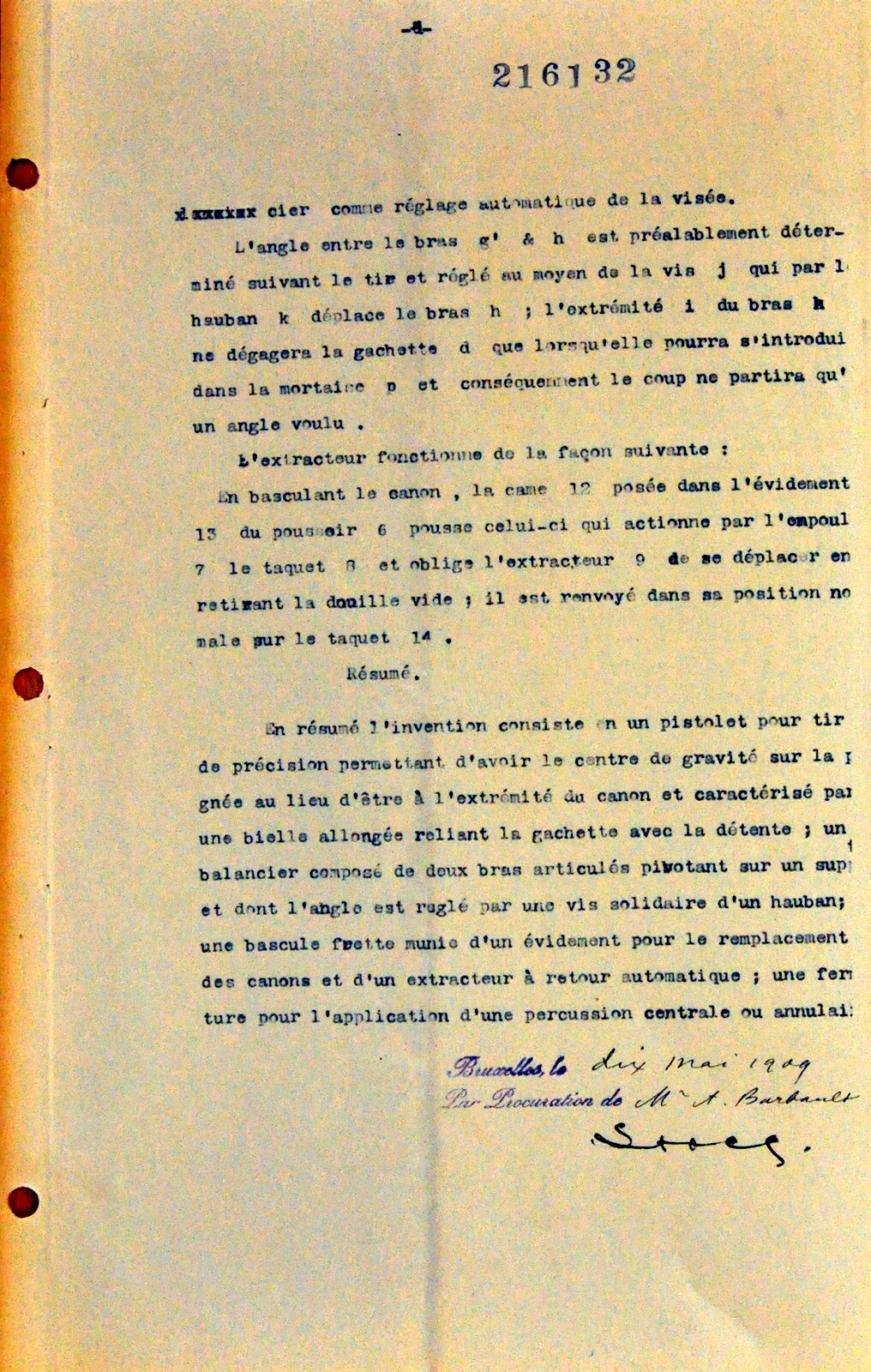
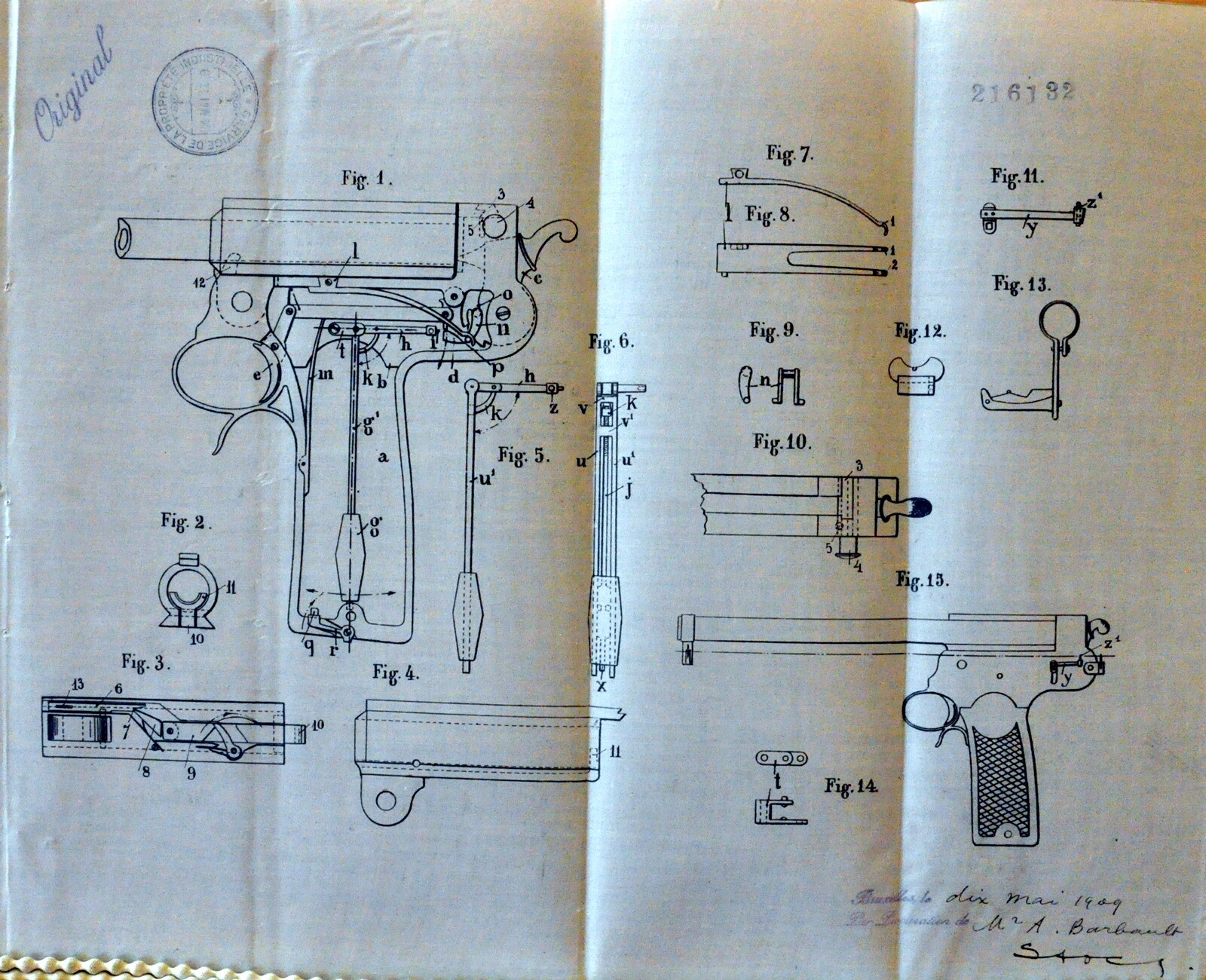
Identification 3404
Le premier cité est le père du second ... (et ne correspond pas patronymiquement parlant à Mounard-Lemaire sauf si ce dernier s'est remarié et a migré de Cheratte à (Souverain) Wandre) ...
Guillaume MOUNARD
Né le 28 juillet 1847 - Cheratte
Décédé le 26 février 1896 - Wandre Liège, à l'âge de 48 ans
Marié avec une Anne Catherine Remi ...
Guillaume Joseph MOUNARD
Né le 27 décembre 1889 - Wandre Liège
Décédé le 10 octobre 1943, à l'âge de 53 ans
Pas d'indication de mariage ...
Par contre, le site de généalogie employé ne
mentionne pas les
professions dans ce cas-ci ...
On Mon, 23 Sep 2019 23:39:23 +0200, Balou Balou
wrote:
> Je crois lire G. (?) Mounard & C°
> Mounard Guillaume, de Souverain-Wandre (brevet en
1910)
> Mounard-Lemaire G. à Cheratte (brevet en 1890)
> qui pourraient être une seule et même personne ?
Je viens de trouver un troisième Mounard ... (Nom extrêmement courant à Cheratte au 19ème siècle, a priori) ...
Guillaume Joseph Mounard :
- armurier / fabricant d'armes,
- né le 20 septembre 1857, à Cheratte, fils de Jean Guillaume Mounard,
platineur
- marié avec Catherine Lemaire, ménagère,
- domicilié à Wandre, il assiste au mariage de sa fille Marie Catherine
Mounard (née le 04 octobre 1886 à Cheratte), le 24 novembre 1910.
- a eu, en tout, 7 enfants dont 3 garçons (1 décédé à l'âge de 2 mois)
- pas de date de décès connue.
Il a sans doute choisi d'associer son patronyme avec celui de son épouse
pour se distinguer de :
Guillaume MOUNARD (armurier)
Né le 28 juillet 1847 - Cheratte
Décédé le 26 février 1896 - Wandre Liège, à l'âge de 48 ans
Marié avec une Anne Catherine Remi ... ou Remy !!!!
et de son fils :
Guillaume Joseph MOUNARD (règleur à la FN)
Né le 27 décembre 1889 - Wandre Liège
Marié avec Lambertine Marie Josèphe Dumoulin
Décédé le 10 octobre 1943, à l'âge de 53 ans
Je ne sais aller plus loin !
On a pas trouvé le brevet de votre arme mais on a trouvé celui-ci !
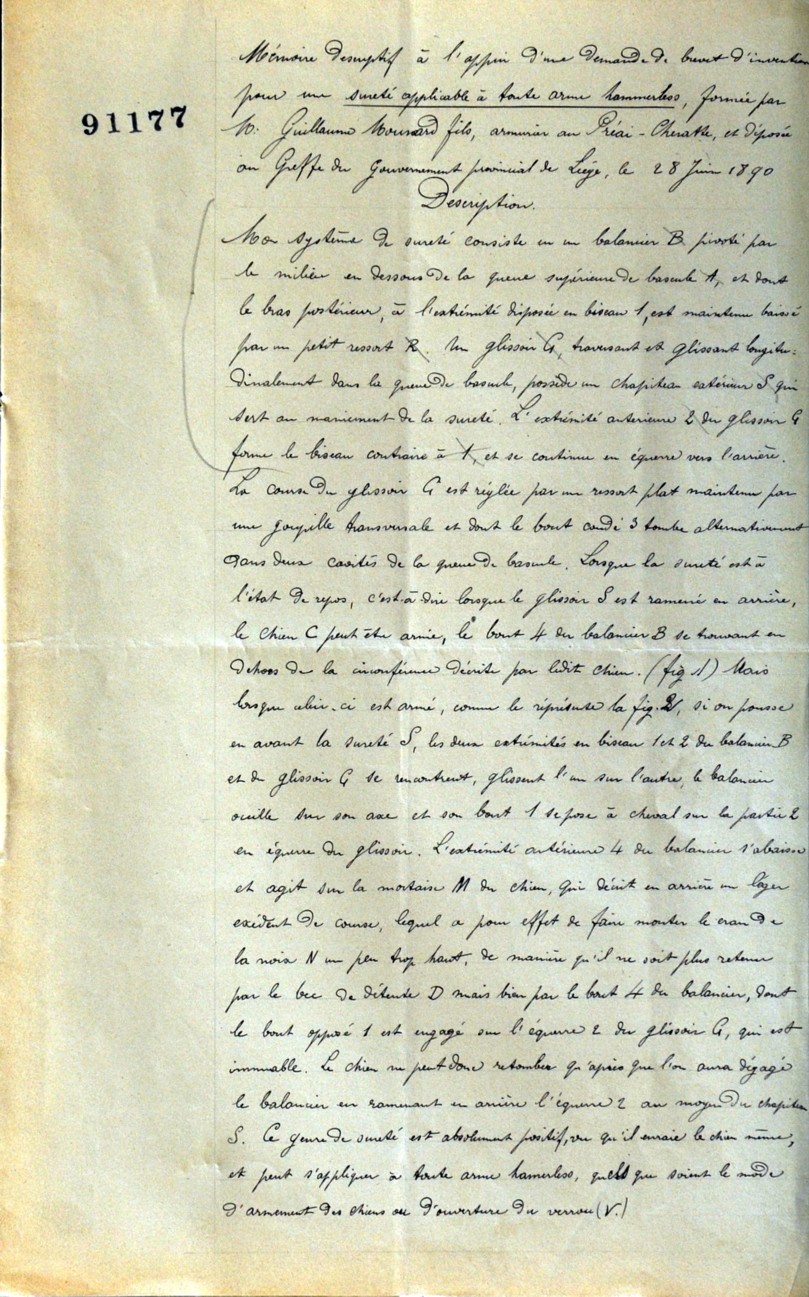
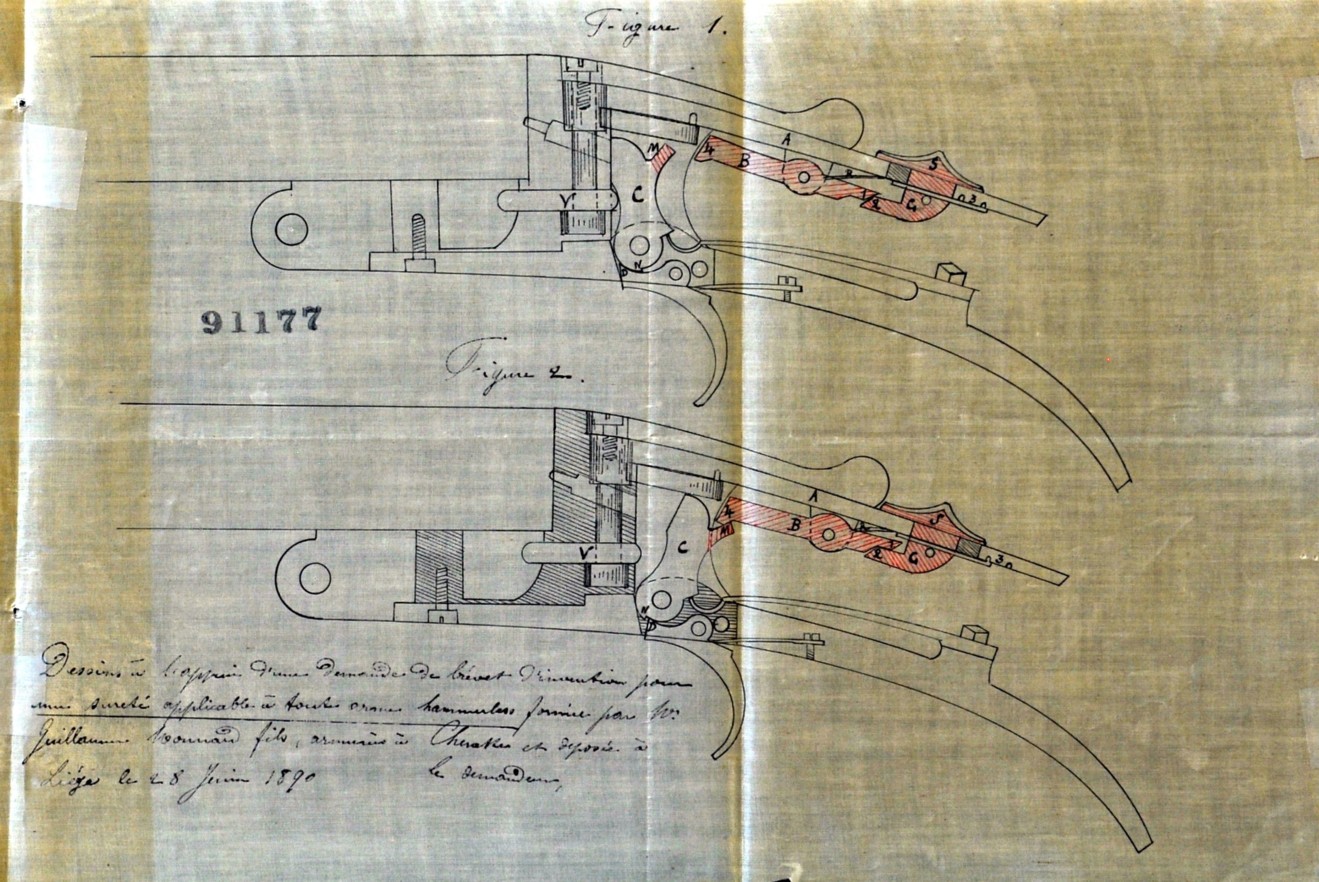
Identification 3409
Here is what, at first glance, could be nothing more than a "stupid little
revolver" from Liège with five shots of undisclosed caliber, a folding
trigger, as hundreds of thousands or even more have been made. In fact, it
is a revolver with a security that could be described as secret.
The markings
ELG on star in crowned oval: acceptance between 1893 and 1968
L
crowned: regularly observed on revolvers of Liège without result. . . .
R
crowned: rifled barrel between 1894 and 1968
Y
under star: countermark of a controller between 1877 and 1968
JD under the plates: it is almost certainly not Jean Duchateau, specialized
in luxury weapons.
?DC in a cartridge on the left side of the barrel: it is most probably
François Dumoulin et Cie, rue Thier de la Fontaine 2 in Liège, registered
with the proofhouse from 1908 to 1968.
See the website :
http://www.littlegun.be/ma_collection/belgique/be%20abcde/a%20be%20dumoulin%20francois%20gb.htm
The originality of this small revolver lies in the
round piece on the left side of the weapon. According to one of the experts
in our research group, this round piece is indeed an example of a very
fashionable "secret security" in the last quarter of the 19th century, even
until the war of 14-18 (he remembers us having seen in a catalogue of the
Jules Pire house in Antwerp before the 1st GM an advertisement of course not
illustrated for "to secret" revolvers in handling was explained in store
when the purchase).
The revolver in question is reminiscent of Colt New
Line 1873, on which this round piece is nothing more than the cover plate
giving (difficult) access to the mechanism. I don't know why Colt has given
this part a relief, which has no other function than to serve as a cover.
On the other hand, the Belgian revolver is very
interesting: the manufacturer imitated the Colt's cover plate, but gave it a
completely different function, namely a "secret" security system designed to
prevent any unintentional use by inexperienced people or children. On the
pictures with the part dismantled, we can clearly see the locking cam of the
hammer halfway out of the frame, and its channel in the inner face of the
round part.
The cam is equipped with a spiral spring that pushes
it outwards into the deep part of the channel so that it does not interfere
with the movement of the hammer during shooting. When the knob is turned to
the right 1/4 turn, with the hammer down, the oblique bottom of the channel
pushes the cam inwards so that it engages in a mortise in the left side of
the hammer, blocking any movement of the hammer.
The system is of course worth what it is worth. . .
.
François Dumoulin had actually been active since
1894 at other addresses. He filed several patents, including one in 1905 for
a security interest for revolvers, but this is not the model we are dealing
with.
GP with the much appreciated help of MC and PHL.
By an extraordinary chance I have just seen
in a gunshow another revolver with the same particularity, and signed
"ML crowned"
(Manufacture liégeoise d'arme à feu). We'll see if we can find the patent in
the name of this firm!
Identification 3412
I do not find sketch exactly similar to this one, but the most prolific
candidate and most resembling being Crucelegui Hermanos would seem, which
produced this weapon as for the German armourer-stockist Gustav Genschow and
Co.
Marcel
I add some drops of water – modestly - to Marcel's mill:
The form of the cannon seems to have been appraised on the German market.
On the other hand mark GECO was deposited by Thieme y Edeler to whom the
logo appearing on a gun is relatively close to that of Velodog in question.
Besides the Spanish seemed to prefer MARCA REGISTRADA As a result Trade Mark
would it have meant a manufacture (Spanish?) intended for the export?
Michel
The book of Zhuck also mentions mark GECO indeed on similar weapon produced
by Crucelegui and Arizmendi. It is perhaps the designation of the model?
I am also tried to think that the mention Trade Mark in English, if she is
Spanish, was affixed on weapon intended for export. This seems to me
logical.
I continue searching.
A precision:
It well seems that THIEME Y EDELER (*) fabricated nothing, but passed orders
in all workshops which agreed to play game (including Belgians): guns,
revolvers, shotguns …
They were manifestly commercial intermediaries who sold retail these goods
everywhere where existed a request.
Therefore, as notes it Marcel, if the mark GECO on a weapon is found, it is
not necessarily a German production of Gustav Genschow and C °, but almost
anything commercialised by Thieme y Edeler, depositor of this mark in Spain
…
The revolver at the origin of our headaches can have been fabricated
anywhere: Belgium, Spain, Germany …
Michel
(*) Adolfo Thieme and Guillermo Edeler were among the founder armourers of
the Bench of Test of Eibar.
Their society was active during all 1st world war and until 1924 when it
became SEAM (The Espanola de Armas y Municiones).
In reality this society did not have clean plant and its activity was purely
commercial.
For the amateurs of exciting and healthy reading, I adapted an article of
Spanish on our "friends " Thieme and Edeler.
The erudite persons will note passage where Tomas de Urizar asserts having
been one of the most important suppliers of both "Germans". Tomas de Uriza -
T in one U - this inspires anything in you???
Would we have made a small step in good direction?
Michel

Identification 3421
This is
what was once called a "garden rifle" (so cheap) in 12mm calibre (also
called. 410) manufactured by the Manufacture liégeoise d'armes à feu.
Juxtaposed barrels, English stock, key of opening between the hammers.
The
markings
ELG on
star in crowned oval: acceptance stamp between 1898 and 1924
EL:
provisional test since 1852
K under
star: countermark of a controller between 1877 and 1968
12 M C
in elongated diamond: size, between 1898 and 1924
Perron:
inspection since 1853
ML in a
circle under the crown: the brand of the Manufacture liégeoise d'armes à
feu. See the link :
and
volume 5 of the series by Alain Daubresse :
http://www.littlegun.be/livres/a%20a%20livre%20alain%20general.htm
The
right barrel is not choked, the left one is 9. 6 mm, 22 cm from the breech
and at the mouth.
10. 3
is (in my humble opinion) the "normal" diameter of a 12 mm/410 barrel.
GP
P. S. :
The manufacturing range of this weapon is therefore between 1898 and 1924
Identification 3423
Voici une belle carabine de jardin à deux canons superposés, l’un en 6 mm à
canon rayé, l’autre en 9 mm à canon lisse. Beaux quadrillages, finition
soignée, une belle pièce ! Pas rare non plus, d’autres armuriers en ont
également fabriqué.
L’arme est basée sur un des nombreux brevets déposés par Mariette
(Dieudonné ?) et fabriquée à Liège ainsi qu’en attestent les poinçons. Elle
a été vendue à Paris par la célèbre maison H. Fauré Le Page.
Il est dommage que l’heureux
propriétaire n’ait pas démonté l’arme
- ne serait-ce que par acquit de conscience – car il se pourrait
qu’il y ait encore d’autres poinçons intéressants sous le canon.
Les marquages
LR couronné : il se pourrait qu’il s’agisse des initiales de Lambert Rouma,
voir
http://www.littlegun.be/arme%20belge/artisans%20identifies%20q%20r/a%20rouma%20lambert%201877%20fr.htm.
Merci posthume à Guy Gadisseur.
T sous étoile : contremarque d’un contrôleur entre 1877 et 1968
Perron : inspection depuis 1853
R couronné : canon rayé (celui du dessus), entre 1894 et 1968
ELG sur étoile dans ovale couronné : acceptation entre 1893 et 1968
Mariette Breveté : je présume qu’il s’agit du brevet 079490 déposé par
Dieudonné Mariette le 10 novembre 1887, mais je n’en suis pas sûr du tout.
D’autant que d’ici, je ne peux pas sentir s’il y a effectivement un ressort
dans le système d’éjection…
Pour H. Fauré Le Page à Paris :
https://fr.wikipedia.org/wiki/Fauré_Le_Page
GP avec l’aide de HPH.
Une
chose qui m’étonne sur cette carabine, c’est que je n’aperçois pas de
sélecteur pour la percussion, en effet il est inimaginable de percuter les
deux cartouches en même temps.
Identification 3426
This is a classic hunting rifle juxtaposed with external hammers and a
semi-pistol butt. The barrels are made of Damascus Bernard. I am not able to
read the inscription in Cyrillic characters on the dealer's carrying case.
The markings:
EL: provisional test since 1852
ELG on star in crowned oval: acceptance between 1893 and 1968
NO FOR BALL: choke smoothbore barrel, in effect between 1878 and 1897
16. 8 and 16. 4: choked barrels cal in mm at 22 cm from the breech and at
the mouth: in effect between 1898 and 1910. This means that the nominal size
could be 16.
On this subject, there is a problem since we do not see - on the photos
which were transmitted to us in any case - any mention of calibre. However,
this mention was introduced in 1892 on the shape - for example - 70 by 20.
6, i. e. 70 mm for the length of the chamber and 20. 6 for the diameter
after the optional test. However, as mentioned above, the weapon was tested
after 1893 and even in principle after 1898.
Peron: inspection since 1853.
M
and Z under star: countermarks of controllers between 1877 and 1968.
U
crowned: this punch cannot be that of a countermark of a controller between
1853 and 1877. But what is it then?
PW: unidentified
HB: we thought for a moment about a member of the Bernard family but we only
know Emile and Léopold.
AS patented crowned: it could be Albert Spirlet, with the emphasis on the
conditional since even if we find at the bottom of the link below the same
brand AS crowned in Albert Spirlet's production, the latter was - to our
knowledge in any case - specialized in revolvers, and not in shotguns.
http://www.littlegun.be/arme%20belge/artisans%20identifies%20s/a%20spirlet%20gb.htm
GP
Date (Range) of manufacture.
The punches of the proofhouse unfortunately proves that the weapon was
tested between 1898 and 1910!
Alain
Identification 3428
Voici une
arme assurément exceptionnelle, un superposé Superbritte comme on n’en
rencontre pas tous les X dizaines d’années puisque la production, d’origine
en tout cas, ne dépassera pas les 250 à 300 exemplaires selon les sources.
Belle crosse en col de cygne
Dans le même genre de fusils superposés à
ouverture latérale, on citera également les fusils Pieper Actionless plus
tardifs (1947), mais c’est une autre histoire (voir le livre de Michel
Druart : « Les hommes, les armes et les machines du Chevalier Pieper & Cie,
1859- 1957 », page 303 et suivantes…)
Les
marquages
k :
lettre annale pour 1932 ;
1kg220 :
poids du canon pouvant tirer des poudres sans fumée depuis 1924
12-70
dans oméga couché : calibre nominal et longueur de la chambre depuis 1924
AC et z
sous étoile : contremarques de contrôleurs entre 1877 et 1968
Lion sur
PV : épreuve à la poudre sans fumée entre 1898 et 1968
ELG sur
étoile dans ovale couronné : acceptation depuis 1893
EL :
épreuve provisoire depuis 1852
CHOKE
18.3 et 18.2 : canons chokés à 22 cm de la culasse entre 1924 et 1968
CAP JF :
fabricant de canons Jean Falla, fabricant d’armes et de canons à Liège rue
Bonne Nouvelle 35. Il utilisait notamment la marque déposée et gravée à la
molette « tête d’aigle » Acier comprimé CAP JF qu’on trouve sur ce fusil ;
il s’agissait d’un acier à haute résistance permettant la fabrication de
canons très légers. On ne voit aussi un ME qui précède le nom et qui est,
plus que vraisemblablement, à mettre en rapport avec « Acier Comprimé ».
http://www.littlegun.be/arme%20belge/artisans%20identifies%20c/a%20cap%20joseph%20fr.htm
Le même Jean Falla avait
aussi mis au point un procédé pour soudure des canons de fusils de chasse :
http://www.littlegun.be/arme%20belge/artisans%20identifies%20e%20f/a%20falla%20fr.htm
5010 : je
me pose des questions concernant ce nombre 5010 qu’on voit deux fois sur ce
fusil. Suggestion : on sait que les chiffres de production des armuriers
liégeois (et sans doute des autres aussi) sont « régulièrement »
fantaisistes. Pour différentes raisons. Dès lors, étant donné que l’arme a
été présentée au Banc d’Epreuves en 1932, soit au
tout début de la production (si j’en crois ce que j’ai lu jusqu’à présent,
voir plus bas), je me demande si Britte n’a pas commencé la numérotation de
la production à 5.000 : il pourrait donc s’agir du dixième exemplaire… mais
ce n’est qu’une hypothèse.
Concernant Britte :
http://www.littlegun.be/arme%20belge/artisans%20identifies%20b/a%20britte%20fr.htm
Le brevet 376297 qui est
mentionné sur le fusil a été déposé début janvier 1931.
Pour être complet, on
signalera également que ce brevet a été suivi en mai de la même année par le
brevet 379537.
Je reconnais volontiers
qu’il y a un « problème » puisque – selon la lettre annale – le fusil a été
présenté au BE en 1932. Mais je n’ai pas d’explication.
On en trouve aussi des
exemplaires signés de maisons liégeoises de renom comme Lebeau-Courally :
http://littlegun.be/arme%20belge/artisans%20identifies%20l/a%20lebeau%20courally%20fr.htm
ou Masquelier :
GP avec l’aide de HPH
Identification 3432
Here
is a very classic garden rifle of caliber .410, system called Warnant,
manufactured by
Dresse-Laloux.
The
markings:
EL: provisional test since 1852
J and m under star:
countermarks of controllers, between 1877 and 1968
Peron: inspection since 1853
10. 2: diameter in mm, probably from. 410/12 mm. To be checked by the happy owner.
I am
surprised not to see the ELG on star in oval, crowned or not.
According to the "Who's
who of the Liège armoury" the Former
Fabrique Dresse-Laloux was registered with the proofhouse between 1867
and 1908.
In 1862, the company took over the activities of Ancion et Cie (Proofhouse 1842/1862) and the Fabriques d'Armes de Liège (proofhouse 1837/1862).
In 1867, Ancion withdrew and continued its own activity. In 1908, the activity was taken over by Etablissements Laloux Georges.
It should be noted that Dresse-Laloux filed no less than 24 patents and the trademark Imperial Gun C° on November 22, 1892.
GP and MD.
Identification 3435
Here is a beautiful hunting rifle juxtaposed with English stock, external hammers, sold by the Brussels arquebusier Jean Van Maele, patented arquebusier, who was a supplier to the King of Serbia at one time. Beautiful damas barrels. In all likelihood - to be confirmed by the lucky owner if necessary - the part in front of the trigger guard allows the barrel to be opened to load the cartridges and eject the casings (some volute levers of this type arm the hammers). I haven't been able to find the inventor so far, especially since I don't know exactly what the lever is for.
The markings
ELG on star in oval: acceptance between 1846 and 1893
Peron: inspection since 1853
EL: provisional test since 1853
18. 2: calibre in mm, since 1889, in principle a calibre 12. As I do not see any other indications concerning the calibre, I assume - with some reservations - that the weapon is pre-1892.
Eugène Bernard, gunner + EB on H in crowned circle:
See also
http://www.littlegun.be/arme%20belge/artisans%20identifies%20b/a%20bernard%20eugene%20gb.htm
And also
http://www.littlegun.be/arme%20belge/artisans%20identifies%20b/a%20bernard%20henri%20eugene%20gb.htm
Once again under any reserve: it is well put Eugène Bernard, but where does the H come from? All the other rifles of Eugene Bernard do not have the H. . .
For Jean Van Maele (1876-1922??), see
http://www.littlegun.be/arme%20belge/artisans%20identifies%20t%20w/a%20van%20maele%20jean%20gb.htm
And again
GP
Supplement identification 3435
Our
specialists found the patent filed by Jean Van Maele of Brussels and N. ( ?)
Bodson of Liege on December 31, 1866, patent 20626 which concerns precisely
such a "volute".
Here's the
said patent:
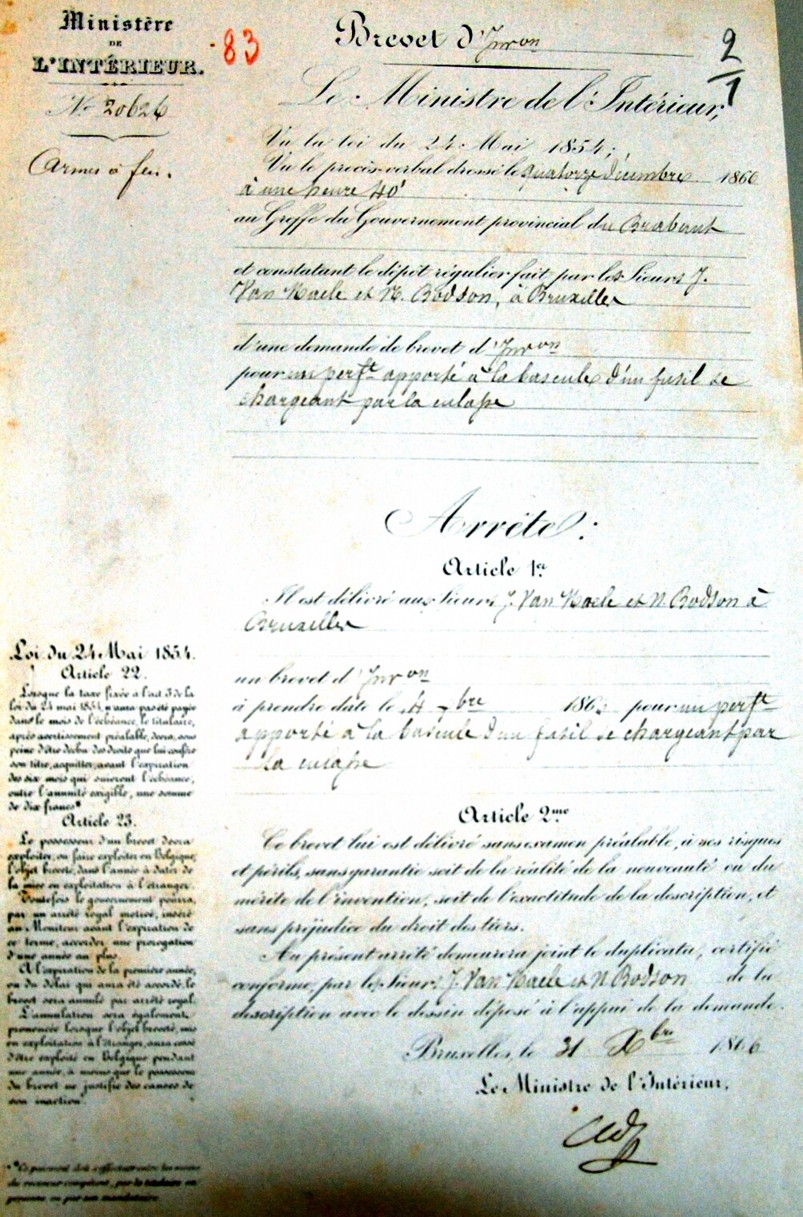
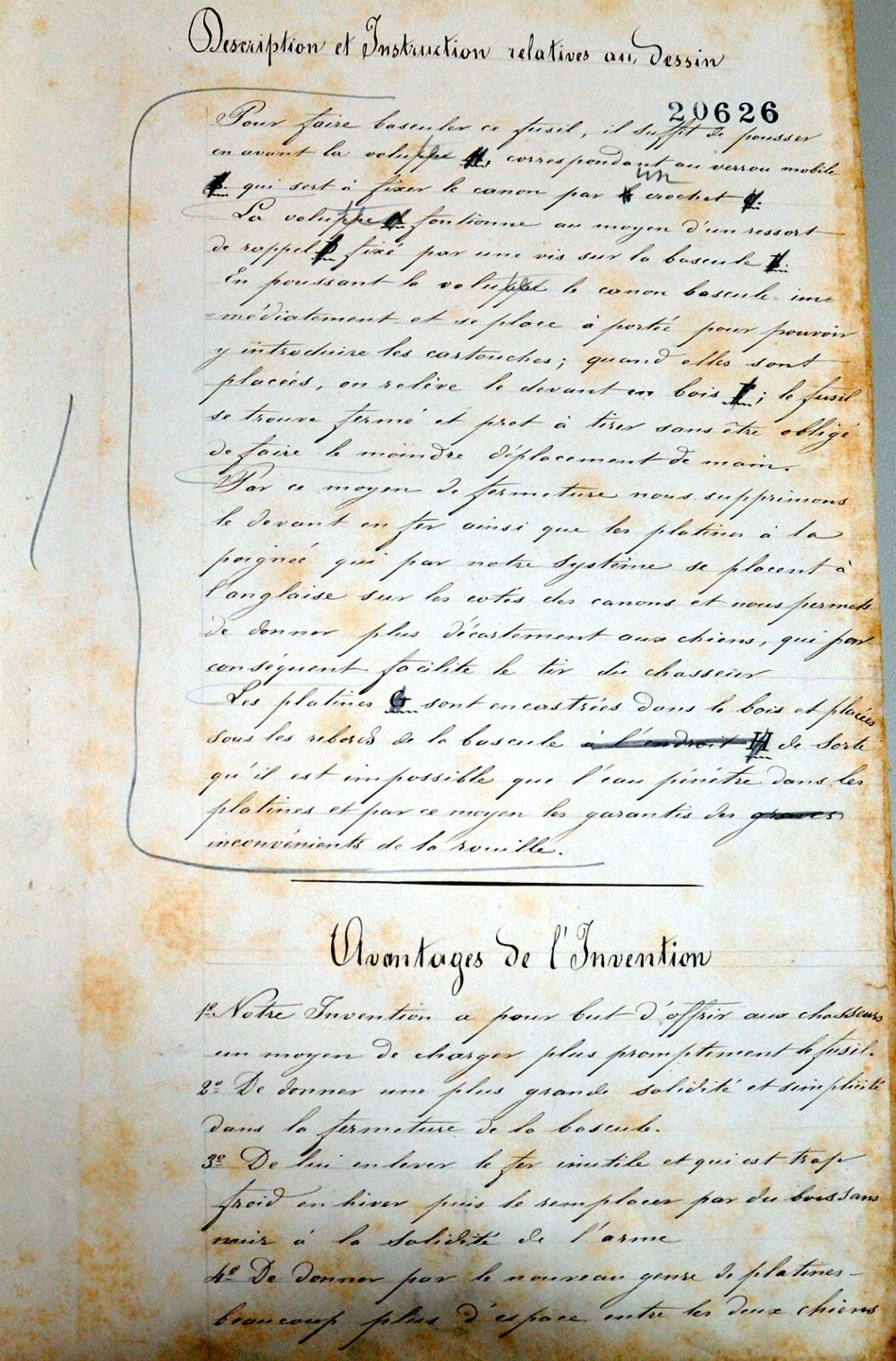
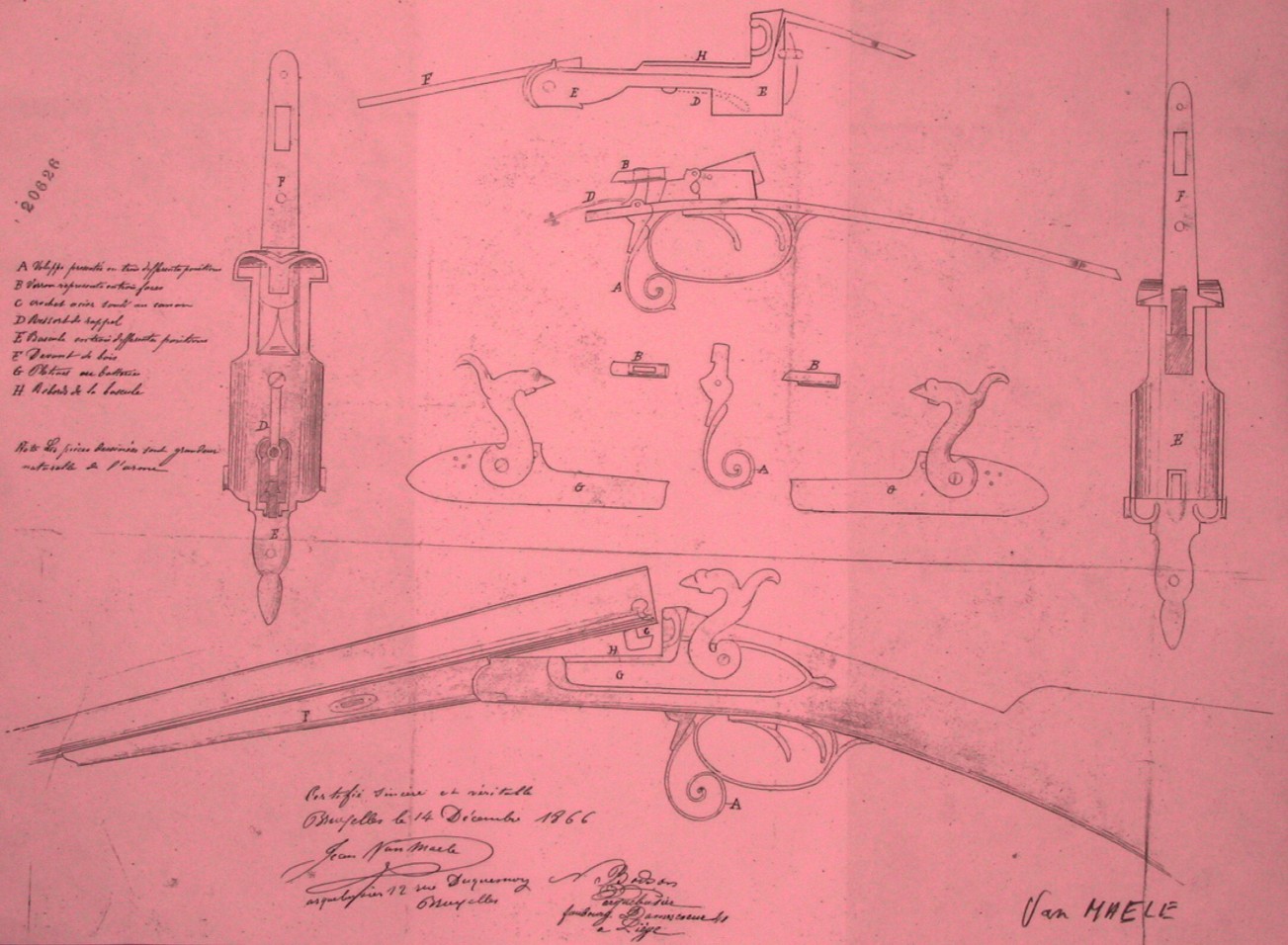
Identification 3436
Bonjour Madame,
Merci de votre demande d'identification d'une copie de S&W 1st Model, que
l'auteur Dowell identifie comme avoir été produite sous licence par Webley.
Tout d'abord, la mention "sous licence" implique que S&W aurait déposé le
maître-brevet de cette arme à Londres ou Birmingham, ce qui n'est pas le
cas. Les moines-copistes anglais avaient donc toute liberté d'inonder le
marché avec des copies "pirates" parfaitement légales pour autant que le nom
Smith & Wesson ne figure pas dessus. Par contre, une arme protégée par un
dépôt de brevet et produite "sous licence" doit être conforme à l'original
dans la plupart des détails,
Quelques armuriers liégeois et stéphanois ont également produit de ces
copies, également sans aucun problème pour la même raison.
Aux USA par contre, la firme Manhattan Arms Co, qui à partir de 1857 a copié
des revolvers Colt Navy à percussion (78.000 ex)
APRES l'expiration du brevet Colt, a été sévèrement condamnée pour une copie
du S&W n°1 en calibre .22 Long, jugée trop proche du modèle original dont le
brevet n'était pas encore tombé dans le domaine public.
Dans son livre "History of Smith & Wesson", l'auteur Roy G Jinks, historien
officiel de la firme, précise que la société n'a commencé à se tourner vers
les pays extérieurs qu' après l'exposition de Paris en 1867, et ne mentionne
qu'un "sales agreement" avec en Angleterre le revendeur J.H. Crane (Londres)
et en France C. W. May (Paris), plus quelques contacts en Russie et dans
d'autres pays est-européens.
Mais il s'agissait donc bien de "contrats de vente" des produits originaux,
et NON de licences de fabrication. De plus, S&W voulait surtout vendre sa
nouvelle version, connue sous le nom "Model 1 Third Issue".
Celà a bien marché jusqu'en 1872, lorsque le brevet Rollin White, propriété
de S&W, a expiré. Dès lors, tous les fabricants américains pouvaient se
précipiter dans le domaine des revolvers à barillet percé de part en part,
et S&W a perdu une bonne part de son marché.
L'auteur anglais Taylerson va dans le même sens, et cite la mention "under
licence" entre guillemets à propos des copies attribuées à Webley. Il n'y a
aucune trace de brevet S&W dans les archives du British Patent Office. Il y
a bien un brevet pour "a Smith & Wesson type revolver" daté de 1869 et
attribué à l'armurier londonien W.R. Lake, mais c'est tout. Aucun besoin de
licence donc.
A la page 120 de son livre, Taylerson montre des photos de S&W n° 1 et 2
originaux ainsi que des copies anglaises, mais ne cite que les noms des
revendeurs, ce qui implique que les noms des fabricants n'étaient pas
connus. (cottage industry).
Sans rien prétendre, je doute pour ma part qu'un fabricant aussi renommé que
Webley se soit aventuré dans la production de copies anonymes d'un revolver
concurrent qui de plus n' avait aucun avenir militaire.
Somme toute, quel qu'en soit le fabricant, votre revolver est conforme à la
vague des copies plus ou moins légales qui était à la mode à cette époque.
Il n'a de plus sûrement pas été produit en masse, et est donc rare. Ne
cherchez donc pas de n° de série, les marques que vous trouvez dessus sont
des marques cryptiques d'atelier ou d'identification de divers intervenants.
Seuls les marques officielles du banc d'épreuve de Birmingham donnent une
idée du lieu et de la date approximative de production.
Une pièce intéressante, qui a sa place dans toute collection d'armes
américaines de cette époque.
J'ajouterai que selon les poinçons BCP et V couronné sur le canon (utilisés
de 1812 à 1904), et eu égard au modèle du revolver construit par S&W de 1856
à 1868, la date estimée de 1865 me semble correcte.
Il reprend d'ailleurs certains détails de la fin de période sur les S&W
originaux, tels que la came de blocage du barillet placée sous le barillet
au lieu du ressort bifide (fragile) actionné par la tête du chien, la came
de fermeture et maintien de la console du canon...
Meilleures salutations
Marcel
Identification 3439
Here is a beautiful percussion pistol of Liège manufacture, signed SJ BOVY.
The damascus barrel is octagonal. We don't know if it's scratched or not. "Empire" stock.
It bears a resemblance to the French officer's pistol model 1833.
Finger bridge with finger rest.
There is only one ELG stamp, the acceptance between 1818 (?) and 1893.
It is almost certain that it is about the arms manufacturer Servais Joseph BOVY, born on December 6, 1779 in Herstal, son of Jean Joseph BOVY (Arms manufacturer) and Anne Marie DELWAIDE.
He married Elisabeth PECKLERS (1778-1838) on 2 January 1822 in Liège. We don't have his date of death.
It must have had a rather
abundant production of quality, judging by the arms signed SJ BOVY which
were found on Internet :
http://www.sailorinsaddle.com/product.aspx?id=1414
https://www.christies.com/lotfinder/Lot/a-fine-belgian-cased-pair-of-percussion-5079520-details.aspx
https://www.icollector.com/Bel-Perc-Single-Shot-Target-Pistols-by-Bovy_i23665837
https://onlineauctions.waddingtons.ca/ItemView.aspx?id=4216
https://www.bonhams.com/auctions/24230/lot/542/?category=list&length=12&page=46
GP with the help of PHL.
Identification 3444
Here is a revolver with
six shots, of unspecified large calibre (undoubtedly a .450), bone plates,
metal of poor quality, ornaments of poor workmanship.
Finger bridge with finger
rest.
The revolver opens by
means of a pedal on the left, probably resulting from one of the patents
deposited in 1871 by Philippe Counet.
There is a "Patented" mention, but no name.
As the weapon dates from after 1893, it was probably no longer necessary to mention the name. . .
The markings :
ELG on star in crowned oval: acceptance between 1893 and 1968
P under star: countermark of a controller between 1877 and 1968
24 is probably a foundry number.
GP
Identification 3446
Here is a splendid pair of juxtaposed rifles with locks marked Jean Stassart and engraved by Hyppolite Corombelle.
According to the happy owner, the rifles are ironed in Austria for a lengthening of the chamber (from 65 to 70mm). They also passed to the Czechoslovak BE and were sold by the trader Adolf Macha from Brno.
The
markings
1kg195:
barrel weight, since 1924.
"k": annual
letter for 1932
u under
star: countermark of a controller from 1877 to 1968; it could be Hubert
Charlier, active between 1923 and 1953.
lion on PV:
smokeless powder test from 1898 to 1968
ELG on star
in crowned oval: acceptance between 1893 and 1968
16-65 in
omega coated: nominal size and socket length since 1924
16/70: new size
Bow and
arrow in circle: unidentified punch.
32 : ? 1932 ?
NPV: punch
of the proofhouse of Vienna.
A turbaned head in an oval and Poldi Anticorro steel Kladno JF: one of the trademarks of the renowned barrel maker Jean Falla, registered in the proofhouse from 1931 to 1933. Became Jean Falla SA, from 1933 to 1945. Business taken over by his son Jean François Falla, active from 1945 to 1953.
I do not explain myself the signature "Jean Stassart Rue Vivegnis 282 in Liege" whereas in the "Who's who of the Liege armoury", it is taken again under the name "Riga-Stassart Jean" manufacturer of weapons, registered with the proofhouse of 1908 to 1936. Its activities were taken over in 1936 by Léon Stassart, rue de Herve in Grivegnée. Jean Riga-Stassart is noted rue Vivegnis 282 in Liege on 11 May 1888, then at 288 of the same street in 1912, then again at 282 in 1933.
Let us note
too that he deposited on February 29, 1912 the patent 243829 for a bolt lock
for rifles with tilting barrels.
Why and
when did he change his name? Mystery.....
As for the
engraver Hyppolite Corombelle, see
http://www.littlegun.be/arme%20belge/graveurs/a%20corombelle%20hyppolite.htm
GP
with the help of HPH.
Identification 3451
Voici un joli pistolet à silex à coffre avec une baïonnette dite lançante
qui se déplie en tirant sur le pontet.
Claude Gaier a eu la gentillesse d’éclairer notre lanterne : « Ce pistolet dit "écossaise" date, d'après le poinçon d'épreuve de Liège,
de l'époque où celui-ci n'était pas encore défini selon le décret de
Napoléon - donc vers 1810-1811 - mais s'en rapprochait déjà, de façon plus
ou moins officielle.
Quant aux initiales AD, elles pourraient se rapporter, sans certitude, soit à un Albert DEBECHE qui, à cette époque, habitait au n° 857 en Haute-Sauvenière, soit à un André DELDERENNE,
mentionné au Faubourg Saint-Léonard en 1791; ces artisans n'étaient pas des marchands d'armes attitrés,
mais ils pouvaient fort bien avoir signé une arme en cette période où régnait encore une grande confusion dans la législation.
Je suis fort étonné par la présence d’une espèce d’immatriculation N 612.84 31 sur la crosse par ailleurs joliment quadrillée (la gravure sur le coffre du pistolet est elle aussi bien réussie).
Je ne sais pas pourquoi je pense à l’arme d’un
officier de la douane ???
J’espère que le mystère se lèvera un jour !
GP avec l’aide de Claude Gaier et HPH.
Identification 3455
Here is a juxtaposed shotgun with percussion, rear locks, squared English stock, with on the band "English ribbon barrels";, a type of Damascus barrel.
Concerning
damascus guns, see :
http://www.littlegun.be/articles/fabrication%20canons%20damas.htm
(Unfortunately I don't have it in english !)
I see only
one kind of punch ELG on star in oval, which certainly resembles the punch
of Liège of acceptance from 1818.
I believe
to see also a 36, which could be the caliber (number of bullets per kilo of
lead) in use between 1811 and 1889 (?).
But this is
in a sense hardly surprising, since this rifle probably dates from the years
1830-1850, when there were, for example, no controllers yet hitting the
barrels of their letter; this was the case, it seems, from 1852 onwards.
There is
also a P with a cross on it, but I haven't been able to identify it so far.
GP
Identification 3468
Here is a
beautiful shotgun juxtaposed with the plates nicely engraved, carried out by
the company of Liège Henri Sauveur et Fils (BE 1908-1938), more known for
its weapons of shooting.
See:
as well as
the book "Liège Gunmakers through their work" by Alain Daubresse.
The markings
Annal letter "i": letter for the year 1930 ;
X under star: countermark of a controller, in use between 1877 and 1968 ;
Lion on PV : smokeless powder test, in use between 1898 and 1968;
ELG on star in crowned oval : acceptance, in use between 1893 and 1968;
1kg346: weight of the barrel that can fire smokeless powders, in
use since 1924;
12-70 in omega lying: nominal size and chamber length, in use since 1924 ;
Perron: inspection, in use since 1853.
GP
Identification 3469
Here is a "classic" folding rifle with snake key, with pistol grip, as thousands were produced in Liege. This one was in 1938.
The
markings
0 kg725:
weight of the barrel, in use since 1924;
ELG on star in crowned oval : acceptance between 1893 and 1968 ;
U and L under star:
countermarks of controllers, in use between 1877 and 1968; the U could be
the mark of Hubert Charlier, active at the proofhouse of Liège between 1923
and 1953; the L could be the mark of Antoine Salmon, active at the
proofhouse of Liège between 1937 and 1968;
Perron: inspection, since 1853;
410-75 in omega coated: size and length of the casing, in use since 1924 ;
Yearbook letter q: 1938.
This weapon
was thus manufactured in 1938 but the manufacturer did not leave a mark, it
will thus remain anonymous !
The letter
E is the letter of the Canadian importer EATON (I assume it is the Canadian
department store chain, founded in 1869).
GP
Identification 3473
Here is a
Levaux revolver manufactured by the "Manufacture d'Armes Jean-Baptiste
Rongé", house founded in 1789, registered with the proofhouse of Liege
between 1832 and 1929. It is a revolver intended for the Danish army (it is
the model 1891 for the Navy). Six shots, calibre 9x17 R.
This one
was in any case manufactured after January 30, 1894 (date of the beginning
of the use of the pnche "crowned R", see below). This copy has been stripped
of its security on the right side for a reason I can't explain. Either it
was an accident, or the Danish army judged it to be useless, or even
dangerous in the event that one has to use one's weapon quickly, without
having time to make sure that the safety is removed. . . This is only a
hypothesis, of course.
Pulling
strongly on the cap ring gives "easy" access to the spring, etc. in
(partial) application of patent 43296 filed by Dieudonné Levaux-Stas on
October 11, 1877.
Here's a
drawing of it:
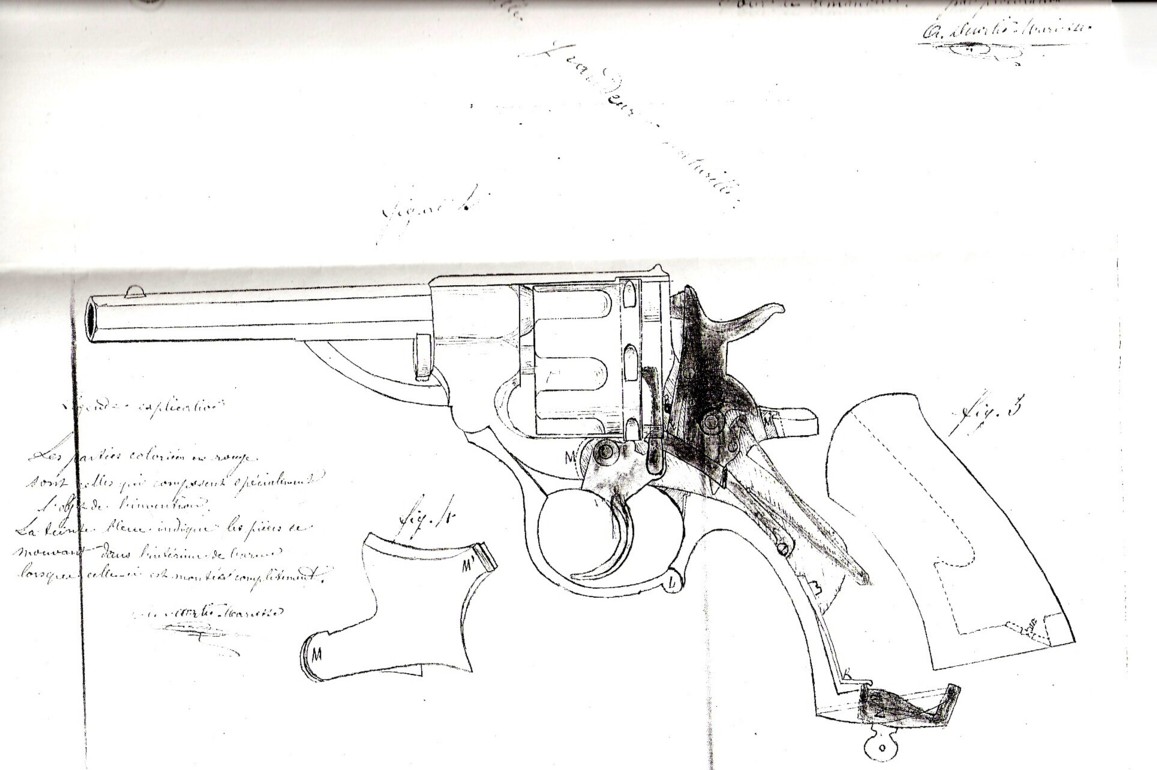
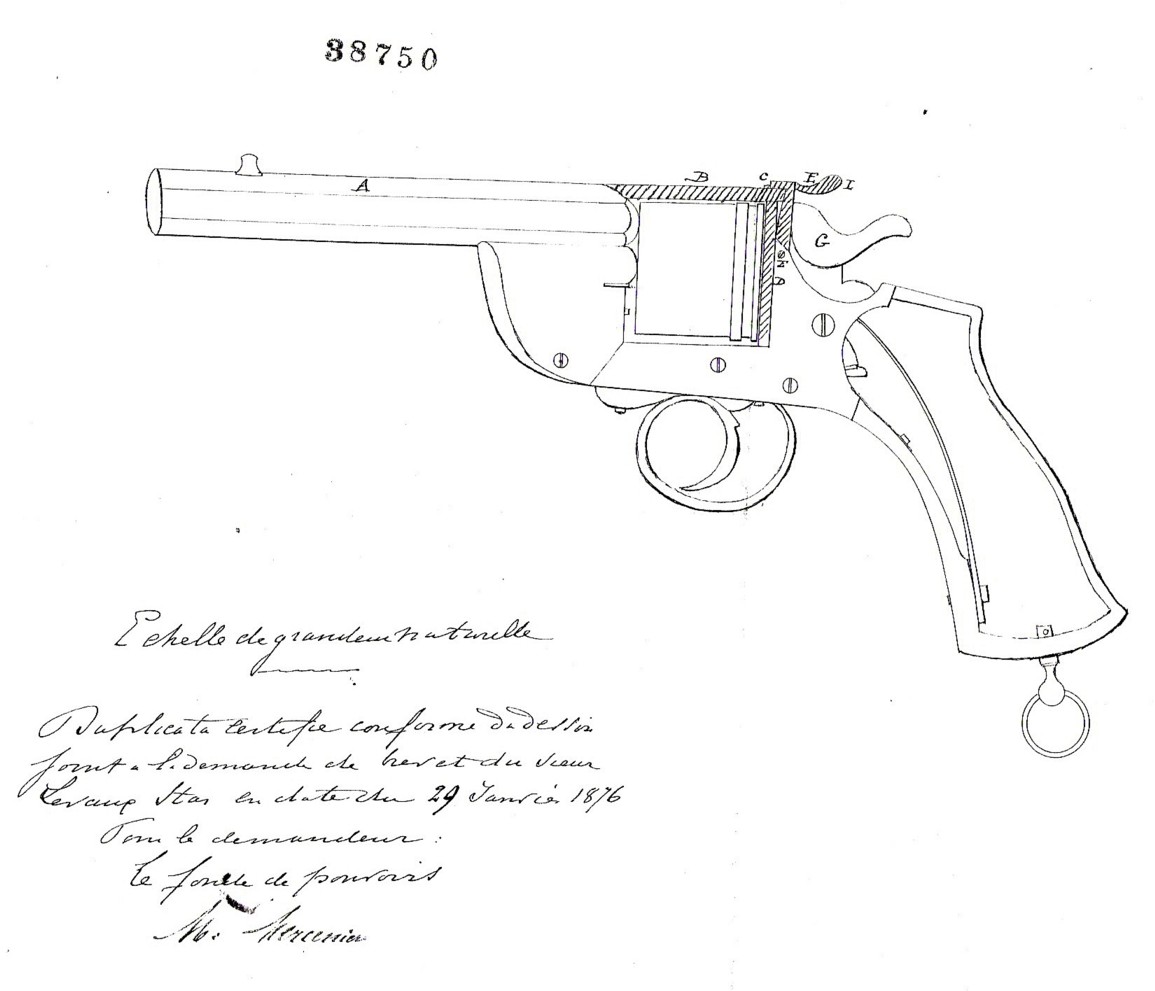
http://www.littlegun.be/arme%20belge/artisans%20identifies%20q%20r/a%20ronge%20gb.htm
And also:
http://www.littlegun.be/arme%20belge/artisans%20identifies%20l/a%20levaux%20gb.htm
And again:
http://littlegun.be/ma_collection/belgique/be%20klmno/a%20be%20mercenier%20g%20gb.htm
where you
can read that other gunsmiths have modified the weapon, such as Scholberg
and Gadet de Liège, for example, who fitted the weapon with a swivelling
cover plate.
The markings
ELG on star
in crowned oval : acceptance, in use between 1893 and 1968;
W under
star: countermark of a controller, in use between 1877 and 1968 ;
R crowned :
rifled bore, in use between 1894 and 1968;
SA crowned:
a mark of the Danish army ;
JBR: the
initials of the manufacturer Jean-Baptiste Rongé.
According to
the link
https://www.tircollection.com/t32493-revolver-marine-danois-mle-1891
, the total
order would have been 2,045 copies, including 600 made by Rongé.
See also the
following description:
http://www.armeetpassion.com/revolverdemarinem1891.html
The photos
do not show that the extractor is not star-shaped but a plate of the same
diameter as the cylinder. In addition, when the weapon is open, the cylinder
can be removed from its axis without tools. According to a German book, the
weapon is based on an idea by Jean Warnant, with a modification by Mariette.
Both pages
in German
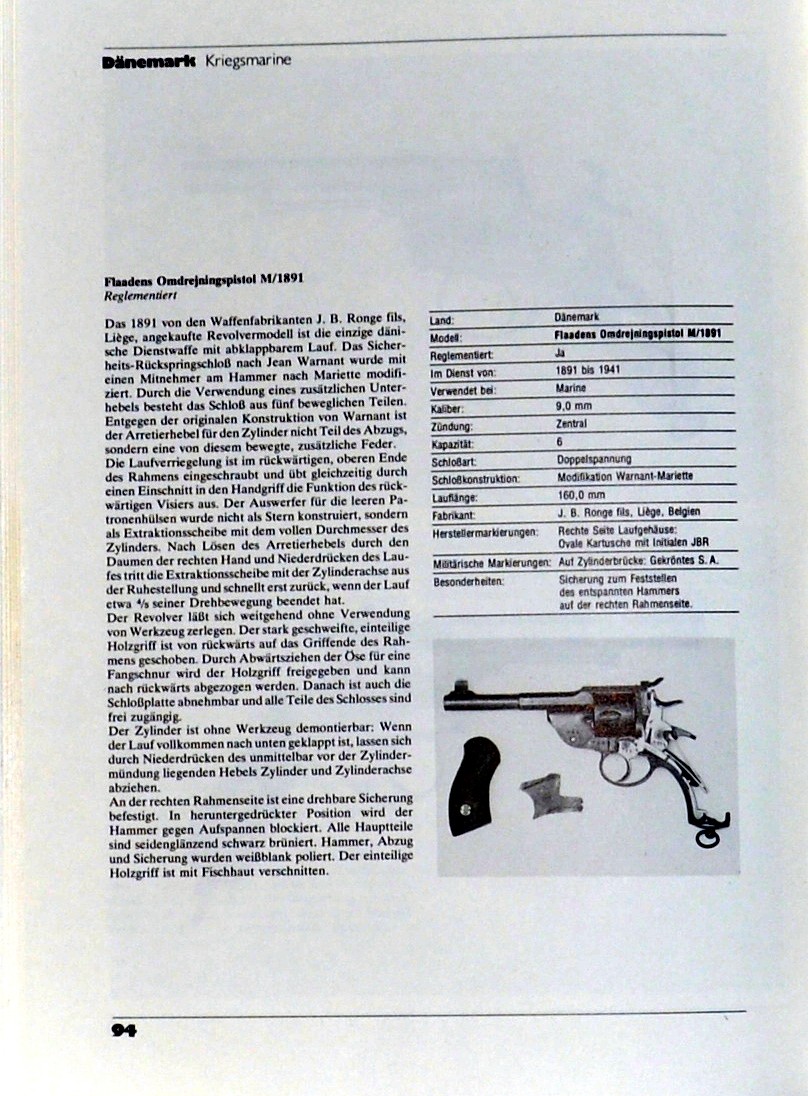
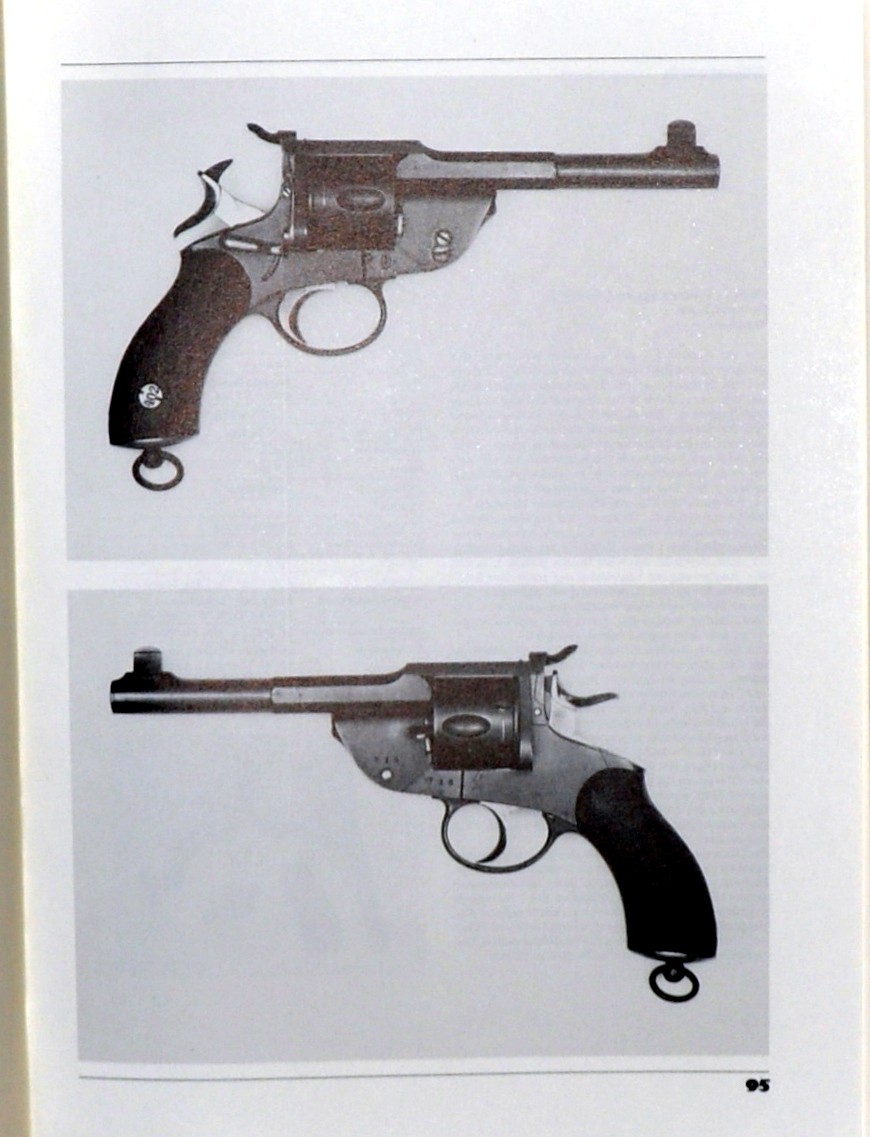
GP with
help of HPH and MD
Identification 3474
Voici un très intéressant fusil à vocation militaire à un coup, semble-t-il basé sur le système Martini, mais avec un chien extérieur. Le chien s’arme lorsqu’on actionne le pontet-levier.
Selon ce qu’on trouve sur la toile concernant ce fusil, il pourrait s’agir d’un fusil d’essai dans le cadre d’un concours destiné à trouver un remplaçant pour le fusil Comblain qui avait été adopté pour la Garde Civique en 1870. On sait qu’en fin de compte, c’est le Comblain 1882 qui l’a remplacé.
Le canon du fusil Dresse-Laloux est en tout cas une copie conforme de celui du Comblain 1870.
On remarque bien sûr le marquage Dresse Laloux & Cie Breveté Liège sur la queue du culasse, ainsi que la marque sur la crosse J. Ancion & Cie 1878.
A propos de ces sociétés, on consultera les liens suivants :
et J. Ancion & Cie
ET
J’ai consulté la liste des 25 brevets répertoriés (il y a déjà un certain temps) déposés par Dresse-Laloux. La seule chose intéressante est le brevet 032202 du 22 mars 1873, qui concerne des modifications apportées aux extracteurs des armes à feu se chargeant par la culasse. Voici le dessin du brevet en question (merci à MD):
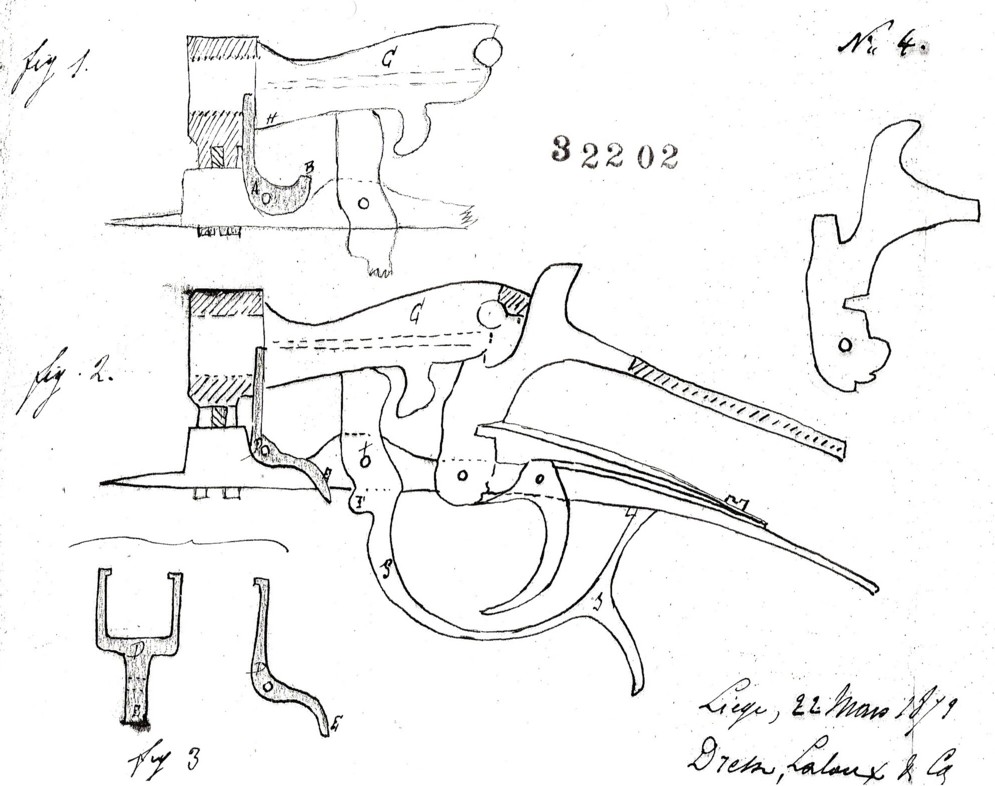
Il serait aussi certainement intéressant de consulter la revue de la Garde Civique « Le Franc-tireur » et la « Revue militaire belge » qui a paru entre 1880 et 1889. Peut-être y a-t-on fait allusion à ces essais de remplacement du Comblain 1870.
Dans la Revue militaire belge (ou est-ce la revue de l’Arme belge ?), troisième trimestre de 1880, à propos d’une exposition qui s’est tenue cette année-là à l’initiative du Syndicat liégeois pour la fabrication des armes de guerre, figure le catalogue des armes exposées. On y trouve ainsi à la page 103 sous le numéro 58 une « carabine avec épée-bayonnette » Dresse-Laloux, et à la page suivante, un mousqueton de cavalerie sous le n° 83, également de Dresse-Laloux. Mais pas de dessin hélas…
Un membre de l’équipe a trouvé le brevet d’une arme assez similaire due aux génies combinés de Malherbe et Salle : voici le brevet 30263 du 21 mars 1872 :
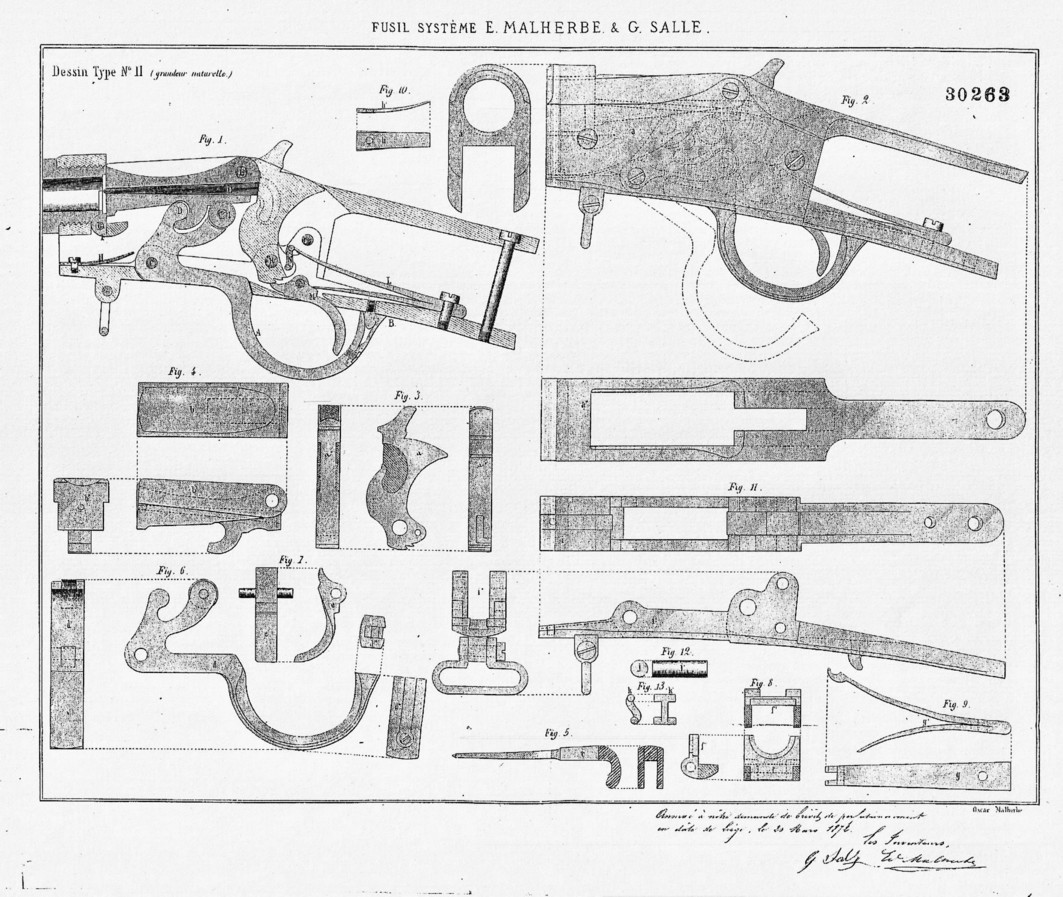
Et voici l’arme en question, qui se trouve dans la collection du Comte de Ribaucourt du War Heritage Institute. Il y a assurément un air de ressemblance, mais je ne crois hélas pas qu’il s’agisse de la même arme :
Il est en tout cas très étonnant qu’il n’y ait AUCUN poinçon (visible) du Banc d’épreuves de Liège NI de la Manufacture d’Armes de l’Etat, organes par lesquels passaient obligatoirement toutes les armes destinées aux forces armées belges. Peut-être y en a-t-il sous le canon?
Signalons enfin qu’il existe au War Heritage Institute un mécanisme Dresse-Laloux qui n’a pas été monté. Il faudrait pouvoir comparer.
GP avec l’aide de HPH, MAX, AD et Paul Dubrunfaut du WHI.
Identification 3476
Here is a revolver of Liège manufacture used by an Italian police force, in this case that of Castellamare di Stabia near Naples. Safety on the left, ejection of the casings by a rod slipped in the axis of the cylinder. Bodeo 10. 4 mm calibre, which has been regulation for decades in the Italian Armed Forces.
The markings
C crowned: the brand of the foundryman or the manufacturer?
R crowned:
punch for rifled barrels, in use between 1894 and 1968
A under star: countermark of a controller between 1877 and 1968
ELG on star in crowned oval: acceptance between 1893 and 1968
I also see initials on the handle on the left side (below the plate) but I can't decipher them.
Brevetto
Baston-Bodeo: Mr. Bodeo is at the origin of the Italian statutory revolver
1889.
As you can
read in the following links, this type of revolver has been used for almost
half a century in several Italian cities and towns.
There are
also examples of Spanish manufacture with "false" Belgian punches....
http://www.littlegun.info/arme%20italienne/ancien%20artisan/a%20baston%20bodeo%20gb.htm
http://www.armicorte.it/2016/10/18/rivoltella-brevetto-baston-bodeo/
GP with the
help of HPH and Alberto Riccadonna
Identification 3477
Here is a
small revolver type Lincoln with five shots in .320, of manufacture of
Liège.
Folding
trigger, ivory or bone stock plates, ejector rod in the axis of the cylnder,
loading through the side door on the right.
Chrome-plated and lightly engraved.
The markings
ELG on star in oval: acceptance between 1846 and 1893
Z under star: countermark of a controller, between 1877 and 1968
611 in an oval: a manufacturing number?
The Paris
Live Protector: a very snoring trademark but not registered in Belgium.
This
revolver was thus manufactured between 1877 and 1893.
GP
Identification 3482
Voici un fusil qui ressemble très fort au modèle 1924 de la Fabrique
nationale d’armes de guerre de Herstal. Calibre non précisé. Cet exemplaire
a fait l’objet d’une « décoration » assez originale sous la forme d’une
ancre.
Les marquages
ELG sur étoile dans ovale couronné : acceptation entre 1893 et 1968
Je crois voir un B dans un cercle ? non identifié
Il me semble voir un poinçon sur le verrou mais la qualité de la photo ne me
permet pas d’être plus explicite.
Il se pourrait qu’il y ait d’autres poinçons sous le canon.
Une ancre d'or incrustée
sur un fusil à vocation militaire incite un membre de l’équipe à penser à
une fantaisie de l'un des propriétaires de l'arme... D'autant que la pièce
sur laquelle elle a été incrustée montre une patine bleue différente du
reste de l'arme. Ce qui est dans un sens logique puisqu’un graveur enlève
cette patine et il doit d'autre part détremper la pièce avant de graver le
sujet.
Cette gravure n’a en
tout cas rien de réglementaire…
GP avec l’aide
de MC.
Identification 3492
Voici un joli petit revolver dans son étui, en calibre .22 short et
plaquettes en os selon son heureux propriétaire, six coups, cadre fermé,
baguette d’éjection dans l’axe du barillet, détente repliable, porte de
chargement à droite, gravures, type Lincoln, comme on en a produit des
milliers à Liège.
Les marquages
ELG dans ovale : acceptation entre 1846 et 1893 ;
U couronné : contremarque d’un contrôleur entre 1853 et
1877 ;
D couronné dans un ovale sous la plaquette gauche : sans
doute la marque du fondeur ou du fabricant, en tout cas non identifié.
Si le canon est rayé, l’arme date d’avant 1894, année d’introduction du
poinçon R couronné apposé sur le canon côté droit.
Mais la « qualité » (= très grossière) des poinçons ELG et U couronné nous « interpelle » comme on dit aujourd’hui : en d’autres termes, nous ne sommes pas du tout convaincus de leur authenticité, que du contraire.
GP avec l’aide d’AD.
Identification 3496
Here is more than likely a flintlock milking rifle of Liège manufacture, relatively short but of strong caliber, a . 92 or 23. 4 mm as indicated on the barrel.
The markings
LLH: Laurent Lochet-Habran, house founded in 1860, see in particular
EL: provisional test, from 1852 to our days;
Perron: inspection, from 1853 to our days;
O under star: countermark of a controller, between 1877 and 1968;
ELG on star in oval (the punch seems to me very new or in any case "different" from those which I saw until now, but I fear that my sight drops seriously......): acceptance, of use between 1846 and 1893;
FC: alas unidentified.
GP
Identification 3499
Here is a beautiful pair of flintlock pistols, one of the barrels of which has a name that could be deciphered as SELIER, preceded by a B?
There is also a crown over what may be a mythical animal with wings whose name escapes me. A griffin maybe?
Various SELIER or SELLIER or even DESELLIER can be found in Paris and Liège in the years 1690-1740. But I'm unable to decide.
GP
You can see in the two pages below the number (9 !!) of Selier, Sellier or Desellier. It is very difficult to know for sure which one is the right one!
A little bit of history.
Belgium has only existed since 1830, before that date it was the favourite terrain of all European wars and conflicts because it is situated approximately in the middle.
Before the revolt of 1830, which created Belgium, we were under Dutch rule, and before that under French rule!
So weapons that were made before 1830 can be considered French, even if they were made in Liège, which is (now) in Belgium.
Alain (Webmaster)
Identification 3500
Here is a
juxtaposed shotgun of English manufacture.
The guns
come from the well-known manufacturer Andrew & C° Ltd Toledo Steel Works
in Sheffield.
See the
site below :
https://www.flickr.com/photos/shefflibraries/6867598556
It is the
same manufacturer who had supplied the barrels of the beautiful rifle of
Fernand Thonon already examined in the notice below :
http://www.littlegun.be/arme%20belge/artisans%20identifies%20t%20w/a%20thonon%20fernand%20gb.htm
It's a
12-gauge.
It was
punched at the London Proof House after 1904 (as a semi-smokeless) and
before 1925.
In the
six-pointed star surmounted by a crown that can be seen on the weapon, one
can distinguish the initials JBR attributable to the belgian manufacturer
Jean-Baptiste Rongé.
http://www.littlegun.be/arme%20belge/artisans%20identifies%20q%20r/a%20ronge%20gb.htm
Although
the initials here are in a star and not an oval, there's almost no doubt
it's Jean-Baptiste Rongé.
"Could it
be a part made in white by Rongé with a specific logo for export" one team
member rightly suggests.
GP with the
help of PHL.
Identification 3504
Here is a classic juxtaposed shotgun of Anson and Deeley type, of manufacture of Liège tested in 1930 and sold by the famous Dutch house Edouard de Beaumont (1841-1895) established at the time in Roermond.
I do not know if the setting with wood is of time, in any case, it is not perfect........
Markings
I: annual letter for 1930
Siemens Martin hammered JF: type of steel used by the gunner Jean Falla
EL: provisional test, in use since 1852
q under star: countermark of a controller, in use between 1877 and 1968
16-70 in omega lying: nominal gauge and length of the casing, in use since 1924
Peron: inspection, in use since 1853
1kg131: weight of the barrel (in use from 1924 to nowadays)
Lion on PV: test with the powder without smoke
ELG on star in crowned oval: acceptance, in use between 1893 and 1968
Choke 16. 9: it means of course that the barrel is choked; in use between 1924 and 1968
JJ in cartridge: ??? that sounds familiar, but ........
According to the other punches, the rifle is proofed by the Czechoslovakian Proof House in Prague.
The house Edouard de Beaumont seems to have been active in Roermond until 1932/33. It was also active in Maastricht for a very long time, at least until 1954.
GP with the help of PHL.
Identification 3511
Here is a very classic Anson and Deeley rifle system made
by Liège, specifically from Emile Warnant, sold by Nicolas Bodson.
Markings
ELG on star in crowned oval: acceptance, between 1893 and
1968;
EL: provisional test, in use since 1852;
Lion on PV: smokeless powder test, in use between 1898
and 1968;
Peron: inspection, in use since 1853;
AB under star: countermark of a controller, in use
between 1877 and 1968;
12 C in diamond: caliber; in use between 1898 and 1924
(June 30);
Choke 17.4 on 18.3 and 17.8 out of 18.3: choked guns in
use between 1910 and 1924 (June 30)
D-65 mm on 20.6: room length in mm and diameter in mm
after optional test with smokeless powder; in use between 1892 and 1924
(June 30);
P 1KG390: weight of the barrel that can shoot smokeless
powders, per gram, in use since 1924 (June 30);
Siemens Martin Steel: the type of steel used
LLH: the initials of gunner Laurent Lochet-Habran
EW under star (and not under crown, as mentioned in the notice below; I concede that the "quality" of the photo is not conducive to immediately distinguishing between a star and a small crown...):
http://www.littlegun.be/arme%20belge/artisans%20identifies%20t%20w/a%20warnant%20emile%20gb.htm
According to a member of the team, the seller of the weapon should be Nicolas Bodson, arquebusier, rue des Prébendiers, 14, in Liège ... around 1920. That's what he found in a phone book.
"There are obviously other N. Bodson referenced in "Who
is who of the Liège Armory," but I think it is a mini-dynasty that traveled
a little in the Amercoeur district between the second half of the 19th
century and the first half of the 20th century," explains the team member.
Observer minds will have noticed that there are contradictions in the punches, three (calibre, room length and chokes) having been in use until June 30, 1924, the fourth (weight) having come into force on June 30, 1924... I don't have an explanation...
Especially since the annual letters were introduced in
1922...
I do not see any.
GP with the help of PHL and GG (†)
Identification 3516
Here is a classic shotgun
with juxtaposed barrels, external hammers and "English" stock.
It dates from between
1910 and 1924.
The barrels are by
Lhermitte and Bruyninckx, but as for the manufacturer......mystery !!.
Markings
ELG on star in crowned
oval: acceptance, of use between 1893 and 1968;
Peron: inspection, of use
since 1853;
Lion on PV: test with the
powder without smoke, of use between 1898 and 1968;
12 C in vertical rhombus:
gauge, between 1898 and 1924;
L under star, x under
star, AV (?) under star: countermarks of controllers, between 1877 and 1968;
EL: provisional test, in
use since 1853;
Choke 17.7 out of 18.3:
choked barrels between 1910 and 1924;
P 1KG232.3: weight of the
barrel, in use between 1892 and 1924;
ACLB in circle:
manufacturer of barrels
Lhermitte and Bruyninckx (it is known that they were active in 1914);
D= 70 out of 20.6: length
of the chamber in mm and diameter in mm after the optional test with
smokeless powder, in use between 1892 and 1924.
GP
Identification 3517
Voici un petit pistolet à percussion de poche, dit « à coffre », fabriqué
par la célébrissime maison liégeoise Auguste Francotte et « fini » par la
maison parisienne Lepage. Crosse en os ou en ivoire qui a connu des jours
meilleurs.
http://www.littlegun.be/arme%20belge/artisans%20identifies%20francotte/a%20francotte%20fr.htm
Il n’y a qu’un marquage, le poinçon ELG sur étoile dans ovale, pour
l’acceptation entre 1818 et 1893.
Il pourrait s’agit de Jean
Lepage, né en 1779 à Paris et mort en 1822.
Ou de la maison Lepage Frères,
évoquée au milieu du texte ci-dessous (très intéressant d’ailleurs).
http://chrisferon.free.fr/blog-articles/paris-ancienne-capitale-armurerie.php
GP
Identification 3518
Voici un revolver dit “bossu” ou Puppy hammerless, barillet et canon bleuis, carcasse jaspée (il y a longtemps…) détente repliable, cinq coups, baguette éjectrice dans l’axe du canon, sûreté à gauche.
Tant à Liège qu’en Espagne, on
a fabriqué une très grande quantité de revolvers de ce type, dans toutes les
qualités et finitions, du meilleur au pire.
Les marquages
ELG sur étoile dans ovale
couronné : acceptation, entre 1893 et 1968 ;
Lion sur PV : épreuve à la
poudre vive, en usage entre 1898 et 1968 ;
J sous étoile : contremarque
d’un contrôleur, entre 1877 et 1968
R couronné : canon rayé, entre
1894 et 1968 ;
7,65 BR retapé sur un autre
marquage : le calibre, donc le 7,65 Browning. La cartouche étant semi-rim,
elle peut être aussi tirée dans un revolver.
Je m’interroge sur ce deuxième marquage : peut-être une erreur au Banc d’épreuves, rectifiée dans la minute ?
Ou l’une ou l’autre
transformation/changement de barillet ?
Il y a aussi un marquage sur
la crosse sous la plaquette, mais je ne peux le déchiffrer et encore moins
l’attribuer.
Je me demande où l’organe de contrôle/banc d’épreuves a été chercher le nom de Janssen & Fils comme fabricant/marque de ce revolver.
Je suppose qu’il a antérieurement enregistré un revolver de ce type marqué Janssen & Fils.
Les armuriers reconnus n’hésitaient en effet pas à faire graver leur nom sur des revolvers de cet acabit.
Cf l’exemplaire signé Cachoir
On remarquera sur la dernière
photo qu’il y a aussi des initiales, du fondeur ou du fabricant.
GP
Identification 3528
Bonjour,
Tout d'abord, je pense que le nom "Cordero" n'est pas un nom de fabricant,
mais plutôt un nom générique, donné
par les Espagnols aux copies de revolvers américains fabriqués de 1916 à
1918 pour les Alliés..
Je ne trouve en tout cas pas trace d'un armurier espagnol de ce nom.
L'appellation complètement fantaisiste "92 espagnol" a été donnée par un
certain Josserand (politicien français ?)
pour regrouper tous les revolvers en calibre 8 mm Lebel comme le St-Etienne
1892.
A noter en passant que le colonel Nicolas Lebel n'a pas non plus inventé le
fusil qui porte son nom, lequel est une évolution des
fusils Kropatchek et Gras, mais en a seulement développé la cartouche. Mais
soit.
En 1915, les troupes françaises et celles du Commonwealth se trouvent
cruellement en manque d'armes de poing, tandis que
leurs fabriques ne parviennent pas à remplir les commandes. La Manufacture
de St-Etienne, par exemple, fait appel à d'autres armuriers
stéphanois pour la fabrication de certaines pièces du 1892, notamment les
canons et les barillets. Ces armes sont reconnaissables au
fait que le canon ne porte pas de millésime et a des poinçons d'épreuve
différents de l'original. On estime le nombre de ces revolvers
à environ 30.000, soit presque 10% de la production totale (330.000 ex entre
1892 et 1924).
Les Français conviennent avec les Espagnols de produire des copies des
revolvers américains Colt Police Positive 1908, Colt Army & Navy
1905 et Smith&Wesson Hand Ejector 2nd Model 1902 chambrés au calibre
standard de 8 mm Lebel.
Les Anglais par contre, qui utilisent le calibre .455 dans leurs revolvers
d'ordonnance, choisissent des copies du Colt New Service 1909 et du S & W
Double Action Topbreak 1st Model..
Ils recevront également de Colt un lot de 107.000 New-Service 1909, version
civile, en calibre .455 d'origine
(Ce calibre n'était pas réglementaire dans l'armée US, mais très populaire
sur le marché civil américain).
Ces revolvers "de dépannage" serviront également dans les armées Roumaine et
Italienne (en cal 10.35 entre autres).
Les armuriers espagnols les plus connus dans ce domaine sont Francisco
Arizmendi y Goenaga (initiales FAG), Garate, Anitua y Cia (GAC),
Orbea Hermanos, Crucelegui Hermanos (CH) et Trocaola, Aranzabal y Cia (TAC),
tous basés à Eibar bien entendu; mais beaucoup de ces
revolvers ne portent pas le nom du fabricant et ne sont donc pas
identifiables. Seul le calibre inhabituel permet de situer la période de
fabrication
sur ces armes livrées à la France: entre fin 1915 et novembre 1918.
Les armes livrées à l'Angleterre portent les poinçons d'épreuve de Londres
ou de Birmingham (épreuve obligatoire de toute arme à feu importée)
et permettent donc une identification plus précise des armes non signées..
J'ignore pourquoi le nom du fabricant est important pour la législation
française en matière d'autorisation de détention, alors que cette
autorisation
dépend surtout du calibre et/ou du genre de munition utilisé (poudre noire
ou nitro), mais je ne peux en dire beaucoup plus. Et comme le revolver
présenté arbore un grand logo commercial ainsi que des initiales dans un
cartouche sur les plaquettes de crosse, je ne vois pas bien le problème.
Marcel
Identification 3529
Lepage (brothers) Henri and Perrin Arquebusiers-fabricants in
Liege, Belgium from 1823-1860.
Then came the arms manufacturers whose warehouse was located
at
12 rue d'Enghien in Paris in 1856.
Personal note: the deposit seems to exist before this date of 1856,
since on the barrel of a revolver model 1854, the LF 272 (of the 2nd half of 1855),
one
can read "Lepage frères, 12 rue d'Enghien in Paris".
(See
on the the very nice site of Guillaume (another collaborator
of Littlegun) :
http://s144812367.onlinehome.fr/la-maison-lepage-freres-lepage-chauvot-successeurs
Here is a revolver for pinfire
cartridges of unspecified caliber which was of beautiful invoice.
The barrel is extended by a part ending in "u" to ensure
its attachment to the frame by means of two screws.
On the
barrel one deciphers (with difficulty) Fabrique Lepage Frères in Paris rue
d'Enghien 12.
See on this
subject :
http://www.littlegun.be/arme%20belge/artisans%20identifies%20l/a%20lepage%20freres%20gb.htm
The
markings :
AJ
under crown: not identified
EL
under crown: the factory of E. Lefaucheux located in Liege;
ELG
on star in oval: acceptance between 1846 and 1893;
G
under crown: countermark of a controller between 1853 and 1877.
I admit
that I don't see very well the link between the Lepage Frères factory in
Paris and the Lefaucheux factory in Liège......
GP with the
help of HPH
Identification 3530
Voici une très classique carabine pliante système Leclercq,
vraisemblablement de Léon Leclercq, actif entre 1908 et 1940 (Cf LL
couronné).
Voir surtout le catalogue à la fin de la
rubrique :
http://www.littlegun.be/arme%20belge/artisans%20identifies%20l/a%20leclercq%20leon%20fr.htm
Les marquages
FL n°3 : le type de munition pour lequel l’arme a été construite, en l’occurrence le 6 mm à tête pointue « de précision », ainsi qu’il appert du document (allemand) figurant dans le lien ci-après ; mais le propriétaire affirme que le diamètre intérieur du canon fait 8mm…
http://www.littlegun.info/arme%20francaise/artisans%20e%20f%20g%20h%20i%20j/a%20flobert%20fr.htm
H sous étoile : contremarque d’un contrôleur, depuis 1877 ;
Perron : inspection depuis 1853 ;
ELG sur étoile dans ovale couronné : acceptation depuis
1893.
Il faut toutefois être prudent à propos des fusils/carabines « système
Leclercq » : on n’a jusqu’à présent pas encore pu déterminer avec précision
QUI est l’inventeur de ce système, du fait qu’on n’a pas – encore – trouvé
le brevet qui s’y rapporte.
Mais
1° l'Office de la Propriété industrielle a "perdu" des brevets, pour des
causes diverses et variées ;
2° tout le monde n'a pas l'intelligence, le temps, l'argent, la présence
d'esprit de déposer un brevet ;
3° il n’existe donc peut-être pas de brevet pour ce « système Leclercq ».
Toujours est-il que des milliers d’armes relevant du « système Leclercq » ont été produites, dans une multitude de calibres, avec des crosses pleines ou évidées.
Et Léon Leclercq en a donc aussi vendu, cf. son catalogue.
Il y a les initiales LL sur cette carabine, mais est-ce bien lui ?
C’est possible, mais pas certain.
GP avec l’aide de HPH et PHL.
Identification 3532
Here is a
magnificent juxtaposed shotgun with locks from Nicolas Lajot & Cie, engraved
by B. Gillet.
markings:
Peron:
inspection, since 1853;
Lion on PV:
test with the powder without smoke, in force since 1898;
ELG on star
in crowned oval: acceptance, since 1893;
16-70 in
omega lying: nominal gauge and length of the casing, in force since 1924;
B under
star: countermark of a controller: it acts perhaps of Charles Roland, active
with the proofhouse of Liege between 1927 and 1959;
1kg195:
weight of the barrel, in force since 1924;
X: annal
letter for 1945
JF: almost
certainly the initials of the gunner Jean Falla S. A. ;
17. 1 choke 16. 9: choked barrels, in force since 1924;
BF: not
identified
Concerning
Nicolas Lajot &Co, see :
And
http://www.littlegun.be/arme%20belge/artisans%20identifies%20l/a%20lajot%20gb.htm
The
engraver is B. Gillet.
Unfortunately, we didn't find anything on him.
GP
with the help of HPH.
Identification 3533
Voici un pistolet à percussion à coffre de fabrication liégeoise, avec canon octogonal en acier (env. 13,2 mm de diamètre),
baguette à bascule et bâti en bronze,
marqué JAP, plus que vraisemblablement les initiales de J. Auguste Petry, actif à Liège entre 1842 et 1867.
Voir http://www.littlegun.be/arme%20belge/artisans%20identifies%20p/a%20petry%20j%20a%20fr.htm
Les marquages
ELG sur étoile dans
ovale : acceptation entre 1846 et 1893 ;
D sous couronne :
contremarque d’un contrôleur, entre 1853 et 1877.
GP avec HPH
Identification 3534
Here is a shotgun
juxtaposed with external hammers, back plates, key of opening between the
hammers, of manufacture of Liège and charged with American history.
The barrels seem very
short and look more like a "coach gun" to me.
Markings :
Peron:
inspection since 1853;
crowned ELG:
acceptance since 1893
12-65 in omega
lying: nominal gauge and length of the casing, since 1924
Y under star:
countermark of a controller, since 1877
EL:
provisional test, since 1852
18. 3:
gauge in mm
Choke 16.2:
choke barrel
D crowned: more than likely the manufacturer of barrel Delcour
HJA: it could be the Workshops Jacquemart in Herstal, but it is not sure at all because they were active between 1943 and 1952 then under another denomination until 1966.
However, as we will see
later, this does not fit the story of the Miller Brothers 101 Ranch and its
great show in which Buffalo Bill participated.
But first, let's locate
Ponca City, in northern Oklahoma:
https://en.wikipedia.org/wiki/Ponca_City,_Oklahoma
The history of this city
is intimately linked to the Miller Brothers and their huge ranch and also
their 101 Ranch Wild West Show very active between 1907 and 1927:
https://en.wikipedia.org/wiki/Miller_Brothers_101_Ranch
In any case, this rifle, which has suffered the outrages of time, must date from this period and even more precisely from the end since it is after 1924.
Unless it belonged to a
member of the show who "embellished" his rifle as a souvenir.
What is in any case very
surprising is the absence of an annals date (at least as seen from
here.....): now, we know that the Belgian proofhouse introduced the annals
letters in 1922.
GP with the help
of PHL and AD.
Identification 3535
Here is a classic revolver known as Montenegrin from the factory of Max Fliegenschmidt in Liege. He had better days, a long time ago of course. But what is very rare is the case that comes with it. Too bad there's no picture of the whole gun on the left side.
The caliber appears to be 11 mm.
I don't have much to add
to what is already on the website Littlegun :
http://www.littlegun.be/arme%20belge/artisans%20identifies%20e%20f/a%20fliegenshmidt%20gb.htm
So this is the long
barrel version.
The weapon is former to
1893 since the punch of acceptance ELG on star in an oval is not crowned.
We also see a "NI" in
front of the sights, for Nikita I, the king of Montenegro who obliged his
male subjects to have a revolver.....
See also :
http://www.littlegun.be/arme%20belge/artisans%20identifies%20b/a%20bertrand%20antoine%20gb.htm
GP and HPH
Identification 3536
Here is a very classic shotgun juxtaposed with external hammers and key of opening known as Lefaucheux, produced by the Manufacture Liégeoise d'Armes à Feu Société anonyme.
Markings
ELG on star in crowned oval: acceptance since 1893;
Peron: inspection since 1853;
16 C in vertical rhombus: calibre, between 1898 and 1924;
EL: provisional test since 1852;
16. 8: calibre in mm (since 1889);
j under star: countermark of an inspector, since 1877;
Concerning this well-known Manufacture, see the two links below:
and in a more general way:
GP and HPH
Identification 3539
Iden 3539 fusil de chasse deux paires de canons H. Sauveur
Voici un très beau fusil de chasse à platines et à deux paires de canons de
la société Henri Sauveur :
http://littlegun.be/arme%20belge/artisans%20identifies%20s/a%20sauveur%20fr.htm
Une arme similaire
figure dans un catalogue de la maison Sauveur de 1928, avec une autre
gravure. Nous n’avons malheureusement rien trouvé sur le graveur N.
Demarteau. Certes, le nom est bien connu, mais il se rapporte à des graveurs
de la fin du XVIIIe siècle…
Les deux paires de
canons ont été éprouvées à Liège et à Ferlach en Autriche.
A propos de la
cartouche .405, j’ai trouvé ceci
https://www.chassons.com/modele/kynoch-405-winchester-centre-fire-demi-blindee-tete-ronde/
Quant à la
cartouche de 8x60 RS :
https://fr.wikipedia.org/wiki/8_×_60_mm_S
qui indique un
poids de 11,7 gr.
Une des paires
vient de Jean Falla, fabricant d’armes et de canons à Liège, rue Bonne
Nouvelle 35. Il utilisait notamment la marque déposée et gravée à la molette
« tête d’aigle – Acier comprimé CAP JF », acier de haute résistance
permettant la fabrication de canons extra-légers.
http://littlegun.be/arme%20belge/artisans%20identifies%20e%20f/a%20falla%20fr.htm
et l’autre de CAP Joseph, fabricant de canons de fusils rue Jonruelle 62 à
Liège
http://littlegun.be/arme%20belge/artisans%20identifies%20c/a%20cap%20joseph%20fr.htm
On a une paire de
canons avec lettre annale "h" pour 1929 et une autre paire avec lettre
annale "m" pour 1934 qui a été également éprouvée à Ferlach en Autriche. On
peut soit penser que les .405 n’étant pas faciles à trouver en Autriche, une
paire de canons en 8 x 60 (sans doute RS) ... a été réalisée, soit que
l’heureux propriétaire voulait aussi tirer un autre type de gibier.
Quant à la
cartouche de 8x60 RS :
https://fr.wikipedia.org/wiki/8_×_60_mm_S
qui indique un
poids de 11,7 gr.
GP avec HPH et PHL
Identification 3543
Here is a pinfire revolver of undisclosed caliber (9 mm ?), marked Hill London on the barrel.
The Stockel mentions a
John Hill active in London (Tooley Street 76, gun and pistol maker according
to a 1843 postal directory) between 1822 and 1856, which could correspond.
This John Hill was in
fact a manufacturer in Birmingham and also active in cutlery, especially
bayonets:
https://collegehillarsenal.com/british-rifle-socket-bayonet-by-hill-c1820
As for the
manufacturer.......
There are many initials:
DAF crowned, LG, TD under the stock plates, probably foundry marks.
I agree with other
members of the team who favour a Birmingham punch on the barrel between each
chamber and on the right side of the carcass near the hammer screw.
GP with HPH and PHL
Identification 3544
Here is a very
traditional revolver of type bull dog (but with ring of cap) of manufacture
of Liège (Albert Simonis), which knew better days.....
Five shots, misses the rod of ejection of the casings. And presumably the trigger return spring.
Markings
ELG on star in crowned
oval: acceptance since 1893
R crowned: rifled bore,
since 1894
? under star: not
identified fatally....
C crowned: I am
astonished to find a letter crowned with what should be the countermark of a
controller, given that one passed in 1877 from crown countermarks to
countermarks under star....however, the revolver is well after 1893
(acceptance stamp) and even 1894 see below.
JG and H under the right
plate: undoubtedly marks of foundryman(s)?
British Boxer: trademark registered by Albert Simonis, rue Trappé in Liège, March 24, 1894.
Albert Simonis was
enrolled in the Belgian proofhouse from 1873 to 1900.
Between "British" and
"Boxer" there is also an inscription, : Jacques ???? Liège : not identified.
GP with the help of HPH
Identification 3545
Here is
what I think may have been a coach rifle given its small size with an
overall length of 76 cm and a barrel length of 38 cm.
This is the third copy I've seen. One of them even bears a famous signature as it is Michel Berleur de Liège.
See the
photos on the site:
http://littlegun.be/arme%20belge/artisans%20identifies%20b/a%20berleur%20gb.htm
(Note that
there are differences between the 1793 Versailles cavalry rifle and the
three examples I saw, but that's another story).
Moreover, the dimensions of the Berleur rifle are almost identical to those of the specimen presented here (the internal diameter of the cannon is, however, a little smaller, of 15 mm). Also with the same tilting wand.
Even a
bridge.
Here, the
octagonal cannon is 16/18 mm; it was probably originally scratched since
there is a two-leaf rise (like that of Berleur).
No
signature here: you can see “something” (two initials?) on the locks, but
it’s not decipherable (for my old eyes anyway). There’s a 2 on the stock,
but I don’t see the meaning....
GP
Identification 3546
Voici un fusil de chasse
juxtaposé pour cartouches à broche, platines arrière, avec la classique clé
de fermeture type Lefaucheux.
Sur la bande, on peut lire Jh Julien fabt d’armes bté à Liège, soit vraisemblablement Joseph Julien, rue Nagelmackers 3 (1865-1876), qui a déposé cinq brevets.
Mais il se pourrait aussi qu’il s’agit de Joseph Julien dit Deboor, fabricant d’armes à Liège et inscrit au Banc d’Epreuves entre 1860 et 1881, qui a aussi déposé des brevets.
De sorte que tous les deux
peuvent s’affubler de la mention « breveté ».
La « décoration » en losanges
n’est absolument pas dans le style de l’époque : elle est quasi certainement
postérieure à la fabrication, d’autant qu’elle me semble être superposée à
une plus ancienne, fort effacée.
Il n’y a comme marquage que le EL pour l’épreuve provisoire (en usage depuis 1852).
Et un 14.6.
Dans un premier temps, je pensais qu’il s’agissait du diamètre des canons, ce qui correspondrait plus ou moins à un calibre 28 qui fait 14,4.
Mais l’heureux propriétaire a mesuré environ 16 mm.
Donc mystère.
Quant Albert Bernard, le « Qui
est qui de l’armurerie liégeoise » mentionne un A. Bernard qui a déposé en
1855 un brevet belge pour un nouveau damas... ce qui ne veut pas dire pour
autant que les canons soient en damas et relèvent dudit brevet…
On voit aussi les initiales
AJD qui pourraient correspondre à Antoine Joseph Defourny, mais comme il a
été actif à partir de 1894, soit à une période bien postérieure à Joseph
Julien et aux cartouches à broche, c’est à écarter.
Donc beaucoup de mystères
demeurent…
GP
Identification 3547
Here is a
rifle Martiny 1885 which passed by at least two test benches, that of Liege
and a British one.
Why?
Mystery....
The
markings of Liège :
ELG
on star in oval: acceptance between 1846 and 1893;
Peron: inspection since 1853;
T
under star: countermark of a controller between 1877 and 1968;
EL:
provisional test since 1852;
11.
4: undoubtedly the calibre in mm;
CW:
unknown.
The punch P
under the two crossed flags is that of the first proof, the punch 2P under
the two crossed flags is of course that of the second proof.
As can be
seen on the attached site, there may still be other punches that can be
spotted on the stock and on the metal part finishing the barrel:
https://www. tircollection. com/t36436-martini-henry-mkii-1885
GP with the
help of PHL and the whole team.
Identification 3548
Voici un revolver bien marqué Chamelot-Delvigne mod 1862 dit « de gaucher » parce que la portière de chargement est à gauche de l’arme, alors que l’immense majorité des revolvers ont leur porte à droite.
La portière à gauche est
pourtant bien plus logique (pour un droitier bien sûr…).
Les marquages
EL couronné :
quasi avec certitude Eugène Lefaucheux et sa fabrique liégeoise
ELG sur étoile :
acceptation entre 1846 et 1893
V couronné :
contremarque d’un contrôleur, entre 1853 et 1877.
On trouvera aussi des données
très intéressantes dans les deux liens ci-dessous.
http://www.littlegun.info/arme%20francaise/artisans%20c%20d/a%20chamelot%20et%20delvigne%20fr.htm
GP
Le spécialiste des armes
suisses nous signale aussi ceci :
À ma connaissance ces pièces
ne recevaient pas de poinçon militaire, si ce n’est peut-être le poinçon
cantonal.
Je crois savoir qu’un revolver
identique à la recherche existe ou à exister au musée de Berne sous le
numéro 482.
Ce revolver aurait été
fabriqué par les sieurs Pirlot-Frères en respectant le
brevet déposé par Chamelot-Delvigne.
Max.
Identification 3550
Here is a shotgun juxtaposed
with external hammers, front plates, marked Enterprise MFG, which seems to
me to be a copy of a weapon presented on the site littlegun. be, namely a
rifle of Henri Pieper under the name Eclipse Gun Cy, company created in 1896
only for export to the United States.
Markings
Laminated steel Belgium: type of steel used;
ELG
on star in crowned oval: acceptance between 1893 and 1968
Perron: inspection since 1853;
H
under star: countermark of a controller since 1877;
12
C in vertical rhombus: gauge between 1898 and 1924;
EL:
provisional test since 1853;
Enterprise MFG of Philadelphia, Pennsylvania, was a very large company selling anything and everything (many metal items) in the second half of the 19th century and the first half of the 20th;
it can be assumed that it entered into a commercial agreement with Henri Pieper to sell rifles made by Pieper similar to those of the Eclipse company, but under his name.
The weapon must thus date from
between 1898 and 1914.
Concerning the Pieper dynasty
and their weapons, see of course " Bayard, les hommes, les armes et les
machines du Chevalier, Pieper & Cie, 1859-1957" by Michel Druart.
Here in any
case a "real" Pieper of Eclipse Gun Cy:
GP
Identification 3557
Voici un fusil juxtaposé, semble-t-il à platines, chiens extérieurs, crosse anglaise, de fabrication belge, en principe fabriqué avant 1922 (étant donné l’absence de lette annale, photographiée en tout cas)
mais rééprouvé en 1951 en Italie.
L’absence et les
anomalies de certains poinçons sont pour le moins étranges.
Les marquages
Acier Cockerill extra
fin sur la bande entre les canons : le type d’acier utilisé ;
Lion sur PV :
épreuve à la poudre vive, en usage depuis 1898 ;
18,2 :
diamètre en mm (correspondant à un calibre 12), en usage depuis 1889 ;
Perron :
inspection depuis 1853 ;
P sous étoile :
contremarque d’un contrôleur après 1877 ; MAIS l’étoile est
beaucoup plus grosse qu’habituellement sur les armes éprouvées à Liège ;
K 1,360 :
poids du canon ; en principe, on aurait dû lire 1K360…
PSF sous étoile dans
cercle : poinçon italien, très vraisemblablement pour poudre sans
fumée ;
FINITO 1951 :
poinçon italien en vigueur après 1950, en l’occurrence frappé en 1951.
MAIS : je suis très surpris de l’absence d’un ELG sur étoile dans ovale, en principe couronné. Ou bien a-t-il échappé à l’appareil photo de l’heureux propriétaire.
Idem de la mention du calibre,
obligatoire depuis 1898.
Or, il y a bien un poinçon
post 1898 (lion sur PV).
Si ce fusil pouvait parler…
GP
Identification 3561
Here is a
beautifully engraved shotgun with lock, English stock, sold by De Brauwer in
Ghent.
I found the
trace of a Widow De Brauwer, Government Street 7 in Ghent in a 1914
directory (but not in another one of 1911...).
Markings
ELG
on star in crowned oval: acceptance, of use between 1893 and 1968;
UA
and M under star: countermarks of controllers, between 1877 and
1968;
Peron: inspection, of use since 1853;
EL:
provisional test, of use since 1853;
12
C in vertical rhombus: indication of the gauge, of use between 1898
and 1924;
CHOKE 18. 3: choked barrel, of use between 1898 and 1910;
JH
(?): unidentified;
GHK
1926: probably the initials of one of the owners and the year of
purchase?
In spite of
the presence of the mention of the year 1926, this rifle was probably
manufactured BEFORE 1922, when the Proofhouse of Liege introduced the annals
letters.
In
principle, it was made between 1898 and 1910, according to the mention of
the choke 18. 3.
But there
is a "problem" since the De Brauwer house is not in the 1911 directory, but
in the 1914 one, as a Widow....
Mysteries!!!
Which does
not take anything away from the quality of the rifle.
GP
Identification 3570
Voici un pistolet à percussion avec les initiales AF couronnées à l’intérieur de la platine, donc plus que vraisemblablement une production de la célèbre maison Auguste Francotte.
Crosse Renaissance, canon à huit rayures profondes, platine avant, pontet avec repose-doigt.
On est sans doute dans les
débuts des armes à percussion puisque la cheminée est placée sur une
masselotte donnant accès à la lumière.
Je ne vois aucun poinçon du
Banc d’Epreuves de Liège.
GP
Identification 3571
Here is a
classic juxtaposed Anson & Deeley with locks made from Liège (1930)
undetermined, tested also at the proofhouse in London.
Marking
ELG on star in crowned oval: acceptance, in use since 1893;
Lion on PV: smoke-free powder test, in use since 1898;
12-70 in
omega coated: nominal size and length of the munition, in use since 1924;
S under star: countermark of a controller,
Choke 18.
4: choked barrel
Peron:
inspection, in use since 1853;
"i" :
annual letter for 1930;
half-block
acier à haute résistance : type of steel used;
CP crowned: London punch, as well as the following
12 in diamond: the caliber;
2 3⁄4: the length of the chamber (70 mm);
NP: Powder proof;
3 1⁄4 tones: I presume pressure.
GP
Identification 3578
Here is a very little known pistol, produced by Auguste Francotte in calibre 6,35 Browning a little before the 1st GM. It is taken up in Zhuk's book p 181, which places him around 1912-1914. Another specimen is already on the site, complete with its grips plates and punches.
On this
one, there is no punch visible on the pictures provided (even if I seem to
see an A on the left side of the barrel, just before a little rust...).
What
strikes you most is of course the single stamped plate of grips.
Why the
presence of a number but the absence of punches and this single plate?.
Personally, I lean towards a weapon of manufacture in August 1914, already
provided with a number of manufacture but not completed and thus not
presented at the Proofhouse of Liege, which was carried by a workman of
Francotte at the first hours of the 1st GM.
How did he get to the States? Who made this stamped plate? Was the second one lost over the years? Mystery. All the theories are plausible.....
I wonder
especially who is the inventor of this pistol, whose principal external
characteristic, as underlined in the already existing leaflet, is the
presence of the gripping grooves of the breech at the front (it is besides
very well seen because it facilitates the gripping of the aforementioned
breech...).
Indeed, I do not find any patent of Auguste Francotte concerning such a pistol (as far as he considered useful to register one...). Maybe he bought someone else's patent. Moreover, there is no mention "Francotte patent" on the other copy already examined.
The lucky
owner mentions other examples he has had the opportunity to see. Does he
have the serial numbers?
GP and the
whole team.
Identification 3579
Here is a very traditional revolver type "bulldog" of manufacture of Liège, marked "The American Bullock" (bullock being a young bull, castrated or not according to the countries).
Closed
frame, six shots, calibre 9 mm; the plates are not original.
Cylinder
ejector rod in the cylinder axis.
Markings
ELG on star in crowned oval: acceptance since 1893;
E
under star: countermark of a controller, in use since 1877;
R
under crown: rifled bore since 1894.
I spotted a
similar revolver with the same trade mark:
https://www.gn.no/vapen-plombert/lommerevolver-american-bullock
In spite of
my research, I did not find this mark, well in the style of the "snoring"
marks of Bertrand and other Riga in the
years 1885-1888.
There is
also Louis Clément who registered the trademark "The
English Bullock" on October 16, 1895....
GP
Identification 3581
Here is an interesting flintlock pistol mentioning on the lock the name of Florkin in Liege.
There are also initials on the barrel, which could - at first - be attributed to Alonso Martinez, who was active in Barcelona and Madrid at the beginning of the 18th century.
Der Neue Stockel mentions three Florkins that may be of interest to us:
Godefroid around 1734, probably associated with Jean David Florkin.
And there is also Jean Florkin around 1724. All three supplied arms to the Austrian army in Holland (dixit Stockel).
As for the
barrel which thus carries a hallmark that, initially, one could attribute to
Alonso Martinez (active in Madrid between 1691 and 1730); Stockel points out
(page 766) that precisely the hallmark which appears on this barrel is
undoubtedly a contemporary forgery....
Claude Gaier (Cinq siècles d'armurerie liégeoise, which includes three photos of weapons from the Florkin dynasty) writes that at that time, it was not uncommon for cannons to be imported and mounted in Liege.
As they say
in these cases, an interesting topic of conversation....
GP
Identification 3584
Here is a
juxtaposed shotgun of Liège manufacture (undoubtedly the second of a pair
since one sees a 2 on the opening key), passed by the Proofhouse of Liège
and that of Vienna, and sold by a arms manufacturer of Bratislava, Jozsef
Seifert.
At first
glance, the weapon has a great family resemblance with the rifle "Le
Rationnel" (mark registered by Henri Pieper on November 16, 1896, whereas
the rifle already existed in 1894). Not only by the (hard) arming lever of
the firing pin on the left of the weapon, but also by the manufacture of the
barrels (see Michel Druart's book: Bayard Les hommes, les armes et les
machines du Chevalier, Pieper & Cie, 1859-1957). It is probably a copy made
after the expiry of the patent, probably filed around 1893/94.
Markings
ELG on star
in crowned oval: acceptance, after 1893;
16 on C in
vertical rhombus: the calibre, in use between 1898 and 1924;
Peron:
inspection, as from 1893;
EL:
provisional test, as from 1852;
D=65 mm out
of 18. 7: length of the chamber in mm and diameter, between 1892 and 1924;
P 1KG457.
7: weight of the barrel, between 1892 and 1924;
Lion on
SCH: optional test with powder without smoke, as from 1891;
X under
star: countermark of a controller, in use since 1877;
JC: it
could be the gunner Joseph Cap, active at the beginning of the XXe century;
NPv: punch
of the Proofhouse of Vienna; there is also another punch of an eagle with
the large spread wings which I did not identify: it resembles an Austrian
punch for the control of the ammunition;
AP: not
identified;
I do not
see an annual letter: the weapon thus probably dates from between 1913/14
(ten years after the deposit of the patent) and 1921, the annual letters
having been introduced in 1922 (I do not know at which precise date).
GP with MD
and MAX
Identification 3585
This is a
very classic pinfire revolver in 7 mm calibre.
Undoubtedly
of manufacture of Liège, although not having punches of the Proof House of
Liège, but of Birmingham, twice under the barrel and on the cylinder.
That makes
it possible to date the weapon between 1856 and 1904.
The weapons
manufactured in Liege but intended directly for a country having one (or
more) recognized proofhouse(s) were indeed exempted from a passage to the
proofhouse of Liege.
The initials
JMJF are unknown to me.
GP
with the help of MC.
On the circumference of the cylinder, the punch is
an English Birmingham punch in use from 1813 to 1904 (two crossed sceptres
with the letters B, C and P and a crown above). I can't quite see, but it
may be that this punch is the controller's, in which case the letters BCP
are replaced by a single crowned V for "verified" between the two lower
parts of the cross sceptres. Normally both punches should appear on the
weapon. If this revolver was manufactured in Liege, it is quite possible
that it did not undergo the Proof House test, because of the law that
exempted from the Belgian test weapons intended for direct export to a
country whose testing methods were deemed acceptable by the Proof House in
Liege.
Marcel
Identification 3586
Voici une belle (et lourde)
carabine de tir, fin XIXe début XXe, de fabrication liégeoise (sans doute
René Warnant), à culasse courte. Calibre 6 mm Flobert (percussion
annulaire). Hausse et guidon réglables.
Les marquages
R couronné :
canon rayé, en usage depuis 1894 ;
AL sous étoile :
contremarque d’un contrôleur depuis 1877
Perron :inspection,
depuis 1853 ;
ELG sur étoile dans
ovale couronné : acceptation, depuis 1893 ;
FL 6 m : le
calibre, 6 mm à percussion annulaire ;
AE : non
identifié
LLH : Laurent
Lochet-Habran, fabricant de canons, maison fondée en 1860, actif jusqu’au
début du XXe siècle
RW : il
s’agit sans doute de René Warnant, inscrit au Banc d’Epreuves de Liège de
191 à 1956.
GP
Identification 3590
Les marquages
ELG sur étoile dans
ovale couronné : acceptation depuis 1893 ;
32-65 dans oméga
couché : calibre nominal et longueur de la douille, depuis 1924 ;
A sous étoile :
contremarque d’un contrôleur, depuis 1877 ;
EL : épreuve
provisoire, depuis 1852 ;
D sous petite couronne
( ?) : non identifié ;
12.8 :
calibre en mm, depuis 1889 ;
L.G 15 : non
identifié ;
Perron :
inspection, depuis 1853.
L’absence de lettre annale
(elles ont été introduites en 1922) m’étonne.
On voit du côté droit les mentions suivantes : A
Espingarda Mineira (l’armurerie)
Edmundo Machado (le gérant)
Rua 7 de Setembro n°... Rio de Janeiro l’adresse.
GP avec l’aide de PHL.
Identification 3591
Here is a beautiful juxtaposed rifle with Anson-Deeley system locks, English stock, nice floral engravings.
he markings
q
: annual letter of 1938 ;
P
under star: punch of a controller ? But it is attributed to Adolphe
Delcommune, active at the proofhouse from 1952 to 1960, which does not
correspond to the 1938 annal letter;
Lion on PV: test with smokeless powder, since 1898;
Peron: inspection, since 1853;
V
under star (?): punch of a controller: it could be Isidor Maçon,
which exerted between 1929 and 1953;
EL:
provisional test, since 1852;
ELG
on star in crowned oval: acceptance, since 1893;
12-70 in omega lying: nominal gauge and length of the casing, since
1924;
1kg343: weight of the barrels, since 1924;
Compressed steel: type of steel used.
EW under star: unidentified; it could be Ernest Wilmart, “fine weapons” according to one of his advertisements, registered on the proofhouse of Liège from 1931 to 1943;
these dates
correspond in any case to the annual letter of 1938;
JM in oval: it could be the initials of Joseph Charles Monisse, rue Renardi in Liège, registered on the proofhouse from 1922 to 1951;
after 1951,
he continued his trade as a craftsman; but the members of the team point out
to me that initials in an oval are “rather” initials of gunnery...
GP and the whole team
More information on Mr Monisse.
On October
31, 1898, he successfully filed a patent with us under No. 138 839 on the
subject of “a further development of ejectors for shotguns.
To be seen
in attachments
Max.
Identification 3594
Here is a Liège copy of a Smith & Wesson revolver (Fourth Model?) of the late nineteenth/early twentieth century.
This copy is in any case after 1894.
Five shots, calibre not specified (probably a . 38/. 380).
No signature, which is hardly surprising on a weapon of
this "quality".
Markings
ELG on star in crowned oval: acceptance,
since July 11, 1893
R crowned: rifled bore, since January
30, 1894;
Y under star: countermark of a
controller, since July 27, 1877;
C under crown: unidentified;
One sees under the plates of the initials JT and JC which
are undoubtedly those of founders or subcontractors.
GP
Identification 3595
Here is what
seems to me to be a "composite" rifle (not to say "milking rifle"), made up
of various and varied elements....including a lock signed P. J. Malherbe.
The stock
certainly does not date from the first half of the 19th century...
There could
be punches on or under the barrel.
There's been
a lot of Malherbe.
This PJ
Malherbe was registered at the proofhouse of Liège from 1836 to 1850 (which
corresponds to the lock).
It was
established at 25 quai Saint Léonard in Liège.
See Malherbe P. J. for see "real" Malherbe.
Really sorry
for your acquisition!
GP
Identification 3596
Here is a classic juxtaposed Anson & Deeley system rifle of Liège
manufacture sold by the French arms manufacturer Jubert, active in Eu (Seine
Maritime) around 1931-1959, teaches us the Jarlier/Buigné.
The weapon was in any case presented to the Proofhouse of
Liege in 1930.
Markings
i: annual letter of 1930;
1KG234: weight of the barrel;
P under star: undoubtedly the
countermark of a controller;
Lion on PV: test with the powder without
smoke, since 1898;
ELG on star in crowned oval: acceptance,
of use since 1893;
12-70 in omega lying: nominal gauge and
length of the casing, of use since 1924;
EL: provisional test, of use since 1852;
One sees also "compound steel CAP", which makes of course
think of the dynasty of the CAP gunners, but they were active well before
1930.
Unless it was the type of steel they would have developed
and continued to use.
Unfortunately, I didn’t find anything on the “funny bird” (Phenix?) or on
the PYRO mark.
GP
Identification 3598
Here is a
superimposed rifle of Liège manufacture, perhaps of Gérard Dehan, master
gunsmith, street Jean Jaurès in Vivegnis: he deposited three Belgian patents
between 1919 and 1932 of which two relate precisely to the superimposed
rifles...it is of course the mention G. DEH. &. Cie Bté which makes us think
of him....
Markings
"r":
annual letter of 1939;
EL:
provisional test, in use since 1852;
ELG
on star in crowned oval: acceptance, in use since 1893;
z
under star: countermark of a controller; it could be Théodore
Degobert, active between 1924 and 1949;
lion on PV: test with the modern powder, in use since 1924;
20-70 in omega lying: nominal gauge and length of the casing, in
use since 1924;
1KG237: weight of the barrel;
crowned D: almost certainly the gunner Delcour, undoubtedly Oscar
and Lucien, of Fraipont-Nessonvaux, registered with the Proofhouse of Liege
from 1930 to 1940.
GP
Concerning
Gerard Dehan, he would have died in 1939!
It would
seem, according to a local historian from Vivegnis, that it was a family of
gunsmiths who were known in the region. But were they gunsmiths, parts
manufacturers, homeworkers?
Unfortunately for the moment, Vivegnis's "memory" cannot tell me more.
Concerning
the address: rue "A la curée" in Vivegnis, it doesn't even evoke anything,
not even a locality!
Strange,
isn't it?
PH
Identification 3599
Here is a classic juxtaposed
shotgun type Anson & Deeley of Liège manufacture (in 1951), pistol grip.
Markings
ELG
on star in crowned oval: acceptance, in use since 1893;
1KG35? weight of the barrel, in use since 1924;
Greek letter delta: annual letter for 1951;
s
under star: countermark of a controller, in use since 1877;
lion on PV: test with the powder without smoke, in use since 1924;
16-65 in omega lying: gauge and length of the casing, in use since
1924;
Peron: inspection, in use since 1853;
EL:
provisional test, in use since 1852;
Choke 17. 0 and 16. 9: choked barrels, in
use since 1924;
R or PM:
unidentified initials, of the gunner or the manufacturer.
GP
The
manufacturer has left no marks, so it will remain unknown.
Identification 3600
Voici un joli petit revolver
hammerless de fabrication liégeoise, joliment gravé et avec des belles
plaquettes de crosse. Détente repliable. Cinq coups, calibre 6,35.
Les marquages
ELG sur étoile dans
ovale couronné : acceptation, depuis 1893 ;
Lion sur PV :
épreuve à la poudre vive, depuis 1898 ;
AB ou AH sous étoile :
contremarque d’un contrôleur, depuis 1877.
On voit aussi un D
sous les plaquettes : on suggère un membre de la dynastie des
Demarteau, ou Jean Delcour-Dupont, industriel à Nessonvaux en 1921, mais
sans garantie aucune.
GP
Identification 3601
Voici un fusil de chasse à canons juxtaposé à chiens extérieurs et clé d’ouverture entre les chiens. Les canons en damas sont marqués Damas Bernard (voir le site littlegun.be). Il est plus que centenaire puisque éprouvé entre 1898 et 1910.
Les marquages
ELG sur étoile dans ovale couronné : acceptation, en usage depuis 1893 ;
Perron : inspection depuis 1853 ;
Choke 17.4 : canon choké, en usage entre 1898 et 1910
12 C dans losange vertical : calibre, en usage entre 1898 et 1924 ;
U (?) sous étoile : contremarque d’un contrôleur, en usage depuis 1877 ;
JJ : initiales non identifiées.
GP
Il faut savoir que le Damas est la méthode de fabrication de l'acier des canons, ce n'est pas le nom de l'artisan !
Dans ce cas-ci l'artisan a donc utilisé le Damas Bernard, mais le fabricant n'est (probablement) pas Bernard.
Alain (Webmaster)
Identification 3603
Here is a copy of the Swedish 1851 rifle with a movable chamber mechanism. It was designed by Swedish lieutenant August Gustaf Reinhold von Feilitzen, who was inspired by a Norwegian rifle. Other examples can be seen in the Museum of the Swedish Navy in Karlskrona.
On land, on water, for real!
(marinmuseum.se)
https://digitaltmuseum.org/021028282427/kammarladdningsgevar
Size 14. 85 mm, six stripes at 1/213. 8 cm pitch.
Most of
these rifles were manufactured in Sweden, only a small number at least a
hundred it seems since this copy bears the number 97 come from the house of
P. J. Malherbe et Cie, 25, quai Saint-Léonard in Liège,
registered with the Liège proofhouse between 1850 and 1869 (at the same
address was registered P. J. Malherbe et Cie., registered
in the proofhouse of Liège between 1836 and 1850).
The date of
manufacture does not appear on Malherbe’s rifles, which is the case for
Swedish-made rifles.
The GvA marking on the stock corresponds to Gustaf Magnus von Arbin, born in 1818 and inspection officer at the Carl Gustav rifle factory in Eskilstuna, Sweden.
During the search, a
member of the team found a patent filed by a certain Edouard Malherbe (I
don’t know if he was related or not to P. J. Malherbe): it is the No. 4433
of 21 May 1857 which has very strong similarities with this Swedish rifle.
Here it is, by way of illustration. Not having followed the courses of the
Liege Armoury School, I am not able to spot the differences.
Text and Drawing of the Patent 4433
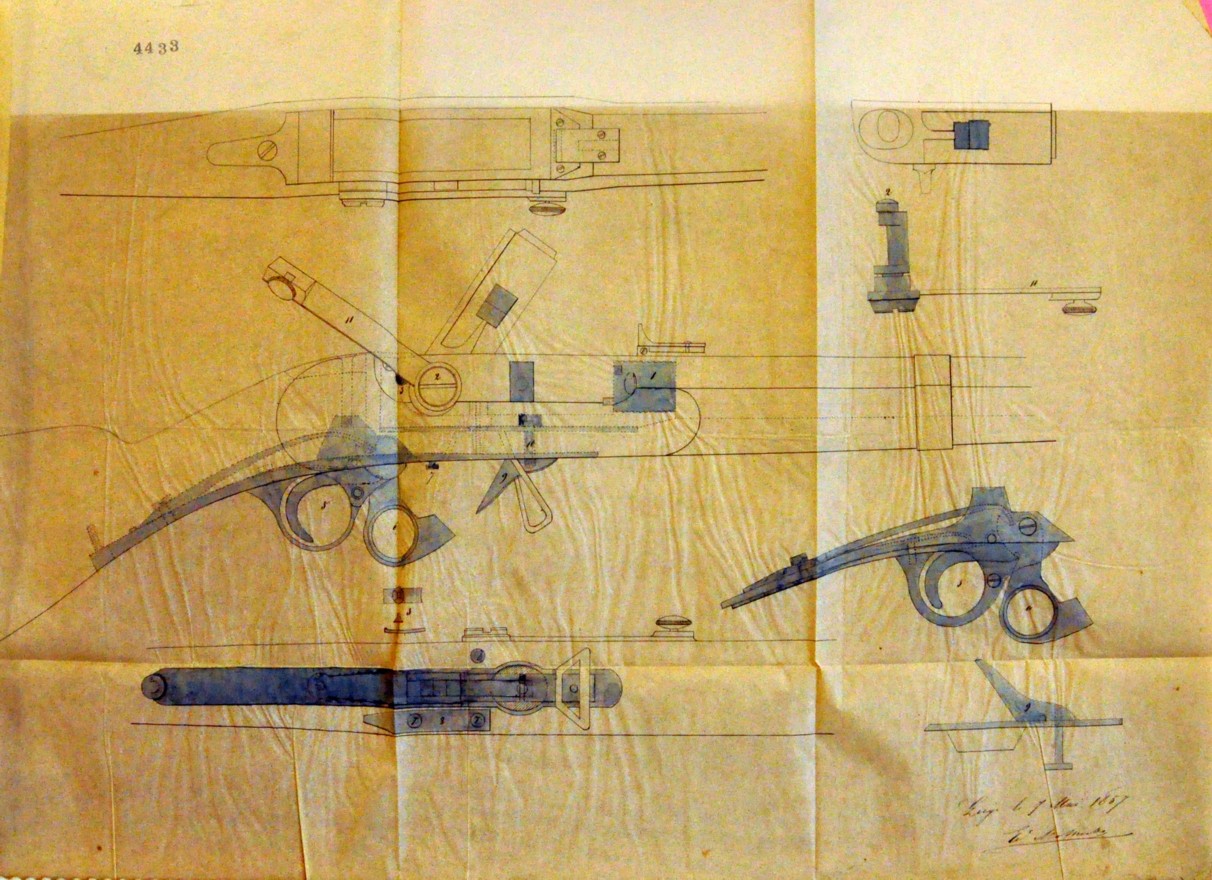
Finally, several members of the team made a match with a Decortis rifle,
which also bears similarities to the PJ Malherbe rifle.


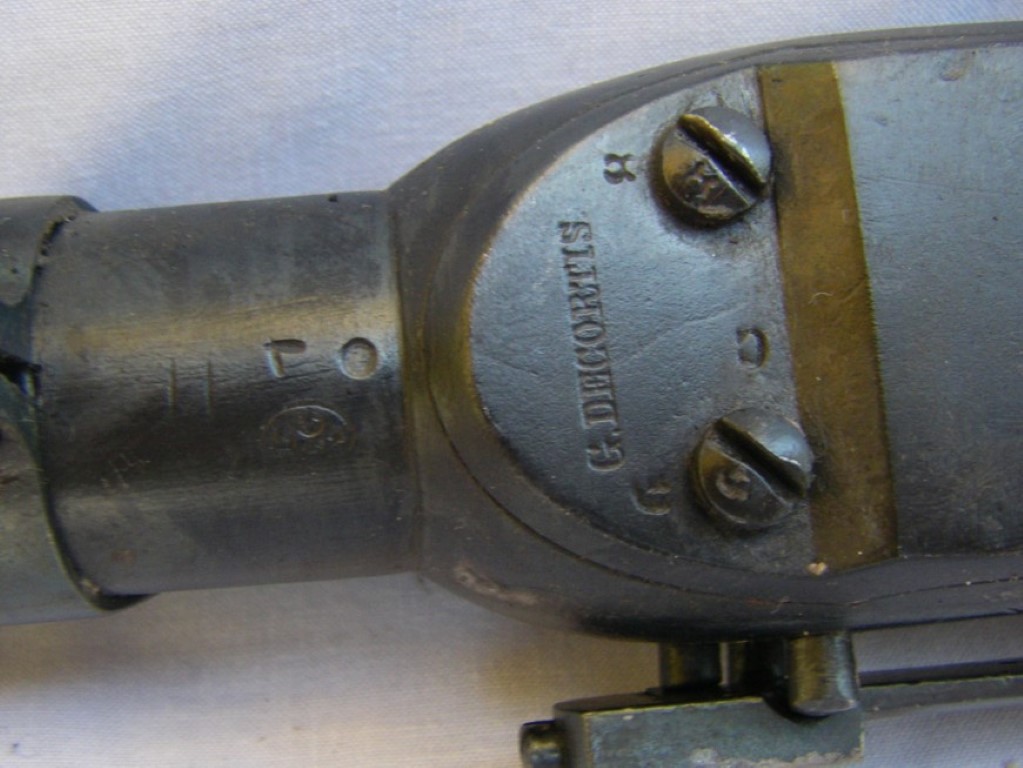
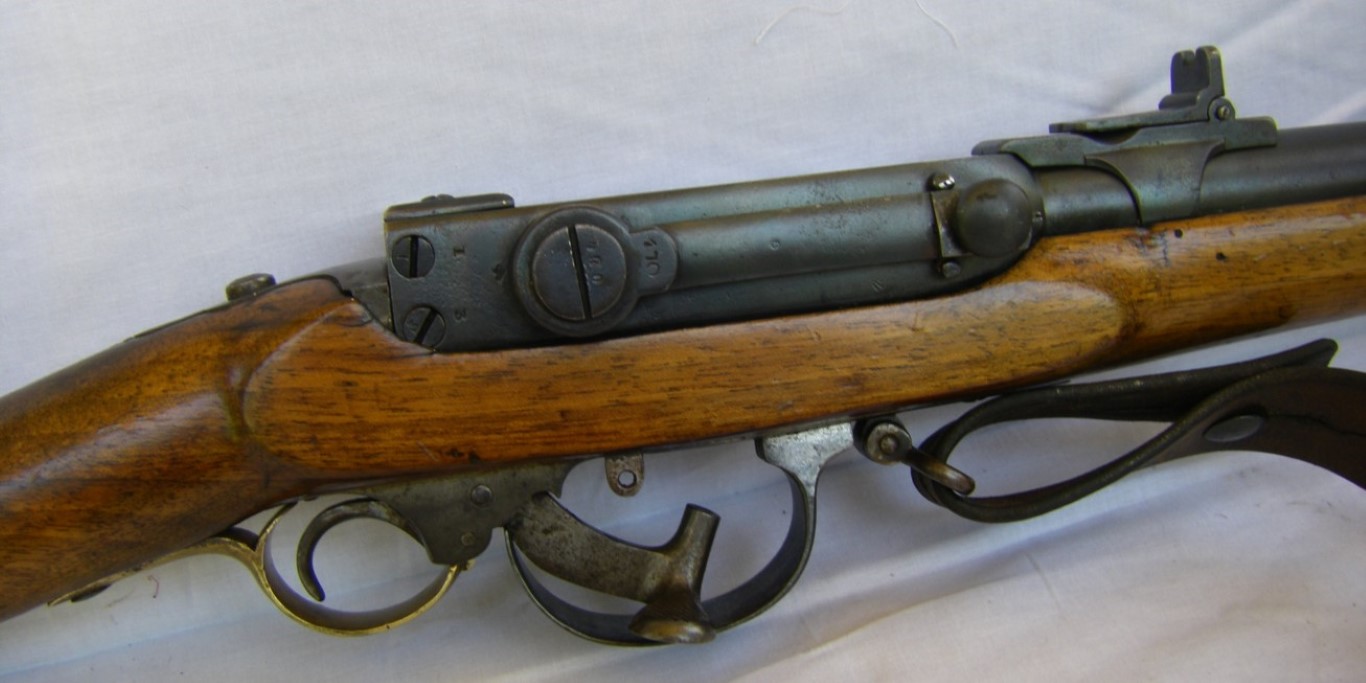
GP with the help
of Max, the whole team, Andreas Ohlsson and Per-Erik Stenborg from the
Karlskrona museum.
Identification 3606
Here is a "cheap" percussion pistol made in Liège, a copy of the pistols used to finish off wounded animals. The barrels are of course made of fake damas. The primer box in the butt of the stock is moulded and not engraved/chiselled. There is no manufacturer's brand, which is understandable because there is no real reason to be proud of it.
The markings
ELG on star in oval: in use since 1893 for the barrels loading by the mouth;
EL: provisional test, in use since 1852;
Belgium: without comment;
17.0:
the diameter of the barrel, in mm.
The barrels do not rotate since there are two hammers and two chimneys and only one barrel has a front sight.
One member of the team believes that it is a production of the "Fabriques d'Armes Réunies" (FAR) or the "Fabriques d'Armes Unies de Liège" (FAUL) dating from the first half - or even the first quarter - of the 20th century.
GP and PHL and the whole team.
Here is a production of these firms
Identification 3610
Here is an interesting percussion block shotgun made in Liège, of nice workmanship, but unfortunately not signed. If the system had been patented, there is every reason to believe that a patented xxx would be found. But that is not the case. Patent searches have not yielded any results.
Only one punch, ELG on star in oval, is shown for acceptance before 1893. The gun probably dates back to the 1830s. -1850 max.
I assume the key will keep the block in place after it has been loaded with powder and lead.
I also think I can distinguish the letters JAR (without warranty), but I have not been able to return them to a specific gunmaker.
I’m sorry I can’t say more.
GP
Identification 3616
Voici un fusil de chasse juxtaposé liégeois (léger puisque de calibre 28) de très belle facture mais hélas non attribuable.
Belle crosse anglaise, système à platines Holland-Holland.
Mais l’Arquebuserie Royale à Liège est « inconnue au bataillon », jusqu’à présent en tout cas.
Et il est fort regrettable que la photo 5 soit si floue, peut-être y a-t-il
l’un ou l’autre marquage intéressant.
Les marquages
z et t sous étoile : contremarques de contrôleurs, en usage
depuis 1877 ;
perron : inspection, en usage depuis 1853 ;
lion sur PV : épreuve à la poudre sans fumée, en usage
depuis 1898 ;
28-70 dans oméga couché : calibre nominal et longueur de la
douille, en usage depuis 1924 ;
ELG sur étoile dans ovale couronné : acceptation, en usage
depuis 1893 ;
Lettre annale grecque phi pour 1961
0 KG 838 : poids du canon, en usage depuis 1924.
GP avec l’aide de PHL.
Identification 3619
Voici un très beau juxtaposé de la maison Auguste Lebeau Courally qui a émigré vers l’Angleterre via la France (Brichet à Nantes : armurerie active à partir de 1855.
A fermé ses portes au célèbre Passage Pommeraye au début des années 2000).
Bouton de sûreté à gauche de la poignée.
Belles gravures florales.
Il date certainement d’avant 1914 puisqu’on peut lire sur le canon gauche « Cours impériales de Russie et d’Allemagne ».
Les marquages
Perron : inspection du Banc d’Epreuves de Liège, en usage depuis 1853 ;
J sous étoile : contremarque d’un contrôleur, en usage depuis 1877 ;
V et CP couronnés : deux poinçons du banc d’épreuves de Londres, en usage à partir de 1887 ;
12 C dans losange vertical : soit le poinçon liégeois, en usage de 1898 à 1924, soit le poinçon anglais en usage depuis 1887 ;
CAL 12 : le calibre bien sûr
Trade mark et un motif (non identifiable) : hélas non identifié.
Voir toute l’histoire de cette célèbre maison sur Lebeau-Courally
GP
Identification 3635
Here is a very interesting shotgun produced by the G. Teschner house in
Frankfurt on the Oder. Interesting for more than one reason since, in
addition to the opening system by the horn section of the bridge that slides
the guns before being able to tip them over, it also pulls the Collath n°3
cartridge with horizontal spindle percussion: it is in fact a calibre 14. As
can be seen from the attached link (in Spanish), the pin/nail is indeed in
the axis, and not vertical as for a Lefaucheux cartridge. It appears that W.
Collath invented the system in the late 1850s because, according to the
attached advertisement, the system was already known in 1858.
But there are no patents on the subject. The internal primer was struck by a
kind of nail driven by a hammer penetrating a few millimetres into the
socket. It is also known that rifles firing the original cartridges were
eventually adapted (= the impactors were slightly shortened) in order to be
able to fire “new” cartridges that have become classic.
http://old.municion.org/lefaucheux/Collath1horizontal.htm
Note also the safety that is activated when it is in the axis of the guns
(which hinders the aim), as shown in the link below:
forums.nitroexpress.com/printthread.php?Cat=0&Board=birdhunting&main=245837&type=thread
Here are pictures of a newer rifle but still with the same safety behind the
barrels.
Collath, W.- Frankfurt/Oder – German Hunting Guns
Another copy of a Teschner/Collath rifle (third row, 4th rifle)
Teschner & Co Frankfurt/Oder - Model: Bock Büsch Flinte S/S (1838-75) -
Halger.dk
Here is what we find on G. Teschner in a directory of the German industry of
1873:
G. Teschner & Co., Gewehrfabrik
Gründer (1865): Joh. Georg Teschner, der
1865 C. W. Th Teschner als Geschäftstheilhaber aufgenommen hat. Es
werdes 30 Arbeiter beschäftigt.(1873
Handbook of Industry, Vol. 1 – German Hunting Guns)
According to the Stockel, Georg Teschner was active between approx. 1838 and
1875; He died in 1880. W. Collath (born in 1838, died in 1906) joined
Teschner’s firm in 1859 (with 12 workers) and became co-worker. -owner of
the company in 1870. We can therefore say that the rifle dates from 1858 to
1870. since” he’s still at Teschner’s name, but he’s already pulling Collath
cartridges for which I haven’t found the date of filing the patent for his
horizontal spindle cartridges. But they are already mentioned in 1858.
Similarly, I do not know whether Georg Teschner has filed a patent for his
rifle opening system via the horn part of the bridge.
GP with the help of PHL and Dirk Ziesing.
Identification 3640
Here’s a short percussion rifle that looks remotely like an Enfield from the early 1850s. Copper trims.
No back sight (at least judging from the photos).
I have seen nothing on the
littlegun.be website or in the “Who is who of the Liège armoury” to support
this suggestion.
In addition, there are very few markings:
EL: provisional proof, in use since 1852
Identification 3644
Here is a 22 calibre rifle made in Liège very strongly inspired by the rifle
of Antoine Joseph Defourny which can be found at the end of the section of
the link below :
www.littlegun.be/arme%20belge/artisans%20identifies%20d/a%20defourny%20a%20j%20gb.htm
It even looks like we’ve hammered the inscription on the left side of the
breech...but I can’t be categorical.
The handle under the barrel is certainly not original.
The markings
R crowned: indicates that the barrel is stripped (in use since 1894)
22L: calibre 22 long
Lion on PV: smokeless powder test (in use since 1898);
M under star: countermark a controller, in use since 1877;
ELG on star in oval crowned: Acceptance by the Test Bank of Liège, in use since 1893;
Perron: inspection, in use since 1853.
GP with the help of Michel Druart
Identification 3645
Here is an
imposing double-acting rifle designed by Franz Kettner (1840/1913) of
Cologne, gunmaker descended from one of the brothers (also called Franz) of
Edward Kettner, founder of the house of arms and well-known hunting articles
(also in Cologne). See the very interesting German/English link
Kettner, Eduard & Franz –
German Hunting Guns
The marks are of course German:
U and B
crowned: test for a finished weapon;
G crowned:
proof for a stripped gun;
8. 14 is
probably the diameter of the barrel: I am thinking of the very popular 8.
15x46 gun R developed around 1890/1900 by Frohn (Suhl) for shooting at 200
m.
Kaliber 8.15x46R
(jagdwaffensammler.de)
16/1: Unidentified.
GP
Identification 3646
Voici une
carabine tout à fait dans le style des Winchester 1866 Yellowboy, mais pas
tout à fait non plus (et pas uniquement parce que celle-ci est
chromée/nickelée). Surtout, et malgré nos demandes, nous n’avons pas de
photos ni des éventuelles inscriptions sur le canon, ni d’un numéro de
fabrication (hormis un 8…) sous le levier d’armement. La première Yellow Boy
porte le numéro 12476, nous précise un membre de l’équipe.
Elle a
assurément été présentée au Banc d’Epreuves de Liège, mais de là à dire
qu’elle a peut-être été fabriquée à Liège, c’est une autre histoire.
On note en
tout cas la présence des poinçons suivants :
Perron :
inspecté au Banc d’Epreuves de Liège, en usage depuis 1853 ;
ELG sur
étoile : acceptation, en usage de 1846 à 1893 ;
K et R
sous couronne : contremarque d’un contrôleur, en usage de 1853 à 1877 ;
10.2 :
sans doute le calibre en mm ;
B dans un
carré : sans doute une autre contremarque d’un contrôleur.
On voit
aussi une espèce de S avec une boucle en plus.
On voit
aussi ce qui semble être un LB et un GB dans un rectangle arrondi. Hélas non
identifiés.
Le même
membre de l’équipe souligne que « en
ce qui concerne le nickelage: selon Dean Boorman, la Yellow Boy était
proposée avec les mêmes finitions que les Henry, soit donc gravure de
différents styles, placage argent, or ou nickel disponibles sur commande
spéciale et moyennant espèces sonnantes et trébuchantes; mais ce n'est PAS
standard. Le modèle standard est en laiton poli et est disponible tant avec
canon rond que canon octogonal. »
Il ajoute : « En regardant
mieux les photos, je constate avec un effarement grandissant la présence,
sur la face gauche du châssis, d'une espèce de plaque de recouvrement ou
couvercle, qui ne se trouve pas sur les Winchester originales. De plus,
l'anneau de selle me semble trop épais. En outre, le bois de la longuesse
enveloppe un peu trop le canon. A mon sens du
moins.
Enfin, je me pose des
questions au sujet du placage nickel, qui n'apparaît pas à l'intérieur du
châssis, ce qui pourrait indiquer un placage tardif par un autre armurier.
Le placage du pontet me semble tout aussi suspect.
En l'absence des marquages
originaux (que j'ai pour les quatre versions et les n° de série), je dirais
qu'il s'agit d'une copie de Dieu sait où, avec canon éprouvé à Liège. »
Il est en tout cas clair qu’il
ne s’agit PAS d’un exemplaire pour le Congo belge comme celui qui a été
décrit par Dirk Ziesing dans le n° de janvier 2011 du Deutsche Waffen
Journal.
En conclusion, l’équipe suppose qu’il s’agit - plus que vraisemblablement -
d’une copie, bien entendu non signée, qui a été présentée au Banc d’Epreuves
de Liège
GP avec l’aide de MC
Identification 3647
Here’s a classic
shotgun juxtaposed system Anson-Deeley Belgian made, most likely sold by the
gunmaker Laroche in Longwy. It was still active in 1931. Unfortunately, I
did not find a name, a hallmark or a mark of the Belgian manufacturer.
The markings
ELG on star in crowned
oval: accepted , in use since 1893;
Peron: inspection, in
use since 1853;
Lion on PV: smokeless
powder test, in use since 1898;
J and AC under a star:
countermarks of controllers, in use since 1877;
16 on c in diamond:
calibre, in use from 1898 to 30 June 1924;
P 1kg317: barrel
weight, in use since 30 June 1924; there is therefore a slight contradiction
between the punch of the calibre and the weight of the barrel: the reference
to the calibre is made before 30 June 1924, while the reference to the
weight of the barrel is made after 30 June 1924. In addition, I seem to see
a "a" in front of the P of the weight of the barrel: it could be an annal
letter, but “a” is the letter for 1922....Understand who can.
D=65 by 18. 9: length
of the chamber and diameter in mm after the optional smokeless powder test,
in use until June 30, 1924.
CHOKE 16. 6 out of 17.
0 and 16. 2 out of 17. 0: choked guns, in use from 1910 to 30 June 1924;
"Poudres pyroxylées"
on barrel: smokeless powders of course.
GP
Identification 3659
Here is a classic
hunting rifle juxtaposed to exterior hammers, rear plates, key between the
hammers, pistol butt with support, presented to the proofhouse of Liège in
1928. It is a product of FAUL, the Fabrique d’Armes Unies de Liège (United
Arms Factory of Liège), already mentioned extensively on the site : Nouvelle
page 0 (littlegun. be)
The markings
Peron: inspection by
the Liège proofhouse.
ELG on star in crowned
oval: accepted, in use since 1893;
Letters inverted m, v
and q under star: countermarks of controllers, in use since 1877;
1kg284: barrel weight,
in use since 1924;
Annual letter g: the
rifle passed to the proofhouse of Liège in 1928;
EL: provisional proof,
in use since 1852;
Lion on PV: smoke-free
powder test, in use since 1898;
16-70 in coated omega:
nominal caliber and casing length, in use since 1924;
Choke 16. 8: choked
barrel, calibre to 22 cm from the breech, in use since 1924.
GP
Identification 3663
Here is a classic
hunting rifle juxtaposed to exterior hammers, rear locks, key between the
hammers, "pistol" butt.
“Premier” on the left
lock, Laminated Steel on the tape: maybe trademarks, but unidentified.
The markings :
Peron: presented to
the proofhouse Liège;
AF (? ) under star: countermark of a controller, in use since 1877;
EL: provisional proof, in use since 1852;
18. 2: calibre in mm, in use since 1889;
12 on C in vertical diamond: calibre, in use between 1898 and 1924;
ELG on star in crowned oval: accepted, in use since 1893;
LLH: almost certainly
the manufacturer of barrels Laurent Lochet -Habran: see on the website
LLH
I also see the
initials AS and JJ with a crowned omega and DC, unfortunately unidentified.
GP with the help of HPH.
Identification 3666
Voici ce qui fut à l’origine plus que vraisemblablement un fusil de dragon modèle An IX produit par la Manufacture Impériale de Liège et transformé à percussion
par on ne sait qui ni dans quel pays.
C’est la première fois, en près d’un demi-siècle, que je vois ce type de transformation à percussion.
Mais cela
ne veut évidemment rien dire.
Les inscriptions qu’on peut, avec de très bons yeux, déchiffrer, correspondent à celles figurant sur un autre fusil de la Manufacture Impériale de Liège
qu’on peut voir sur le site.
La
longueur, et surtout le fait que la grenadière est à deux battants, font en
sorte qu’il s’agissait à l’origine d’un fusil de dragon.
GP et HPH
Iden 3666
fusil Dragon An IX transformé à percussion
(Modification)
Voici ce
qui fut à l’origine plus que vraisemblablement un fusil de dragon modèle An
IX produit par la Manufacture Impériale de Liège et transformé à percussion,
plus que vraisemblablement à la manufacture de Saint-Blaise (établie dans
l’ancien couvent Sankt-Blasien) dans le Wurtemberg (aujourd’hui
Baden-Württemberg), si l’on en croit le lien suivant (communiqué par
l’heureux propriétaire que nous remercions), par ailleurs extrêmement
intéressant :
https://collegehillarsenal.com/w
Comment ce
fusil, sorti de la Manufacture impériale de Liège est arrivé à Saint-Blaise,
restera sans doute un mystère. Peut-être une arme récupérée sur un champ de
bataille, stockée et « modernisée » à percussion ?
Les
inscriptions qu’on peut, avec de très bons yeux, déchiffrer, correspondent
en tout cas à celles figurant sur un autre fusil de la Manufacture Impériale
de Liège qu’on peut voir sur le site (voir parmi les artisans identifiés la
rubrique Manufacture Impériale de Liège). Avec le même G couronné sur 13, le
G étant sans doute celui du directeur Gosuin.
La
longueur, et surtout le fait que la grenadière est à deux battants (plus
résistante qu’une grenadière simple), font en sorte qu’il s’agissait à
l’origine d’un fusil de dragon.
GP, HPH et
l’heureux propriétaire.
Identification 3670
Here is one and even
two classic shotguns juxtaposed Anson & Deeley system from the Liège
armourer Joseph Monisse sold by the Parisian armourer Hubert Antoine. Floral
engravings, English butt.
As the very happy
owner of this beautiful rifle sent us a little later a second request for
identification of an identical rifle, from the same Liège manufacturer sold
by the same Parisian armourer bearing the same number 925, but with a 2 on
the stripe between the two guns and a 2 (different. . . ) on the opening
key, we assume (quite logically) that he would be able to identify the same
rifle. It’s a pair.....unless the lucky owner wanted to check if the I. D.
team was awake.....
The markings
Poldi Anticorro Steel Kladno JF:
registered by gunman Jean Falla; Kladno is a city of the former
-Czechoslovakia (Bohemia) known for its steel industry, unfortunately
abandoned;
m: annual letter for
1934 ;
EL: provisional proof,
in use since 1852;
Lion on PV: smokeless
powder proof, in use since 1898;
q under star:
countermark of a controller, in use since 1877;
ELG on star in crowned
oval: acceptance, in use since 1893;
12 -70 in coated
omega: nominal caliber and length of the casing, in use since 1924;
1KG397: barrel weight,
in use since 1924;
18. 5 CHOKE 18. 3:
choked barrel, in use since 1924;
Perron: inspection, in
use since 1853;
Joseph Charles
Monisse, Rue Renardi in Liège, was registered in the proofhouse of Liège
from 1922 to 1951. He continued his trade as a craftsman. He was using the
J. M. brand.
Hubert Antoine, 31
avenue de Suffren in Paris, was known for his luxury hunting weapons in
pairs. He also sold luxury foreign weapons, including Holland and Holland.
According to one source, it was active in the 1900s. -1950, according to
another between 1931 and 1978. So there’s a mistake somewhere, but anyway,
these guns are from 1934.
GP with the help of
HPH, PHL, and the team.
Identification 3676
Here is a classic
shotgun juxtaposed with locks, butt semi-pistol, support cheek.
The attribution of
this rifle to the one or the other Liège armourer is difficult, in the sense
that if we can see the initials JBR under a five-pointed star with a crown
in the centre of the star, which belong to "Jean-Baptiste Rongé", the
mention Excelsior (Hammerless) on the band between the barrels was deposited
by the "Manufacture Liégeoise
d’Armes à feu"
under number 622 on August 7, 1893.....
The same company also
filed the trademark Acier Excelsior under number 1052 on September 7, 1901.
It is logical to think
that the Excelsior Hammerless brand is also one of the brands of the "Manufacture Liégeoise d’Armes à feu".
Understand who can.
The markings
EL: provisional proof,
in use since 1852;
Perron: inspection, in
use since 1853;
16. 6 and 15. 8: it
should be the diameter in millimetres, but it doesn’t “sticky” so. . . , the
16 gauge being 17. 4 mm. . .
16 on C in diamond:
calibre, in use between 1898 and 1924;
ELG on star in crowned
oval: accepted, in use since 1893;
J under a star:
countermark of a controller, in use since 1877;
JW: Unidentified.
About the house JB
Rongé, see
http://littlegun.be/arme%20belge/artisans%20identifies%20q%20r/a%20ronge%20gb.htm
as well as the
"Exceptional collection".
The same goes for the
"Manufacture Liégeoise d’Armes à feu".
GP with the help of
HPH
Identification 3678
Here is a classic
bull-dog type revolver with long barrel (to be shortened after import I
presume).
Six rounds, caliber
.380 as indicated on the carcass to the left, as the manufacture number is
almost certainly 3360 on the stock. The gun was presented to the proofhouse
of Liège.
The markings
R crowned (? ) on the
carcass on the right: this may be the punch used from January 30, 1894 to
indicate that the gun is rifled, but then there is a contradiction with the
following punch:
ELG on star in oval:
acceptance mark, in use from 1846 to July 11, 1893, a little more than six
months BEFORE the entry into force of the previous punch......
H under star (? ):
countermark a controller, in use since 1877;
There are also
initials on the handle underneath the grips, JP and TM or IM, presumably
founders.
One member of the team
suggests that what I think is a crowned R might be DF and he suggests
Dumoulin Frères or Dumoulin François et Cie. It is indeed perhaps a better
track since my proposal does not “sticky” from the point of view of dates.
But it’s not 100% guaranteed either.
Finally, another
member says I’m right – so to speak – about the Crowned R, but it still
doesn’t “sticky” with the acceptance mark....
GP with the
help of HPH and PHL and the team.
Identification 3690
Here is a beautifully engraved superimposed rifle, with a beautiful English lacrosse, from the Liège house Pirotte & Fils. It’s from 1948. It’s a pity that the engraver didn’t sign his work.
The markings
Greek letter alpha: Annal letter of 1948;
1kg377: gun weight capable of firing smokeless powders, since 1924;
Y under star: controller countermark, in use since 1877
Lion on PV: smoke-free powder test, in use since 1898;
ELG on star in crowned oval: accepted, since 1893;
Perron: inspection by the Liège Test Bank;
12 -70 in coated omega: nominal caliber and length of the socket, in use since 1924;
Do it: the manufacturer of the guns, Jean -François Jr. , registered at the Test bench of Liège from 1945 to 1953;
Demi -CAP J hammered steel block: probably a J Cap manufacturing process taken over by Falla?
I also see two unidentified markings:
Banded bow and arrow in a hexagon (already met)
In a pentagon: it looks like a P and an F: Pirotte and Son?
The house Pirotte et Fils, 45 rue Saint-Laurent in Liège, dates back to 1910.
GP
Identification 3696
Voici un
classique fusil de chasse juxtaposé à chiens extérieurs de la Manufacture
Liégeoise d’Armes à Feu. Clé d’ouverture entre les chiens, crosse pistolet,
gravures sur les platines.
Les
marquages
y : lettre
annale pour 1946 ;
1kg360 :
poids du canon, en usage depuis 1924 ;
M sous
étoile : contremarque d’un
contrôleur, en usage depuis 1877 ;
Lion sur
PV : épreuve à la poudre sans fumée, en usage depuis 1898 ;
ELG sur
étoile dans ovale couronné : acceptation, en usage depuis 1893 ;
16-70 dans
oméga couché : calibre nominal et longueur de la douille, en usage depuis
1924 ;
ML
couronné dans ovale : marque de la Manufacture Liégeoise d’’Armes à Feu ;
CHOKE
16.9 : indique que le canon est choké ; en usage depuis 1924 ;
Je crois
aussi voir les lettres ACM dans un cercle : il se pourrait qu’il s’agisse de
la marque du fabricant des canons. Ce qui serait un peu étonnant dans la
mesure où la MLAF avait sa propre usine à canons à Nessonvaux. Mais elle a
peut-être aussi acheté des canons chez d’autres fabricants, l’un n’empêche
pas l’autre…
La
Manufacture Liégeoise d’Armes à Feu était établie à Liège rue du Vertbois
52-54 à Liège ; selon le « Qui est qui de l’armurerie liégeoise » elle a été
inscrite au Banc d’Epreuves de Liège de 1866 à 1929, mais il faudra un jour
« rectifier le tir » puisque le fusil qui nous occupe a été éprouvé en 1946…
Signalons
aussi qu’elle a déposé pas moins de vingt-six brevets entre 1866 et 1898,
mais aucun ne concerne ce fusil.
D’autres
armes de la MLAF sont présentées sur le site littlegun.be, tant parmi les
artisans identifiés que dans la collection exceptionnelle.
GP
Réponse à vos questions :
1-Me confirmer que mon fusil a bien été fabriqué par : LA MANUFACTURE
LIÉGEOISE D’ARMES À FEU à Liège en Belgique.
OUI.
2. En quelle année cette arme a-t-elle été fabriquée? Ou en quelle période?
1946.
3.- Cette arme est-elle encore visible régulièrement?
OUI.
4- Peut on la considéré comme une arme de collection? Non.
Identification 3697
Here is a beautiful FN
Auto rifle in .22 short engraved by the engraver Sophie (Jadwiga) Purgal.
What’s more, in a nice Emmebi suitcase according to the very happy owner.
The pictures speak for themselves, a description is useless.
The markings
L underlining: Annals
for 1990;
F under star:
countermark of a controller, in use since 1877;
ELG on star in crowned
oval: accepted by the Liège proofhouse since 1893.
The acronym in front
of the engraver’s signature is that of the cooperative “Les Graveurs de
Herstal”, founded in 1987 and active until 1992 (we also find the date of
March 20, 1993) of which Sophie (Jadwiga) Purgal was a member. This
cooperative had 15 members.
Sophie Purgal was
previously active at the
Fabrique Nationale d’Armes
de Guerre de Herstal
(National War Weapons Factory in Herstal).
Another realization by
Sophie Purgal in 1989 can be seen on littlegun.be in the Engravers section.
See : www
.littlegun.be/arme%20belge/graveurs/a%20purgal%20sophie.htm
She was also chosen to
engrave one of the ten rifles commemorating the centenary of the FN. It’s
all said.
The Internet allowed
us to see more than 140 emails about another production of Sophie Purgal;
one of the last emails reported contact between the lucky gun owner and
Sophie Purgal in November 2019.
Unfortunately,
however, the Internet also reports the death of Sophie (Jadwiga) Purgal on
January 14, 2021.
I think that the happy
owner would be well advised to contact the FN of Herstal and especially
Adrien Marnat who is involved in the management of the historical heritage
of the FN and certainly has the necessary documentation.
GP with the help of
PHL.
Identification 3699
Here is a very classic
folding rifle called Lecler(c)q like thousands were made in Liège in the
20th century. Caliber 9 mm Flobert, pistol butts. Normally, the gun folds
completely when the left side button is pressed. Which made it the perfect
weapon for illegal hunting (or the destruction of “harmful”) since hiding –
quite easily...
The markings
FL 9: calibre 9 mm
Flobert;
S under star:
countermark of a controller, in use since 1877;
Peron: inspection, in
use since 1853;
ELG on star in crowned
oval: accepted by the
proofhouse of
Liège, in use since 1893.
The letters
AD in a circle could be those of
Alexandre Dupont, rue de la
Province in Liège, who also filed the trademark "Bijou". It was active from
1923 to 1961. The company became the
Maison A. Dupont at the same address from 1962 to 1970.
GP
Identification 3716
Here is a Remington
rifle from the well-known Liège Firearms Manufacture
MLAF, already widely evoked on
the site and in the exceptional collection, probably for a house in St.
Petersburg IF I understood the marking on the barrel.
The markings
Perron: inspection, in
use since 1853;
AE under
star:countermark of a controller, after 1877;
ELG on star in crown
circle: accepted, in use since 1893;
FL 22: calibre .22
Flobert;
R crowned: striped
gun, in use since 1894.
You can also see on
the gun: made for J.J. ????? SHOW St-Petersburg. Unfortunately, the web
didn’t help us.
GP
Identification 3725
It is of course
Chaineux Bté, and not "Rte" as the happy owner believes to read it (I
readily admit that the B is not well marked...)
ELG: Acceptance,
between 1846 and 1893
X under crown:
countermark of a controller, between 1853 and 1877.
The 12 is – almost
certainly – a “brand” of a fondry, not a manufacturing number.
I see a PC on the
handle, and something else on the barrel on the left side that I can’t
decipher, but I don’t see anywhere the crowned V evoked by the happy owner.
There are in fact
three Chaineux: Joseph Lambert in Liège, Joseph in Wandre and P. in
Cheratte. It could therefore be the latter.
In any case, the model
seems to me to be the most classic and I doubt that any patent will be
attached to it. In any case, I don’t have a patent from P. Chaineux.
And the patents Chaineux I own have nothing to do – at first glance
at least (you would have to disassemble the revolver completely to try to
figure it out) – with the revolver in question.
In any case, let’s not
forget that the reference to “patented” may mean two things: 1) the gun in
question is indeed linked to a patent filed for, generally, 10 years; 2) the
gunmaker in question holds a gunmaker’s patent/diploma.
As for the story of
this revolver, I can’t add anything and I won’t let my imagination run
wild...
The fact remains, it’s
a beautiful part.
GP
Identification 3731
Here is an express
rifle in 9.3 x 74 R of nice workmanship that causes us problems as to its
manufacturer.
Belgian markings :
Cockerill steel: type
of steel used;
PV surrounding a type
of porch in crowned oval: acceptance of live powder, in use since 1968;
A
: annual letter for 1998;
F spangled :
controller’s countermark: it could be Joseph Scholtissen, active since 1974,
but I don’t know until when.
BE on L in a badge:
hallmark of the Liège proofhouse since 1998;
But as for FGS:
mystery.
We thought of Giuseppe
Sabatti, but according to a member of the team, he marked his rifles with
the marks: (lys de France) SGF (lys de France) or: FIAS, or GFS in a circle
and finally: SARS.
Another member of the
team did some research on the web:
“The +FGS+ marking
resists me but ...I stumbled upon the beginning of the track here:
https://forums.pigeonwatch.co.uk/forums/topic/266237-proof-mark-help/
https://www.doublegunshop.com/forums/ubbthreads.php?ubb=showflat&Number=244031
We’re going to an
Italian manufacture of a subcontractor for Belgium?
https://classic.gunauction.com/search/displayitem.cfm?itemnum=14928482
I can’t get into this
last site despite my attempt to register.
GP with the help of
Bruno Joost de Ter Beerst and his book on “Marks and hallmarks of firearms
in Belgium”, Alberto and PHL.
Identification 3734
Voici un
magnifique fusil Britte à canons superposés d’où le nom Superbritte. Belle
crosse en col de cygne. Numéro de fabrication 219.
Cette
maison liégeoise a déjà été amplement évoquée sur le site :
littlegun.be/arme%20belge/artisans%20identifies%20b/a%20britte%20fr.htm
Trop peu
de poinçons ont été photographiés, c’est fort dommage. Il s’agit d’un
calibre 16 à canons légèrement chokés. On voit le EL, pour l’épreuve
provisoire, un J sous étoile pour un contrôleur, un D couronné, mais ni le
ELG couronné, ni la mention du calibre, ni la lettre annale, etc. C’est fort
regrettable.
GP avec
l’aide de HPH
En l'absence de photos convenables il nous est impossible d'en dire plus.
La photo reçue de l'ensemble des marquages des canons est trop petite et trop peu claire pour une interprétation correcte. L'agrandissement "artificiel" ne fait que rendre les pixels encore plus flou.
Alain (Webmaster)
Identification 3737
Voici un
joli petit revolver en 7 mm CF que l’heureux propriétaire a, dans un premier
temps, pris pour un Chamelot-Delvigne « de transition », de fabrication
liégeoise. Mes recherches en ce sens n’ont rien donné. L’originalité de ce
revolver réside dans le ressort de la portière de chargement et dans le fait
que lorsque la portière est abaissée, le chien ne peut fonctionner.
Par la
suite, il a vu sur un forum un revolver identique, mais avec des poinçons
français et, sur le talon de la crosse, une montgolfière du même type que
celle que l’on voit sur les armes Giffard (à air comprimé).
Aucun de
ces deux revolvers n’a un marquage de fabricant/inventeur ni de mention
« breveté ». D’après les poinçons, il est postérieur à 1894.
Les
marquages
R couronné
sur le canon : canon rayé, en usage depuis 1894 ;
q sous
étoile sur le canon et sur le barillet : contremarque de contrôleur, en sage
après 1877 ;
ELG sur
étoile dans ovale couronné : acceptation, en usage depuis 1893 ;
C sous
couronne sur le barillet : non identifié.
On soit
aussi les initiales DL sous la plaquette de crosse droite : soit les
initiales du fondeur, soit celles du fabricant/inventeur ? Je n’ai repéré
que Denis Léonard qui puisse entrer en ligne de compte en tant que
fabricant, mais il était actif plus tôt, vers 1860/70; il y a aussi
Dieudonné Levaux-Stas mais ses initiales sont DDL.
GP
Identification 3740
Voici un
très classique fusil pliant à deux coups et chiens extérieurs système
Leclercq dit « de braconnier » (puisqu’il se plie complètement) qui pourrait
venir de la maison liégeoise Alexandre Dupont. Crosse anglaise.
Les
marquages
ELG sur
étoile dans ovale couronné : acceptation, en usage depuis 1893 ;
Lion sur
PV : épreuve à la poudre vive, en usage de 1898 à 1968 ;
Perron :
inspection, en usage depuis 1853 ;
V et Y
sous étoile : contremarques de contrôleurs, en usage depuis 1877 ;
EL :
épreuve provisoire, en usage depuis 1852 ;
32-65 dans
oméga couché : calibre nominal et longueur de la douille, en usage depuis
1924 ;
Lettre
grecque gamma : lettre annale pour 1950.
On voit aussi ce qui me paraît être les lettres AD dans un cercle : il pourrait s’agir d’Alexandre Dupont, rue de la Province 19 à Liège ; il a été inscrit au Banc d’Epreuves de 1923 à 1961. C’est d’ailleurs ce que suggère aussi un autre membre de l’équipe.
Voir aussi www.littlegun.be/arme%20belge/artisans%20identifies%20den/a%20dupont%20alexandre%20fr.htm
GP
avec l’aide de HPH
Identification 3741
Voici un
très classique fusil de chasse juxtaposé système Anson & Deeley de
fabrication liégeoise. Crosse anglaise.
Les
marquages
Perron :
inspection, en usage depuis 1853 ;
EL :
épreuve provisoire, en usage depuis 1852 ;
ELG sur
étoile dans ovale couronné : acceptation, de 1893 à 1968 ;
q, P et E
sous étoile : contremarques de
contrôleurs, en usage depuis 1877 ;
12 sur C
dans losange vertical : calibre, en usage entre 1898 et 1924 ;
P 1
K269.7 : poids du canon, en usage entre 1892 et 1924 ;
Lettre
annale qui devrait être la lettre C de 1924 ;
D=70m sur
20.6 : longueur de la chambre et diamètre en mm après l’épreuve facultative
à la poudre sans fumée, entre 1892 et 1924.
Il me
semble aussi voir un A dans un C (canonnier ?).
On voit aussi les lettres D.JD qui sont attribuées à Delcommune Auguste & Cie, société en nom collectif : A. Delcommune, J. Joiris & L. Dejardin, rue des Clarisses, 24 à Liège (inscrite au BE de 1920 à 1925).
Ce sont les successeurs de
Hanchar-Duthoit.
GP
avec l’aide de PHL
Identification 3742
Voici un
beau fusil de chasse système Anson & Deeley à platines et crosse pistolet à
joue passé par le Banc d’Epreuves de Liège. Les canons sont d’origine
britannique (Toledo Steel Works à Sheffield). On trouvera davantage
d’informations et de commentaires sur ces excellents canons sur le site
suivant :
https://doublegunshop.com/forums/ubbthreads.php?ubb=showflat&Number=137432&page=all
Le
fabricant de ce beau fusil n’a hélas pas marqué son œuvre, ou en tout cas je
n’ai rien repéré en ce sens.
Les
marquages
AV et AP
sous étoile : en principe des contremarques de contrôleurs ; ou de
fabricants ?
Lion sur
PV : épreuve à la poudre sans fumée en usage entre 1898 et 1968 ;
ELG sur
étoile dans ovale couronné : acceptation, en usage entre 1893 et 1968 ;
Perron :
inspection, en usage depuis 1853 ;
12 sur C
dans losange vertical : calibre, en usage entre 1898 et le 30 juin 1924 ;
P 1K328 :
poids du canon, en usage depuis le 30 juin 1924 ; on remarque le hiatus
entre ces deux derniers marquages. A moins qu’il s’agisse d’un poisson
d’avril… Blague bien sûr, puisqu’il devrait y avoir une lettre annale (pour
rappel, elles ont été introduites en 1922).
GP
Identification 3743
Voici un
fusil de chasse à chiens extérieurs de la Manufacture Liégeoise d’Armes à
feu. Crosse pistolet à joue.
La
Manufacture Liégeoise d’Armes à feu a déjà été évoquée sur le site :
littlegun.be/arme%20belge/artisans%20identifies%20ma/a%20man%20liegeoise%20fusil%20hammerless%20fr.htm
ainsi que dans la collection exceptionnelle.
Les
poinçons du Banc d’Epreuves de Liège
Perron :
inspection, en usage depuis 1853 ;
Lion sur
PV : épreuve à la poudre sans fumée, en usage entre 1898 et 1968 ;
B sous
étoile : contremarque de contrôleur, en usage depuis 1877 ;
12-70 dans
oméga couché : calibre nominal et longueur de la douille, en usage depuis
1924 ;
ELG sur
étoile dans ovale couronné : acceptation, en usage entre 1893 et 1968 ;
Lettre
annale W pour 1944, ce qui est tout de même tardif pour un tel type d’arme…
ML sous
couronne dans un cercle : marque de la Manufacture Liégeoise d’Armes à feu,
inscrite au BE de Liège de 1866 à 1929.
Je vois
bien que cela ne correspond pas avec la lettre annale de 1944, mais je n’ai
pas d’explication provisoirement.
GP
avec l’aide de HPH.
Identification 3746
Il s’agit d’une belle copie liégeoise du revolver
British Bull Dog N°2 introduit par l’Anglais Webley de Birmingham en
1873-1875. On peut trouver sur le site de nombreuses informations concernant
ces Bull Dogs, par exemple :
http://www.littlegun.info/arme%20britannique/webley/a%20a%20webley%20bull%20dogs%20fr.htm
http://littlegun.be/technique/a%20technique%20glossaire%20british%20bull%20dogs%20fr.htm
Ce revolver est en excellent état de conservation
et sa facture semble de bonne qualité. Le calibre est sans doute le 450
européen. Le marquage du fabricant BFB entre deux sabres entrecroisés
indique sans hésitation une production par Bayet Frères comme relevé par HPH
Des informations sur Bayet Frères sont disponibles sur le site :
Le deuxième B peut signifier Brothers (selon HPH),
Belgique ou Belgium (selon Chris), mais plus probablement Brevetés (selon
PHL).
Les marquages :
English Bull-Dog sur la carcasse, en lieu et place du plus commun marquage
British Bull Dog. Cette appellation a été auparavant relevée sur plusieurs
productions liégeoises de revolvers Bull Dogs (cf Gordon Bruce dans Gun
Digest 2011, pages 80-81).
Poinçon BFB attribué à Bayet Frères.
Contremarque N sous étoile côté gauche de la carcasse et à l’intérieur du
barillet.
Classique ovale ELG à l’intérieur du barillet.
Marquages DC et JC couronné sous la plaquette droite. Cette dernière marque
est déjà repérée sur le site, mais sans certitude quant à son origine :
http://littlegun.be/arme%20belge/artisans%20identifies%20c/a%20chefneux%20j%20j%20fr.htm
Chris avec l’aide de HPH et PHL
Identification 3753
Je sèche sur ton fusil il comporte plein de bizarrerie qui pourraient faire
penser à une bidouille, pourtant d’autre montrent que c’est un modèle
particulier, que je ne connais pas.
Le photo de la platine. J’ai la nette impression qu’il s’agit d’une remise à
silex, parce que l’on voit la trace de l’ancienne masselotte sur le canon.
Son poinçon indique qu’il s’agit d’une arme de fabricant civil vers 1830
L’intérieur du canon : c’est la preuve de la bidouille. Le canon est rayé,
et les armes à silex n’ont jamais été rayées. En France la rayure est
apparue vers 1853.
Sur le fusil entier, on constate que l’équilibre de la grenadière n’est pas
respecté : elle devrait se trouver entre la capucine et l’embouchoir, or ce
n’est pas le cas.
Le bout du fut n’est pas dans le même bois, il y a une enture sous la
grenadière
L’embouchoir ressemble à celui de la carabine mle 1859 mais la queue est
trop courte pour dire qu’il s’agisse de ce modèle.
Il y a un guidon, impensable pour une arme à silex
Une baguette tête de clou, elle va bien pour une arme rayée, mais pas pour
une arme à silex.
Coté contre platine, il y a une bride avec deux vis. Jamais vu cela, mais
cela semble bon.
La joue protubérante est contraire à l’usage français ou c’est une joue en
creux. On dirait plutôt la joue d’une arme autrichienne, pas le reste des
garniteures
Je crois qu’il n’y a pas de question, c’est bien une bidouille.
JJ
Identification 3758
Here are two
beautifully percussion rifles from the Liège company François Dumoulin.
Both are 12 mm/410
caliber. One has a barrel and a pistol butt, the other two barrels and an
"English" butt.
According to the proud
owner, based on the previous owner’s statements, the rifles were
manufactured shortly before a “sports exhibition” held in Berlin in 1933 and
won a prize there. They were bought by an Australian. Unfortunately, the
documents that accompanied them have been lost.
The markings
ELG on star in oval:
acceptance for muzzle-loading guns, in use since 1893;
EL: provisional proof,
in use since 1852;
G, V and C under
crown: Controller countersigns, in use since 1877;
12.0: calibre in mm;
Cockerill steel: type
of steel used;
DF and arrow to the
left: trademark of François Dumoulin;
LLH: barrel
manufacturer Laurent Lochet-Habran.
Note the absence of an
annual letter (they were introduced in 1922).
Many other weapons of
this house can be found on the website Littlegun :
littlegun.be/arme%20belge/artisans%20identifies%20den/a%20dumoulin%20francois%20et%20cie%20gb.htm
and
littlegun.be/collection%20privee/belgique/be%20abcde/a%20be%20dumoulin%20fr%20et%20cie%20gb.htm
GP
Identification 3766
Here is a beautiful
side lever opening gun called Leclercq, adjustable sight, signed Mariette.
Which of the Mariettes is not easy to determine since there were a dozen of
them. Especially since there is no mention of “patented”, which is “normal”
since Mariette did not invent the Leclercq system... The weapon is, in any
case, after 1893.
An overview of the
production of some members of the Mariette dynasty is given here.
http://littlegun.be/arme%20belge/artisans%20identifies%20ma/a%20mariette%20guillaume%20gb.htm
and in the exceptional
private collection.
The markings
ELG on star in crowned
oval: accepted, in use between 1893 and 1968;
LD crowned: Lambert
Dumoulin?
Y under star:
countermark of a controller, in use from 1877 to 1968;
Perron: inspection by
the bench of proofs of Liège, in use since 1853;
G.S: unidentified;
EL: provisional proof,
in use since 1852;
5.4: in principle it
should be the calibre: I expected 5.6 or 6 mm, but I can’t find 5.4 in my
modest documentation.
GP with the help of
HPH
Identification 3768
Voici un
beau juxtaposé express de fabrication liégeoise, bien conservé pour son âge
puisqu’il date de 1954.
Il me
semble que c’est un système Anson & Deeley mais modifié car il y a une vis
(qui doit agir sur le percuteur ?), bien visible sur l’avant-dernière photo,
que je ne me souviens pas avoir remarquée sur les nombreux autres fusils A &
D que j’ai déjà vus.
Les
marquages
Perron :
inspection par le Banc d’Epreuves de Liège, en usage depuis 1853 ;
Lion sur
PV : épreuve à la poudre sans fumée, en usage depuis 1898 ;
G sous
étoile : contremarque de contrôleur, en usage depuis 1877 ;
9,3 x 74 R
balle blindée : calibre ;
R sous
couronne : canon rayé, en usage depuis 1894 ;
EL :
épreuve provisoire, en usage depuis 1852 ;
ELG sur
étoile dans ovale couronné : acceptation, en usage entre 1893 et 1968 ;
Lettre
grecque lambda : lettre annale pour 1954 ;
1kg780 :
poids du canon, en usage depuis 1924 ;
VG (?)
sous couronne : hélas non identifié, mais j’espère qu’un membre de l’équipe…
On voit
aussi une tête d’aigle, la marque du canonnier Joseph Cap voir
www.littlegun.be/arme%20belge/artisans%20identifies%20c/a%20cap%20joseph%20fr.htm
GP
avec l’aide de PHL
Identification 3769
Here is a shotgun with
juxtaposed barrels and outside hammers of Liège manufacture.
The key is located in
front of the bridge. "English" butt. Butt forearm are carved. Rear locks.
The markings
Peron: inspection by
the proofhouse of Liège, in use since 1853;
ELG on star in oval:
accepted, in use from 1846 to 1893
EL: provisional proof,
in use since 1852;
17.0: diameter in mm:
this is probably a 16 gauge;
D under star:
countermark of a controller, in use since 1877;
L. Bernard on the gun:
there is a problem: the name “Bernard” is of course very well known in
Liège, there have been several, see the “Who is who of the Liège armoury”,
and the website littlegun.
I can find only two L.
Bernard, who were also contemporaries: a Lambert Bernard enrolled on the
proofhouse from 1836 to 1865, and a Lambert Joseph Bernard, enrolled only
three years at the proofhouse, from 1848 to 1851.
However, the rifle we
are dealing with dates, according to the punches, between 1877 and June 11,
1892, the day on which the mention of the weight of the barrels entered into
force in the proofhouse of Liège (not present on this rifle).
I hope that the rest
of the team will come across more data or a third L. Lambert contemporary of
this fine-looking rifle.
GP
Identification 3770
Voici ce
qu’on appelait autrefois une « arme de dame », un revolver « Le Mignon » du
Liégeois émigré à Paris Charles Galand. Mis sur le marché dans les années
1870, il a existé dans plusieurs calibres et sous au moins deux formes,
j’entends avec un busc très (comme celui-ci) ou peu prononcé. On en voit
régulièrement sur la toile, et même souvent avec un étui en cuir, mais la
littérature spécialisée n’est guère prolixe à son sujet (hormis un article
dans un numéro de l’Amateur d’Armes n° 71 de 1987).
Un autre
exemplaire figure déjà sur le site, mais pas sous l’appellation « Le
Mignon » :
littlegun.be/arme%20belge/artisans%20identifies%20g/a%20galand%20revolver%20fr.htm
Cet
exemplaire-ci est à six coups, calibre non précisé. Détente repliable.
Remarquez la hausse sur queue d’aronde… très utile sur un tel revolver…
Les
poinçons
U sous
couronne sur le barillet : contremarque d’un contrôleur, en usage de 1853 à
1877 ; on voit aussi U « tout court » sur le canon : mystère ;
ELG sur
étoile dans ovale : il est « mal » placé de sorte qu’on ne voit pas s’il a
une couronne ou non, mais en principe, il n’en a pas puisque le poinçon du
contrôleur date d’avant le 26 janvier 1877. On sait que le ELG couronné a
commencé à être utilisé le 11 juillet 1893, tandis que le ELG sans couronne
qui nous occupe a été utilisé à partir du 8 septembre 1846.
On voit
aussi le chiffre 5 sur le barillet et sur la poignée.
Et bien
sûr sur le côté gauche Galand Paris.
GP avec
l’aide de Max.
Identification 3771
Voici un
revolver hammerless espagnol en calibre 6 mm Vélodog, avec une très forte
probabilité de la société de Tomas de Urizar (Eibar ou Barcelone), connue
pour sa production de vélodogs et aussi pour ses petits pistolets en calibre
6,35.
Voir
notamment
www.littlegun.info/arme%20espagnole/ancien%20artisan/a%20de%20urizar%20tomas%20y%20cia%20fr.htm
Voir en bas de page
Bon état
de conservation, détente repliable, canon et barillet bronzés, cadre jaspé.
J’adore la sécurité de chien…
On voit
sur le côté gauche Trade Mark entourant les lettres TU.
Aussi un
P dans un cercle. Non identifié.
On peut
en voir des similaires à la page 160 du livre de Zuhk.
GP avec
l’aide de Chris et AD.
Identification 3776
Voici un
beau juxtaposé Anson & Deeley de fabrication liégeoise, gravé par Léonard
Smeets. Il fut nommé graveur incrusteur sur armes de Sa Majesté le Roi en
date du 20 octobre 1952 (donc sous le règne du Roi Baudouin). Voir le lien
suivant :
http://littlegun.be/arme%20belge/graveurs/a%20smeets%20leonard.htm
Le vendeur
de ce fusil est la société Adolphe Jansen, déjà abondamment évoquée sur le
site, active à Bruxelles pendant quasi un siècle, comme on peut le lire à la
rubrique suivante :
http://littlegun.be/arme%20belge/artisans%20identifies%20i%20j%20k/a%20janssen%20adolphe%20fr.htm
Adolphe
Jansen fut lui aussi lié à la famille royale belge au XIXe siècle, mais nous
ne savons pas jusqu’en quelle année.
L’arme est
en fait un produit de la société liégeoise bien connue de Jean Falla.
http://littlegun.be/arme%20belge/artisans%20identifies%20e%20f/a%20falla%20fr.htm
Les
marquages
Y : la
lettre annale Y pour l’année 1946 ;
I kg 235 :
poids du canon, en usage depuis 1924 ;
M sous
étoile : contremarque d’un contrôleur, en usage de 1877 à 1968 ;
Lion sur
PV : épreuve à la poudre sans fumée, en usage de 1898 à 1968 ;
ELG sur
étoile dans ovale couronné : acceptation par le Banc d’Epreuves de Liège
entre 1893 et 1968.
12-70 dans
oméga couché : calibre nominal et longueur de la douille, en usage depuis
1924.
GP avec
l’aide de HPH et PHL.
Identification 3778
Voici un
pistolet avec crosse métallique de fabrication liégeoise qui fut plus que
vraisemblablement une arme de braconnier. L’arme s’ouvre en appuyant sur le
bouton devant le pontet. Plus simple et frustre n’existe sans doute pas,
encore que Liège ait produit le meilleur et le pire, c’est bien connu.
L’arme est en tout cas postérieure à 1924.
La qualité
des photos ne me permet pas de tout identifier, et encore moins avec
certitude.
25 : sans
doute un numéro de fabrication puisqu’il se trouve à au moins trois
endroits ;
10,4 : le
diamètre du canon, en usage depuis 1889 ;
O ( ?)
sous étoile : contremarque d’un contrôleur, en usage entre 1877 et 1968 ;
EL :
épreuve provisoire, en usage depuis 1852 ;
HW ? : non
identifié
T sous
étoile: contremarque d’un contrôleur, en usage entre 1877 et 1968 ;
ELG sur
étoile dans ovale couronné : acceptation, en usage entre 1893 et 1968 ;
410
(?)-65 : calibre nominal et longueur de la douille, en usage depuis 1924 ;
Perron : inspection par le Banc d’Epreuves de Liège, en usage depuis 1853.
GP
Identification 3783
Voici un
beau revolver à percussion signé T(oussaint) Lhoist Breveté à Cheratte (une
commune de l’agglomération liégeoise). Lui et d’autres homonymes ont déjà
été évoqués sur le site.
Le terme
« breveté » porte soit sur le fait que l’armurier est détenteur d’un
« brevet d’armurier », soit qu’il a déposé un ou plusieurs brevets, ou que
l’arme en question a fait l’objet d’un brevet.
On sait
que Toussaint Lhoist a déposé trois brevets entre 1851 et 1853, mais aucun
ne concerne le mécanisme de ce revolver : la baguette sous le canon peut
glisser d’environ deux centimètres afin de faire entrer une balle dans le
barillet.
Peut-être
a-t-il déposé davantage de brevets, dont un concernant ce revolver ? En tout
cas, et jusqu’à présent, on n’en a pas la trace. Ou a-t-il utilisé le brevet
de quelqu’un d’autre, sans mentionner son nom ? Mystère.
On sait
qu’il a été actif jusqu’en 1873 et a été en relation avec Colt qui l’a
autorisé à utiliser ses brevets. Il a fabriqué des revolvers et des fusils
de chasse/carabines à barillet.
L’arme est
passée par le Banc d’Epreuves de Liège : ELG sur étoile dans ovale
(acceptation entre 1846 et 1893), et q inversé couronné (contremarque d’un
contrôleur, entre 1853 et 1877).
GP avec
l’aide de HPH, MD et MAX.
Identification 3784
L’heureux propriétaire de ce fusil signé sur la platine Joseph Manton, célèbre armurier britannique, se demande à quoi servait les deux entailles qui ne servent (plus) à rien. Et il s’interroge sur le « trou » très bien bouché (entouré de rouge) sur une des photos.
Dans un premier temps, j’ai pensé à la réutilisation d’anciennes platines à silex, les entailles servant à fixer le bassinet, et le « trou » ayant accueilli la vis de la batterie. Mais il devrait alors aussi avoir d’anciens « trous » pour le ressort de batterie, et l’on voit aussi rapidement qu’il n’y avait pas la place pour un tel ressort.
L’heureux propriétaire suggère aussi que les entailles permettaient d’y glisser/fixer le tube à fulminate du modèle antérieur de 1818 : c’est tout-à-fait plausible.
J’ai trouvé sur la toile un fusil assez similaire de Joseph Manton, mais la photo (à droite) ne permet pas de voir s’il y a aussi les fameuses entailles
https://losgi.com/joseph-manton
Je suis aussi intrigué par la crosse en deux parties dans le sens de la longueur : c’est la première fois que j’en rencontre une de ce type (mais ma mémoire f… le camp).
JW pourrait être le canonnier, mais sans garantie aucune.
Un détail me frappe également, à savoir que la deuxième photo montre bien que le pourtour de la platine était à 45°, mais cela s’arrête au-dessus du petit trou qui accueille la petite tige au bout du grand ressort (désolé pour la pauvreté de mon vocabulaire de technique armurière…)
Je suggère dès lors qu’il s’agit tout de même de platines « de réemploi » qui étaient plus grandes à l’origine et qu’on a transformées pour la percussion (éventuellement pour le système 1818).
D’autant qu’à l’époque, on ne jetait (presque) rien…
GP
Identification 3785
Voici un
bien étrange pistolet pouvant être équipé d’une crosse, sans aucun marquage,
dont le fonctionnement est difficile à expliquer, surtout à distance…
Un
collectionneur propose l’explication suivante :
« J'imagine comment ce truc fonctionne. La mini détente avant
(semble quadrillée) ne serait-elle pas une sécurité bloquant la détente ?
Quant à la
cartouche à broche, je suis perplexe car l'introduction me paraît difficile,
voire hasardeuse dans la mesure où la culasse semble creuse (?) et devrait
dès lors contenir la cartouche ou l'étui seul, sauf si cette culasse enfonce
la cartouche dans le chambre et enserre une extension arrière du canon
(invisible sur photos). De plus, y a-t-il un trou ou une rainure pour
faire passer une broche ?
Sous
toutes réserves, j'opterais plutôt une cartouche de type cup primed avec
percussion périphérique extérieure, et appui intérieur par la culasse.
Question :
y a-t-il un extracteur ou faut-il extraire l'étui tiré par le canon ? »
GP avec
l’aide de FL
Identification 3786
Voici un
beau fusil de chasse juxtaposé à platines d’Antoine Joseph Defourny, déjà
évoqué sur le site et dans le « Qui est qui de l’armurerie liégeoise ».
Il a été
actif de 1894 à 1959.
L’arme
date de 1937.
Les
marquages
AH sous
étoile : contremarque de contrôleur, en usage de 1877 à 1968 ;
Perron :
inspection par le Banc d’Epreuves de Liège ;
Lion sur
PV : épreuve à la poudre sans fumée, en usage de 1898 à 1968 ;
1kg 308 :
poids du canon, en usage depuis 1924 ;
Lettre
annale p pour 1937
ELG sur
étoile dans ovale couronné : acceptation, en usage de 1893 à 1968 ;
12-70 dans
oméga couché : calibre nominal et longueur de la douille , en usage depuis
1924.
GP
Identification 3791
It is a classic Liège
copy of the British Bull Dog N°2 revolver introduced by the Englishman
Webley of Birmingham in 1873-1875. On the website you can find a lot of
information about these BullDogs, for example: (unfortunately only in
French!)
http://www.littlegun.info/arme%20britannique/webley/a%20a%20webley%20bull%20dogs%20fr.htm
http://littlegun.be/technique/a%20technique%20glossaire%20british%20bull%20dogs%20fr.htm
This revolver is in
good condition and its workmanship seems to be of good quality. The owner
indicates that the gun tolerates SW 38 caliber cartridges, so we can deduce
that the caliber of the revolver is the European 380 (with black powder, of
course, as the owner assumes). We will therefore prefer the name “Puppy” to
that of Bull Dog. The metal shows a nice patina, the handle is equipped with
rather worn wooden pads and presents a well marked search. Most likely made
at the very end of the 19th century.
The revolver does not
give a precise indication of its manufacturer. A team member (HPH) suggested
a production by J. Mussen Lallemand, due to the analogy of the marking “The
British BullDog” with other weapons previously identified, see:
https://littlegun.be/arme%20belge/artisans%20identifies%20m/a%20mussen%20lallemand%20gb.htm
However, this origin
remains to be confirmed...
The markings:
The British BullDog on
the carcass.
Countermark R under
star right frame of the carcass and inside the barrel.
Classic oval ELG
inside the barrel.
HH and R markings
inverted under left plate.
Number 4 to the right
of the carcase.
A serial number 21 810
is mentioned by the owner but is not shown on the submitted photos.
Chris
Identification 3794
This is a very
interesting revolver, characterized by a hinged door opening system
occupying a third of the left handle.
It should be noted at
the outset that the inventor of this hinged door is still unknown.
The revolver in
question appears to be derived from a patent of Michael Kauffmann
(associated with) Scholberg & Gadet :
hence the initials
SGK. But Michael Kauffmann’s patent indicates that it is an improvement on a
patent filed by the well-known Jean Warnant, and if I have read and
understood correctly, it relates to the release system, not to the hinged
door opening system.
Looking through the
many patents of Jean Warnant, I found 039792 of 17 June 1876 concerning the
release system, but the latter is already accessible via a hinged door!
Here is another
revolver of the same style , which was tried by the Saxon War Department :
https://veryimportantlot.com/fr/lot/view/revolver-system-warnant-scholberg-gadet-liege-311059
There is also another
example: a DDL (DieuDonné Levaux) with the characteristic shape and opening
system of the Levaux, but also with this opening system with hinged door
with S.G.K. Patent marking.
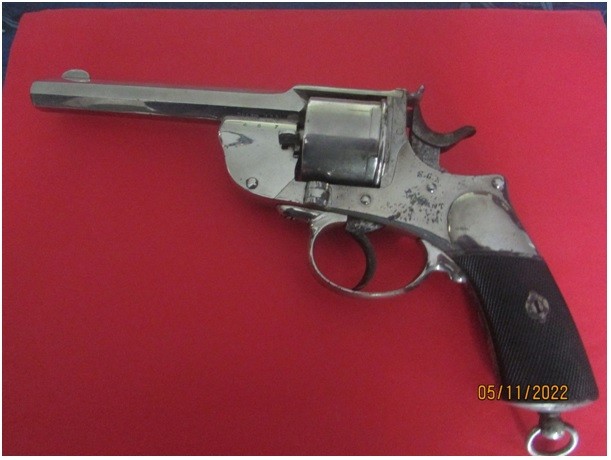
Let's add that
Michael Kaufmann lived in London, hence probably the "Patent"!
But as said in the
introduction, we don’t know (yet...) who invented the hinged door...
GP with the help of HPH.